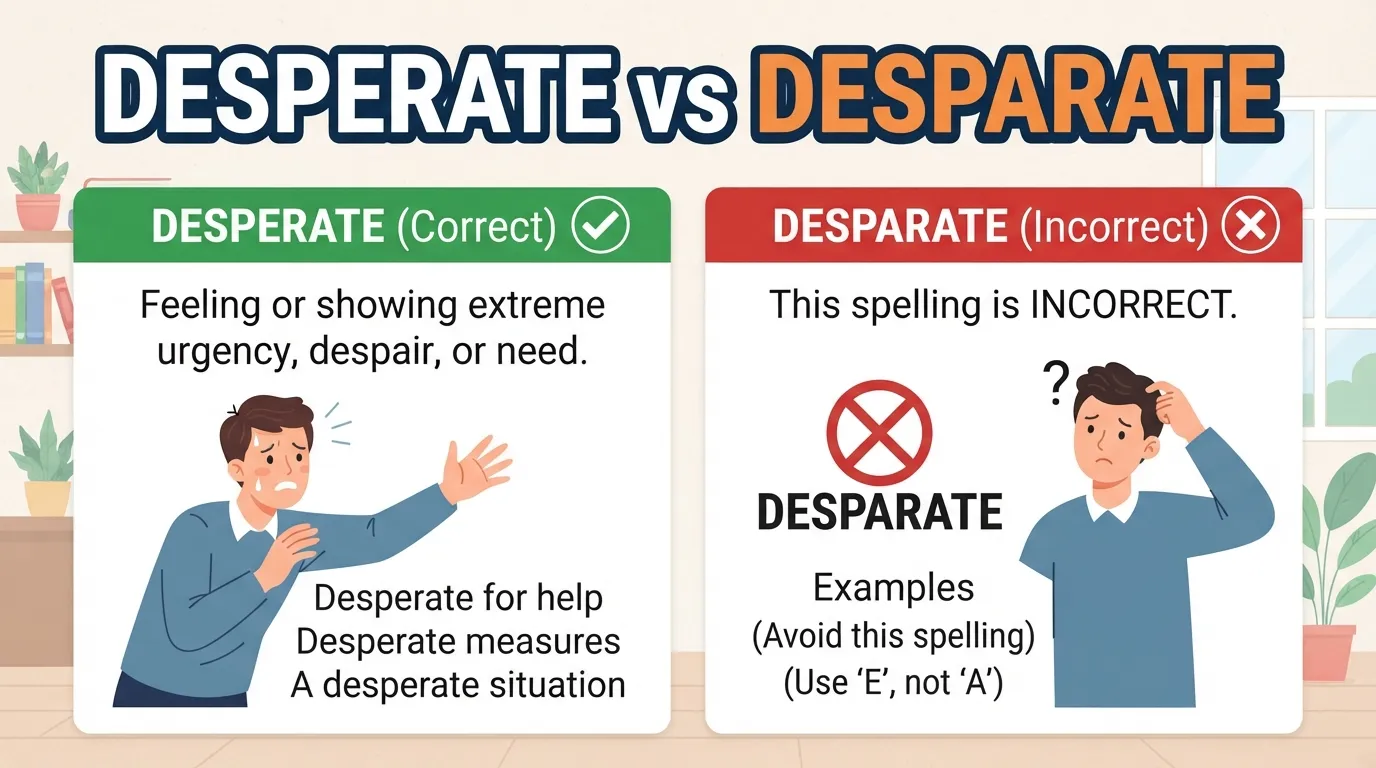
It is 2 a.m. in the emergency room, and the triage nurse is sorting the night’s arrivals by urgency. A man with a broken wrist waits patiently in a chair. A woman clutching her chest goes straight back. A child with a fever gets a thermometer and a calm voice. The nurse is doing what the word desperate does in a sentence: deciding what cannot wait. And then, on the intake form, a tired hand writes desparate — with an A where an E belongs. The error is small, the meaning is clear, and it is wrong. The correct spelling is desperate. Desparate is a misspelling. The reason it happens is a story about sound, a sneaky vowel, and a parent word that most people forget.
Desperate is one of those words that gets misspelled precisely because it is so common. People write it in a hurry — in texts, in emails, in exam answers — and the hurried hand produces desparate more often than any other wrong version. The fix is not to memorize a random string of letters. It is to see where the word comes from, because once you see the parent, the spelling explains itself.
Triage at 2 a.m.
Desperate describes a state of urgent need, or a situation so serious that extreme action feels justified. “She was desperate for work.” “The team made a desperate attempt to score.” “They were in desperate need of help.” In each case, the word carries the same charge: something has to happen, now, because the alternative is unbearable.
The word also stretches into a second sense: reckless, driven by hopelessness. “A desperate gamble.” “Desperate measures.” “He took a desperate swing at the ball.” Here the urgency has curdled into risk — the action is extreme because the situation is extreme. Both senses share the same root, and the root is the key to the spelling.

There is a third use, quieter and more everyday: desperate as a description of something severely lacking. “The town is desperate for rain.” “The room was desperate for color.” This is the same word, softened — not a crisis, just a strong want. All three senses, from the ER to the living room, spell the word the same way: d-e-s-p-e-r-a-t-e.
Notice the shape of the word. The first syllable is des-, not das- or dis-. The middle carries an E: -per-, not -par-. The ending is -ate, the same ending as separate, deliberate, and accurate. The whole word is built from three clean pieces, and the misspelling desparate breaks the middle piece by swapping the E for an A.
The Letter That Sneaks In
Why does the A sneak in? Two reasons, both understandable. The first is sound. In unstressed syllables, English vowels blur into a neutral murmur — the schwa sound, the “uh” that lives in the middle of so many words. The second syllable of desperate is unstressed, so the E in -per- comes out sounding like “uh”: “DES-pruht.” The ear hears “uh” and the hand, guessing, writes A — the letter that most often stands for that murmur in words like separate, desert, and parade. The guess is reasonable and wrong.
The second reason is analogy. English has a large family of words with -par- in the middle: separate, compare, prepare, repair, despair — wait. Despair. That one matters, because despair really does have an A, and it is closely related to desperate in meaning. A writer who knows despair can easily reason that desperate must share its spelling. It does not. The two words are cousins, not twins, and the spelling split is the proof.
There is also the pull of separate, one of the most commonly misspelled words in English, which really is spelled with an A in the middle. The brain files desperate next to separate — both long, both Latin, both ending in -ate — and borrows the A across the filing cabinet. The borrowing is natural. It is also the entire error.
Despair Is the Parent
Here is the fact that fixes the spelling for good. Desperate comes from the Latin desperare — de- (without) + sperare (to hope). To despair is, literally, to be without hope. Desperate is the adjective form of that idea: having lost hope, and therefore willing to do anything.
Look at the Latin: de-sper-are. The middle is -sper-, with an E. English kept that E when it borrowed the word. Desperate is des- + per + -ate: the hope-word, with its E intact. There is no A anywhere in the ancestry. The A in desparate is an invention of the hurried hand, with no history behind it.

The parent word gives you a memory hook that actually holds. Desperate is the child of despair — no, wait. That is the trap again. The hook needs care: think of the Latin sperare, “to hope.” Hope has an E. Desperate keeps hope’s E. Or, more simply: the word is about losing hope, and the spelling keeps the hope in it — des-per-ate, with the E of per standing for the hope that was lost. The A belongs to despair the noun. The E belongs to desperate the adjective. They are related, but they are not spelled the same, and knowing which is which is the whole game.
The family confirms it. Desperation — the noun — keeps the E: d-e-s-p-e-r-a-t-i-o-n. Desperately — the adverb — keeps the E. Despair, despairing, despairingly — the despair branch — keep the A. Two branches, one family tree, and the vowel tells you which branch you are on.
Desperate Measures, Desperate Times
The word earns its keep in every register, and the spelling matters in all of them. In journalism, desperate describes crises: “desperate families fleeing the flood,” “a desperate shortage of medicine.” In business, it describes markets and negotiations: “a desperate bid to save the company.” In sports, it describes the final minutes: “a desperate shot at the buzzer.” In everyday speech, it describes ordinary urgency: “I’m desperate for a coffee.”
The fixed phrases are worth knowing because they show the word’s range. Desperate measures — extreme actions taken when nothing else works. Desperate times call for desperate measures — the full proverb. Desperate straits — a dire situation. Desperate for — urgently needing something. Desperate to — urgently wanting to do something. In every phrase, the spelling is the same, and the E is non-negotiable.
There is also a tone warning worth hearing. Desperate has a strong charge, and overusing it drains it. A writer who calls every deadline “desperate” and every request “desperate” ends up sounding dramatic about nothing. The word is at its best when the urgency is real. Save it for the ER, not the inbox — and when you do use it, spell it with the E, because a word that describes urgency should not look uncertain about itself.
Desperate in the Headlines
Journalists reach for desperate more than almost any other profession, and the word’s behavior in headlines is worth studying. A headline that reads “Desperate families flee the flood” tells the reader two things at once: the situation is dire, and the people in it have run out of options. The word does the work of a whole sentence, which is why editors love it — and why careful editors use it sparingly. A headline that calls every shortage “desperate” and every delay “desperate” teaches readers to ignore the word, and then it is unavailable when a genuinely desperate situation arrives.
The word also appears in sports headlines, where the stakes are lower but the drama is real: “Desperate shot wins the game.” “Desperate defense holds the lead.” Here the word describes a team that has abandoned caution — a team that knows it will lose unless it risks everything. The sports sense is the purest form of the word’s second meaning: recklessness driven by hopelessness, compressed into a single play.
And in business headlines, the word carries a warning: “Desperate bid to save the company.” “Desperate measures at the retailer.” Readers learn to read these headlines as signals — the company is in trouble, and the measures being taken are extreme because ordinary measures have failed. The word, in all three newsrooms, does the same job it does in the emergency room: it triages. It says: this one cannot wait.
The Lock-In
So how do you hold the spelling? Three anchors, any one of which is enough. First, the parent: desperare, to be without hope — the E of hope stays in the word. Second, the family: desperation, desperately — all E, no A. Third, the contrast: despair has the A; desperate does not. If you remember that the two cousins split on the vowel, you will never borrow the A across again.

And one final check for the keyboard: when the word appears in your draft, look at the middle. If you see -par-, you have written desparate, and the A is an intruder. Swap it for E. Des-per-ate. The triage nurse would approve — the word is urgent, the spelling is certain, and the patient, in this case the sentence, is going to be fine.











