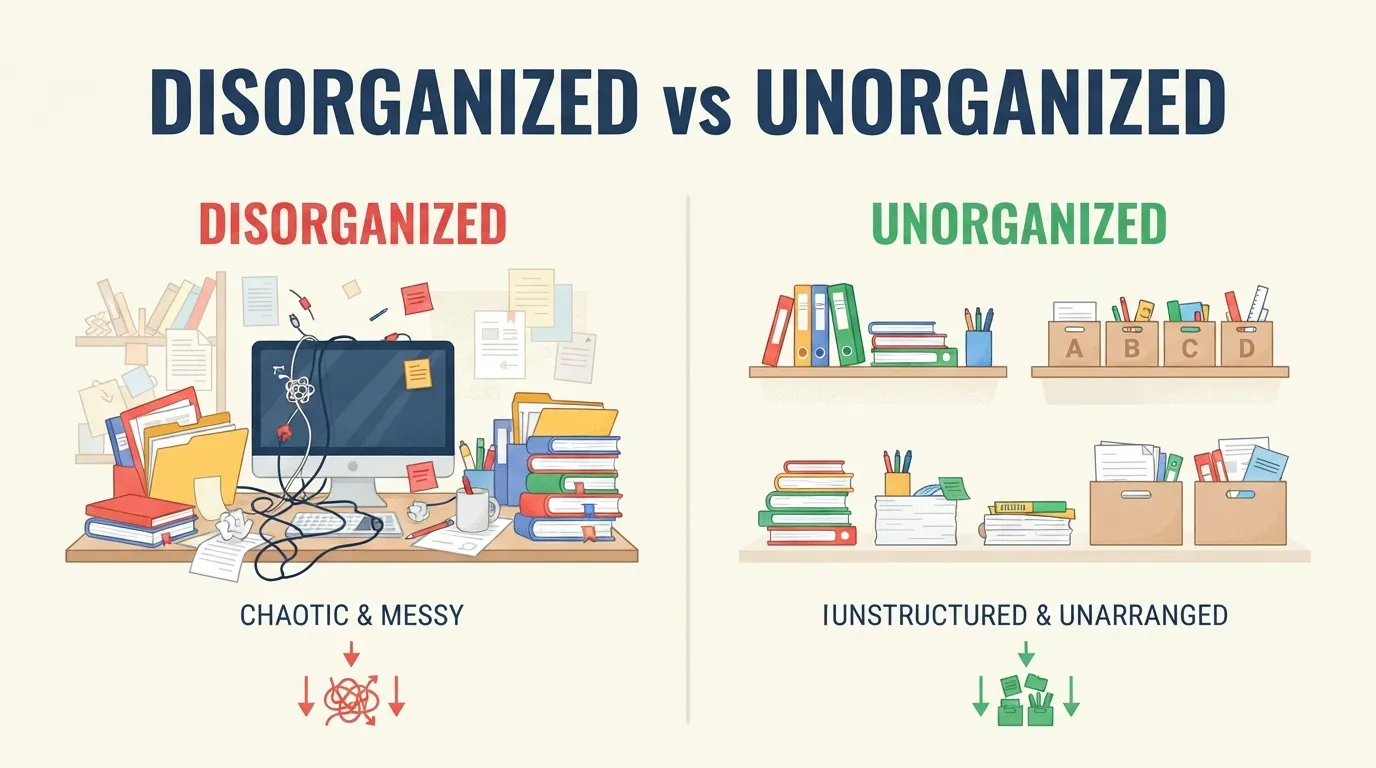
Look at two desks. Desk A is buried: papers stacked sideways, coffee cups on top of notebooks, cables tangled like vines, a charger plugged into nothing. Desk B is bare: a clean surface, one chair, nothing on it — not because it was tidied, but because nobody has ever worked there. Both desks lack order. But they lack it in different ways, and English has two different words for the two kinds of lack. Desk A is disorganized. Desk B is unorganized. The difference is not tidiness. It is history: one desk fell apart, and the other never came together.
Disorganized and unorganized are closely related, but they are not interchangeable. Disorganized describes something that is messy, poorly arranged, or lacking a working system — order that failed or fell apart. Unorganized describes something that simply has not been arranged or structured — order that never arrived. In everyday American English, disorganized is far more common, and it is the natural choice for mess and poor planning. Unorganized is the choice for the absence of organization — and it carries one special meaning that disorganized never has.
Desk A: Disorganized
Disorganized is an adjective meaning not arranged in an orderly, systematic, or effective way. It describes physical objects, information, activities, plans, businesses, and people. “Her notes are disorganized.” “The meeting became disorganized.” “His schedule is completely disorganized.” “The company has a disorganized management system.” “I felt disorganized after missing several deadlines.” In each sentence, the word points to a system that is not working — a plan that drifted, a room that accumulated, a process that lost its shape.
The key implication is failure or breakdown. A disorganized desk was presumably meant to be organized, and the organization did not hold. A disorganized person struggles with planning, scheduling, or keeping things in order — not because they never tried, but because the trying does not stick. A disorganized presentation is difficult to follow because its structure collapsed somewhere between the outline and the delivery. The word carries a judgment: something should have been orderly, and it is not.
That judgment is why disorganized is the word people reach for when describing themselves critically. “I’m so disorganized” is a confession — an admission that the system failed. It is also why the word appears in discussions of work and productivity: disorganized teams miss deadlines, disorganized files slow down audits, disorganized meetings waste time. The word names a cost, not just a state.

Desk B: Unorganized
Unorganized is an adjective meaning not organized, arranged, classified, or structured. It focuses on the absence of organization rather than its failure. “The documents are unorganized.” “The research data is still unorganized.” “We have a large collection of unorganized photographs.” “The material remains unorganized.” In each sentence, the word says something has not yet been arranged into a system. Nobody arranged it and failed. Nobody arranged it at all.
The distinction is subtle, and the two words overlap heavily — which is why they are confused. Compare the pair directly: “The files are disorganized” suggests the files are scattered, mixed up, difficult to use — a system that broke down. “The files are unorganized” can simply mean nobody has arranged them into categories yet — a system that has not been built. The first describes a mess. The second describes a blank. In practice, native speakers often use the words interchangeably for the middle cases, and no one will misunderstand. But when the distinction matters — when you need to say whether the problem is breakdown or absence — the two words give you the precision to say it.
Unorganized is also the natural word for groups that have not formed or operated as an organized body: “The volunteers were unorganized when they first arrived.” “The group is currently unorganized.” Here the word does not imply mess at all. It implies a starting point — people who have not yet found their structure, and may find it soon.

Dis- vs Un-: Undoing vs Absence
The difference between the two words is written into their prefixes. Dis- and un- are both negative prefixes, but they negate in different ways.
Dis- means reversal, removal, or undoing: disagree (reverse agreement), disconnect (undo a connection), disarm (remove arms), disappear (go out of sight). When dis- attaches to organized, it means organization undone — order that was present, or should have been, and has been removed or reversed. Disorganized is organization in reverse.
Un- means absence or negation: unhappy (not happy), unfinished (not finished), unknown (not known), unpaid (not paid). When un- attaches to organized, it means organization absent — order that is simply not there. Unorganized is organization missing.
The prefix test works across the language. Dis- words describe something that was or should have been: disloyal (loyalty broken), dishonest (honesty violated), disorganized (order undone). Un- words describe something that is not: unhappy, unfinished, unorganized. The prefixes are small, but they carry the whole distinction. Undoing versus absence. Breakdown versus blank.
At Work
The workplace is where the distinction earns its keep. A disorganized meeting is one where the agenda existed and collapsed — people talked over each other, the topic drifted, the decisions never landed. An unorganized meeting is one where no agenda was ever set — people arrived without a plan, and the hour evaporated. Both meetings wasted time. The first failed at its structure. The second never had one.
The same logic applies to data. Disorganized data is data that was filed badly — mislabeled folders, duplicated records, a database that grew without discipline. Unorganized data is raw material that has not yet been structured — survey responses in a spreadsheet, photographs in a folder, notes in a drawer. The first needs cleanup. The second needs a system. The remedies are different, and naming the problem correctly is the first step toward the right remedy.
Self-description follows the same pattern. “I’m disorganized” is the common confession, and it implies a struggle with systems that exist but do not hold. “My files are unorganized” is a neutral report: the files have not been arranged yet. The first invites advice about habits. The second invites an afternoon with folders. Knowing which one you mean saves both of you time.

Disorganized vs Messy
There is a third word in this neighborhood worth meeting: messy. A messy desk is untidy — papers out of place, crumbs on the keyboard, a coffee ring on the wood. A disorganized desk is something more: a desk whose system has failed. The difference is that mess is physical and visible, while disorganization is structural. A desk can be messy but organized — the owner knows exactly where everything is, even though it looks chaotic to a visitor. And a desk can be tidy but disorganized — clean surfaces hiding a filing system that no one can follow.
The same distinction applies to people and plans. A messy person leaves things out of place. A disorganized person loses track of priorities, deadlines, and dependencies. Mess is about appearance. Disorganization is about function. That is why “disorganized” carries a stronger judgment than “messy”: mess is a state of the surface, and disorganization is a failure of the system underneath it. When you call a meeting disorganized, you are not saying the room was untidy. You are saying the structure did not hold.
The Labor Meaning of Unorganized
Unorganized carries one meaning that disorganized never has, and it is important enough to deserve its own section. In labor and economics, unorganized describes workers who are not members of a labor union, or an industry in which unions have not formed. “Unorganized labor.” “Unorganized workers.” “The unorganized sector of the economy.” In these phrases, the word has nothing to do with mess. It means not organized into a union or association — a precise, technical sense.
Disorganized never carries this meaning. A “disorganized workforce” is a workforce that is messy or poorly managed. An “unorganized workforce” is a workforce without union representation. The two phrases describe different realities, and swapping them changes the sentence from a management observation to a labor-relations fact. This is the sharpest proof that the two words are not interchangeable: in this one context, they belong to different conversations entirely.
The labor sense also shows why unorganized survives despite disorganized being more common. A word that carries a unique technical meaning does not need to win the popularity contest. It needs to do its one job, and unorganized does it: it names the absence of organization — of a union, of a system, of a structure — without implying that anything broke down.
Did It Fall Apart, or Never Come Together?
When the word appears in your draft, ask the one question that settles it: did it fall apart, or did it never come together? If a system existed and failed — a desk that accumulated, a plan that drifted, a meeting that collapsed — write disorganized: order undone. If no system ever existed — files never arranged, a group never structured, workers never unionized — write unorganized: order absent. In the middle cases, where either could apply, disorganized is the safer default in American English, because it is the more common word and the one readers expect. But when the distinction is the point — breakdown versus blank — the two words give you the precision to say exactly which one you mean. Desk A fell apart. Desk B never came together. The words know the difference, and now so do you.