Vendor vs Vender: Which Spelling Is Correct? Meaning, Differences, and Usage

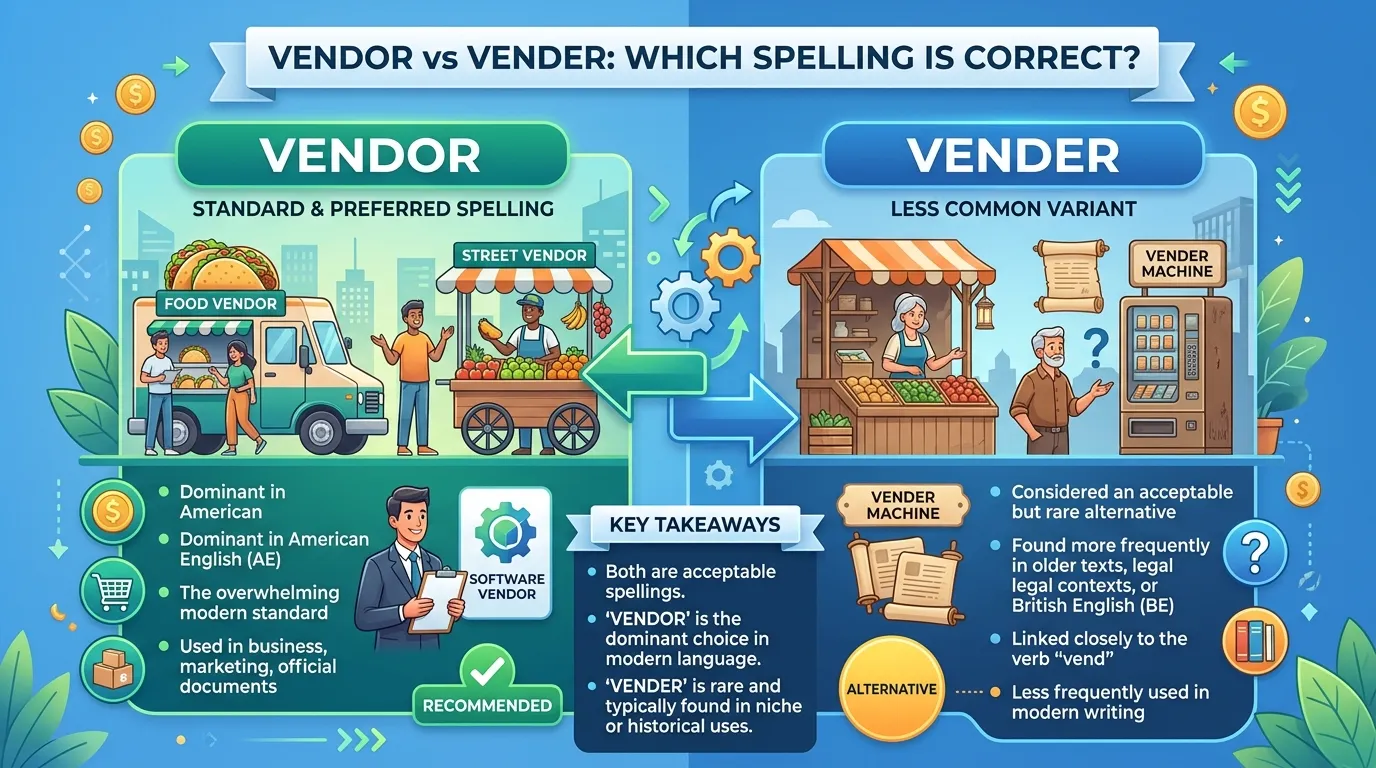
If you have ever wondered whether vendor or vender is the correct spelling, you are not alone. The two words look almost identical, sound the same in most varieties of English, and both can refer to someone who sells goods or services. However, vendor is overwhelmingly the preferred spelling in modern American English, while vender is a much less common variant.

The distinction matters most in business writing, academic work, journalism, websites, contracts, product descriptions, and other professional settings. Choosing the more familiar form can make your writing clearer and more natural.

In this guide, we will explain vendor vs vender in detail, including their meanings, grammatical roles, pronunciation, history, regional usage, formal and informal contexts, common mistakes, examples, synonyms, collocations, and practical writing advice.


Quick Answer: Vendor vs Vender

Vendor is the standard and most widely used spelling in modern American English for a person or company that sells goods or services.

Vender is also found as a noun meaning a seller, but it is uncommon and generally considered a variant spelling. Most modern writers should choose vendor, especially in business, academic, technical, and professional writing.

At a glance

WordMeaningModern UsageBest Choice
vendorA person or company that sells goods or servicesVery commonYes
venderA person who sells somethingUncommon variantUsually no
vendTo sell, especially publicly or commerciallyStandard verbYes
sellerA person or business that sells somethingVery commonYes

Simple rule: When you mean “a seller,” use vendor unless you have a specific reason to preserve the less common spelling vender.


What Does Vendor Mean?

A vendor is a person, business, organization, or company that sells goods or services.

The word is especially common when discussing business transactions, suppliers, marketplaces, technology, events, and commercial relationships.

Dictionary-style definition of vendor

Vendor (noun): A person or organization that sells goods, products, services, or merchandise.

Examples

  • The software vendor released a new security update.
  • We need to contact the food vendor before the event.
  • The company selected a new equipment vendor.
  • Several local vendors were selling handmade products.
  • Our online store works with international vendors.

Notice that vendor does not necessarily mean someone standing behind a physical market stall. A large corporation can also be a vendor.

For example:

The hospital signed a contract with a medical equipment vendor.

Here, the vendor is a company rather than an individual seller.


What Does Vender Mean?

Vender means a person who sells something. It can function as a noun and is essentially a less common spelling variant of vendor.

For example:

The street vender sold fresh fruit.

The sentence is understandable, but most modern American readers would expect:

The street vendor sold fresh fruit.

The spelling vender is not usually the best choice for contemporary professional writing. Although dictionaries may recognize it as a variant, it is much less frequent than vendor.

Dictionary-style definition of vender

Vender (noun): A person who sells goods or merchandise; a variant spelling of vendor.

The key point is that vender is not a completely different concept from vendor. Their meanings overlap closely.


Vendor vs Vender: The Main Difference

The biggest difference is usage frequency and standardness, not meaning.

Both words can describe someone who sells something. The major practical distinction is:

  • Vendor = standard, common, widely accepted
  • Vender = uncommon variant
  • Vendor = preferred in modern business and professional English
  • Vender = understandable but often looks unusual to contemporary readers

Compare these examples

Natural:

We contacted the software vendor about the problem.

Possible but uncommon:

We contacted the software vender about the problem.

The second sentence is not likely to confuse a reader, but the first sounds much more natural.

If you are writing a business proposal, article, report, résumé, academic paper, or website, vendor is almost always the better choice.


Why Do People Confuse Vendor and Vender?

There are several reasons these words cause confusion.

1. They sound the same

In ordinary American English, vendor and vender are generally pronounced the same.

Both are commonly pronounced approximately:

VEN-dər

Their similar pronunciation makes it impossible to determine the spelling from speech alone.

2. Both relate to selling

Both words describe a person involved in selling.

That means there is no major difference in meaning to help writers distinguish them.

3. English has many similar word patterns

English contains many nouns ending in -er that describe people who perform an action:

  • teach → teacher
  • drive → driver
  • write → writer
  • sell → seller

Because vend means “to sell,” some writers naturally expect vender.

However, vendor has its own historical development and has become the dominant modern form.

4. “Vend” looks like it should produce “vender”

The verb vend means to sell. Therefore, vender can seem like a perfectly logical construction.

Even so, modern English overwhelmingly favors vendor when referring to a seller.


Is Vendor or Vender Correct?

Both spellings can be found in English, but vendor is the preferred modern form.

This distinction is important.

It would be misleading to say that vender can never be correct. The word exists and has been used historically and in modern dictionaries as a variant.

However, if you are asking which spelling you should normally use, the answer is simple:

Use vendor.

This recommendation applies particularly to:

  • American English
  • Business writing
  • Academic writing
  • Journalism
  • Technical documentation
  • Marketing
  • Blogging
  • Professional emails
  • Contracts and proposals
  • E-commerce
  • Corporate communication

Vendor Meaning in Business English

Vendor is extremely common in business environments.

A vendor may provide:

  • Products
  • Equipment
  • Software
  • Consulting services
  • Food
  • Office supplies
  • Manufacturing materials
  • Cloud services
  • Advertising services
  • Maintenance services

Common business examples

We are evaluating three potential vendors.

The purchasing department negotiated with the vendor.

The vendor agreed to replace the damaged equipment.

Please send the invoice to our approved vendor.

We are looking for a reliable technology vendor.

In business English, vendor can describe both an individual seller and a large company.


Vendor vs Supplier: Are They the Same?

Vendor and supplier are closely related, but they are not always interchangeable.

A supplier generally provides products, materials, or services to another business.

A vendor can be any seller, including someone selling directly to consumers.

Example

A manufacturer might purchase steel from a supplier.

A store might purchase finished products from a vendor.

However, business terminology varies by industry, and companies often use the two terms differently.

Simple distinction

TermGeneral Meaning
VendorSeller of goods or services
SupplierProvider of goods, materials, or services
SellerPerson or business that sells
MerchantPerson or business involved in trade
RetailerBusiness selling directly to consumers
WholesalerBusiness selling goods in bulk, often to retailers

Vendor in Technology and Software

The word vendor is especially common in technology.

A software vendor is a company that develops or sells software.

Examples include:

  • software vendor
  • technology vendor
  • cloud vendor
  • security vendor
  • hardware vendor
  • platform vendor
  • database vendor
  • service vendor

Example sentences

The IT department contacted the software vendor.

The company changed cloud vendors after reviewing its costs.

The vendor released a patch for the security issue.

Our organization uses several third-party technology vendors.

In technical writing, vendor is strongly preferred over vender.


Vendor in Retail and Everyday English

Vendor can also describe an ordinary seller.

Examples

A street vendor was selling roasted corn.

The market has dozens of food vendors.

Local vendors displayed handmade crafts.

The festival invited several vendors.

This use is common in everyday American English.

You will frequently encounter phrases such as:

  • street vendor
  • food vendor
  • market vendor
  • local vendor
  • retail vendor
  • online vendor
  • independent vendor

Vendor in Events and Festivals

Event organizers often use vendor to describe businesses or individuals selling products at an event.

For example:

The festival will have more than 30 food vendors.

Vendors must register before the event.

Each vendor receives a designated booth.

The organizers are accepting applications from local vendors.

In this context, vendor is the natural choice.


Vendor in E-Commerce

Online shopping has made vendor even more common.

An online vendor can sell products through:

  • A personal website
  • An online marketplace
  • A social commerce platform
  • A digital storefront
  • A business-to-business platform

Examples

The customer contacted the online vendor about the order.

The marketplace allows independent vendors to sell products.

Check the vendor’s return policy before purchasing.

Again, vendor is the normal spelling.


Is Vender Used in American English?

Yes, vender can appear in American English, but it is relatively uncommon compared with vendor.

A reader will generally understand it, but it may look unusual or outdated.

Consider:

The vending machine vender repaired the machine.

Most readers would find this less natural than:

The vending machine vendor repaired the machine.

Even though the first sentence can be understood, vendor is the safer modern spelling.


British English: Vendor or Vender?

Vendor is also the normal spelling in British English.

Therefore, switching from American to British English does not normally require changing vendor to vender.

For example:

The company selected a new software vendor.

This spelling is appropriate in both American and British contexts.

Regional preference

Variety of EnglishPreferred Form
American Englishvendor
British Englishvendor
Canadian Englishvendor
Australian Englishvendor
International business Englishvendor

Vender remains possible as a variant, but it is not the preferred everyday spelling across these varieties.


Vendor vs Vender Pronunciation

The two words are generally pronounced alike.

Vendor

VEN-dər

Vender

VEN-dər

The first syllable receives the main stress.

Because they are normally homophones, you cannot reliably determine whether someone means vendor or vender simply by hearing the word.

You need to know the context or see the written form.


Grammatical Role of Vendor

Vendor is primarily a noun.

It identifies a person, company, or organization that sells something.

Singular

The vendor delivered the equipment.

Plural

Several vendors attended the trade show.

Possessive

The vendor’s contract expires next month.

Plural possessive

The vendors’ booths were inspected before the event.

Attributive noun

Vendor can also appear before another noun:

  • vendor agreement
  • vendor management
  • vendor relationship
  • vendor contract
  • vendor selection
  • vendor payment
  • vendor database
  • vendor risk
  • vendor list

In these phrases, vendor is still a noun, but it modifies another noun.


Grammatical Role of Vender

Vender is also used as a noun, meaning a seller.

For example:

The vender offered handmade jewelry.

Its grammatical role is therefore similar to vendor.

However, its low frequency means that using it may make your writing appear unusual.

If your goal is natural contemporary English, vendor is normally the better option.


What Does Vend Mean?

The verb vend means to sell, especially goods or merchandise.

It is less common in ordinary conversation than simply sell.

Examples

The company vends products through authorized retailers.

Vendors were permitted to vend food at the event.

The machine vends snacks and drinks.

The related noun vendor refers to the person or company doing the selling.

Word relationship

vend → vendor

This relationship helps explain why the two spellings can seem confusing.


Vendor vs Seller

In many situations, seller is a simpler alternative to vendor.

Seller

A seller is anyone who sells something.

Vendor

A vendor is also a seller but often suggests a commercial, organized, professional, or marketplace context.

Compare:

The seller sent me a message.

The software vendor sent us a maintenance notice.

Both are correct, but vendor sounds more natural in business and organizational contexts.


Vendor Synonyms

Depending on context, useful synonyms for vendor include:

  • Seller
  • Merchant
  • Supplier
  • Retailer
  • Dealer
  • Trader
  • Provider
  • Distributor
  • Business
  • Shopkeeper
  • Marketer
  • Contractor

These words are not always perfect substitutes.

For example, a supplier may provide goods to a business, while a retailer generally sells directly to consumers.


Vendor Antonyms

There is no single perfect antonym for vendor, but context can provide contrasts.

Possible opposites include:

  • Buyer
  • Customer
  • Purchaser
  • Consumer
  • Client

For example:

The vendor negotiated with the buyer.

Here, vendor and buyer represent opposite sides of a transaction.


Common Vendor Collocations

Collocations are words that frequently appear together.

Some common combinations with vendor include:

Business

  • approved vendor
  • preferred vendor
  • authorized vendor
  • third-party vendor
  • external vendor
  • reliable vendor
  • trusted vendor
  • local vendor
  • potential vendor

Technology

  • software vendor
  • technology vendor
  • cloud vendor
  • hardware vendor
  • security vendor
  • platform vendor
  • service vendor

Events and retail

  • food vendor
  • street vendor
  • market vendor
  • retail vendor
  • online vendor
  • festival vendor
  • independent vendor

Learning these combinations can help your writing sound more natural.


Common Phrases With Vendor

Here are several practical expressions:

Vendor management

The process of selecting, monitoring, and working with vendors.

The company improved its vendor management process.

Vendor relationship

The business relationship between an organization and a vendor.

Strong vendor relationships can improve service quality.

Vendor agreement

A contract or formal arrangement between a company and a vendor.

The legal team reviewed the vendor agreement.

Vendor selection

The process of choosing a vendor.

Vendor selection took several weeks.

Vendor payment

A payment made to a vendor.

The accounting department processes vendor payments every Friday.

Third-party vendor

An outside company providing goods or services.

The application uses a third-party vendor for payment processing.


Common Mistakes With Vendor and Vender

Mistake 1: Using vender in formal business writing

Less natural:

We selected a new software vender.

Better:

We selected a new software vendor.

Mistake 2: Assuming vender is the only logical spelling

Because vend means “sell,” it may seem that vender should be the standard noun.

But historical English does not always follow simple spelling patterns.

Vendor is the established modern form.

Mistake 3: Treating vendor as a verb

Incorrect:

We need to vendor these products.

Better:

We need to sell these products.

Or:

We need to find a vendor for these products.

The verb vend exists, but vendor is normally a noun.

Mistake 4: Confusing vendor with supplier

These terms overlap but can carry different meanings depending on the industry.

Choose the word that best describes the business relationship.


Awkward vs Natural Examples

Awkward or UncommonNatural Alternative
We hired a new product vender.We hired a new product vendor.
Contact the software vender.Contact the software vendor.
The vender sent an invoice.The vendor sent an invoice.
We need three food venders.We need three food vendors.
The vending vendor sells snacks.The vending machine vendor sells snacks.

The issue is not always grammatical correctness. Often, it is simply naturalness and modern usage.


Formal vs Informal Alternatives

The best word depends on the situation.

Formal business writing

Use:

vendor

We are reviewing proposals from several vendors.

Casual conversation

Use:

seller or vendor

The seller gave me a discount.

The vendor at the market was friendly.

Academic writing

Use:

vendor, supplier, or seller, depending on the exact meaning.

Journalism

Vendor is usually the clearest choice.

Technical writing

Use vendor consistently.

Blogging

Use whichever term best matches the audience, but vendor is generally the safest.


Vendor in Academic Writing

Academic writing often requires precise terminology.

If you are discussing businesses that sell products or services, vendor is acceptable and widely understood.

For example:

The study examined how small vendors use online marketplaces.

Or:

Organizations should evaluate vendors based on cost, reliability, and security.

Avoid using vender unless you are discussing historical language, quoting a particular text, or analyzing spelling variation.


Vendor in Journalism

News writing commonly uses vendor for sellers operating in public places, markets, or commercial environments.

Examples include:

Street vendors gathered near the stadium.

Local food vendors prepared meals for visitors.

The city introduced new regulations for market vendors.

The spelling vendor is concise, familiar, and easy for readers to recognize.


Vendor in Sports

Sports contexts may use vendor when discussing people or businesses selling food, merchandise, or other products at sporting events.

Examples:

Food vendors opened their stands before kickoff.

Stadium vendors sold team merchandise.

Fans lined up at several concession vendors.

The word is not usually a special sports term. It simply retains its ordinary commercial meaning.


Vendor in Technical and Professional Language

Technical industries often use vendor in compound expressions.

Examples include:

  • vendor software
  • vendor support
  • vendor documentation
  • vendor lock-in
  • vendor-neutral
  • vendor-specific
  • vendor compatibility
  • vendor certification

Vendor lock-in

Vendor lock-in occurs when a customer becomes heavily dependent on one provider, making it difficult or expensive to switch to another provider.

Example:

The company wanted to avoid vendor lock-in by using open standards.

This is a common professional and technical expression.


Vendor-Neutral and Vendor-Specific

Two useful technical expressions are vendor-neutral and vendor-specific.

Vendor-neutral

Something that is not tied to one particular company or provider.

The organization prefers vendor-neutral technologies.

Vendor-specific

Something designed for or associated with one particular vendor.

The application includes several vendor-specific features.

These expressions almost always use vendor, not vender.


Historical Development of Vendor and Vender

The history of these words helps explain why both forms exist.

Vendor is connected historically with Latin words associated with selling. English developed the noun through earlier forms related to a seller or person who sells.

Vender, meanwhile, can be understood as a spelling formed more directly around the English verb vend plus an agent-like ending.

Over time, vendor became the overwhelmingly dominant form in standard modern English.

This is a useful reminder that English spelling is not always predictable from modern word formation.

A word may look as though it should be spelled one way while historical usage establishes another spelling as standard.


Is Vender Old-Fashioned?

Vender can sound old-fashioned or unusual to many modern readers, although it is not necessarily incomprehensible or completely obsolete.

Its lower frequency is the main issue.

If you encounter vender in an older document, historical text, or particular publication, the spelling does not automatically indicate an error.

However, when writing for a modern audience, vendor is usually the stronger choice.


Memory Trick: How to Remember Vendor

A simple memory trick is:

A vendor is a person or company that vends.

Think:

VEND → VENDOR

You can also remember:

Vendor = business seller

Whenever you are writing about a company, marketplace seller, software provider, or commercial seller, vendor is probably the word you want.


Vendor vs Vender: Which One Should You Use?

Use this practical guide:

Choose vendor when:

  • Writing for a general American audience
  • Writing a business document
  • Writing an academic paper
  • Writing technical documentation
  • Writing a news article
  • Writing a blog post
  • Describing a company that sells services
  • Describing a market or street seller
  • Writing contracts or proposals
  • Writing e-commerce content

Consider vender only when:

  • You are discussing spelling variants
  • You are analyzing historical usage
  • You are reproducing an original text
  • A specific publication or style requires it
  • You are intentionally preserving an established spelling

For nearly every ordinary writing situation, vendor is the safer choice.


Everyday Examples of Vendor

Here are examples you might encounter in real-world writing:

  1. The food vendor opened early.
  2. We need a new internet service vendor.
  3. The vendor offered free delivery.
  4. Please contact the vendor directly.
  5. The company became an approved vendor.
  6. Several vendors participated in the fair.
  7. The vendor updated its pricing.
  8. We reviewed five vendor proposals.
  9. The retailer changed its primary supplier.
  10. The software vendor released a new version.

Formal Examples of Vendor

Business

The procurement team evaluated each vendor’s pricing structure.

Legal

The vendor must comply with the terms of the agreement.

Academic

The researchers obtained the equipment from an established vendor.

Technical

The vendor provides regular security updates.

Journalism

Local vendors reported increased demand during the holiday season.

Marketing

Our platform connects customers with trusted vendors.


Casual Examples of Vendor

In everyday conversation, vendor is also perfectly natural:

I bought it from a local vendor.

That vendor sells great coffee.

Ask the vendor how much it costs.

There was a food vendor outside the concert.

The word does not sound excessively formal. Its tone depends largely on context.


Vendor vs Vender: A Practical Comparison

FeatureVendorVender
Basic meaningSellerSeller
Part of speechNounNoun
PronunciationVEN-dərVEN-dər
Modern frequencyVery highLow
American EnglishPreferredVariant
British EnglishPreferredUncommon
Business writingStrong choiceAvoid
Technical writingStrong choiceAvoid
Academic writingStrong choiceUsually avoid
Casual writingNaturalUnusual
Historical textsCommonMay appear
Recommended todayYesUsually no

Are Vendor and Vender Homophones?

Yes, in most standard pronunciations they are homophones: words that sound alike but have different spellings.

Because their meanings are also essentially the same, the difference is mainly orthographic and usage-based.

That makes this pair unusual compared with many common homophones.

For example:

  • their / there / they’re have different meanings
  • right / write have different meanings
  • vendor / vender have essentially the same meaning

The challenge is therefore remembering the preferred spelling.


Can Vender Be Used in a Sentence?

Yes.

For example:

The vender sold handmade baskets at the market.

The sentence can be understood, and the spelling may be recognized as a variant.

But if you are writing the sentence yourself, this is generally better:

The vendor sold handmade baskets at the market.

The second version is more familiar to modern readers and fits standard professional usage more comfortably.


Should Bloggers Use Vendor or Vender?

Bloggers should generally use vendor.

This is especially important for:

  • product reviews
  • e-commerce articles
  • business blogs
  • software guides
  • technology content
  • marketplace articles
  • business-to-business content
  • product comparisons

For SEO-focused writing, vendor is also the more natural keyword choice because it is the dominant contemporary spelling.

If your audience searches for “vendor,” repeatedly choosing “vender” can make the article appear less natural even when the meaning is technically understandable.


SEO-Friendly Usage of Vendor

When writing online, use vendor naturally in phrases that accurately describe your subject.

Useful long-tail expressions include:

  • vendor meaning
  • vendor definition
  • vendor vs vender
  • vendor or vender
  • is vender a word
  • is vendor correct
  • correct spelling of vendor
  • vendor meaning in business
  • vendor meaning in English
  • vendor vs seller
  • vendor vs supplier
  • software vendor meaning
  • what is a vendor
  • vendor examples
  • vendor spelling

Do not force these phrases into every paragraph. Clear, useful writing is more important than repeating the same keyword.


Quick Editing Checklist

Before publishing, ask:

  • Do I mean a person or business that sells something?
  • If yes, have I used vendor?
  • Am I writing for a modern American audience?
  • Is the context professional, academic, technical, or business-related?
  • Have I accidentally used vender when I meant vendor?
  • Would seller or supplier be more precise in this sentence?
  • Am I using vendor consistently throughout the document?

If the answer to the first question is yes, vendor will usually be the right choice.


Frequently Asked Questions About Vendor vs Vender

1. Is vendor or vender the correct spelling?

Vendor is the preferred modern spelling. Vender is a recognized but uncommon variant meaning a seller. In most contemporary writing, especially American English, use vendor.

2. Is vender a real word?

Yes. Vender is a real English word used as a variant spelling of vendor. However, it is much less common. Modern writers generally choose vendor.

3. Are vendor and vender pronounced the same?

Yes. In most standard English pronunciation, vendor and vender are pronounced essentially the same: VEN-dər.

4. What is the difference between vendor and vender?

The main difference is usage frequency and preference. Both can mean a person who sells goods or services, but vendor is the standard and much more common modern spelling.

5. Should I use vendor in business writing?

Yes. Vendor is strongly recommended for business writing. It is common in phrases such as vendor agreement, vendor management, vendor selection, software vendor, and approved vendor.

6. Is vender correct in American English?

It can be considered a valid variant, but it is uncommon. For contemporary American English, vendor is the safer and more natural spelling.

7. Is vendor the British spelling?

Yes. Vendor is also the standard spelling in British English. You generally do not need to change vendor to vender when writing for a British audience.

8. Is a vendor the same as a supplier?

Not always. A vendor is broadly a seller of goods or services, while a supplier often refers to a business providing goods, materials, or services to another business. The terms overlap in many contexts.

9. What is the plural of vendor?

The plural is vendors.

Example:

Several vendors attended the trade show.

10. What is the best way to remember vendor vs vender?

Remember VEND → VENDOR. If you need a noun for a person or company that sells something, vendor is the form to use in most modern writing.


Conclusion: Vendor vs Vender

The difference between vendor vs vender is simpler than it first appears.

Both words can refer to a person who sells goods or services, and both may be encountered in English. However, vendor is by far the more common and preferred spelling in modern English, including American and British English.

Vender is a legitimate variant, but it is uncommon enough that it can look unusual in contemporary writing. For business documents, academic papers, technical content, journalism, blogs, websites, e-commerce pages, and everyday professional communication, vendor is the clear recommendation.

Remember the simple rule:

Vendor = the standard modern spelling for a seller.

Use seller when you want the simplest everyday term, supplier when you are emphasizing the role of providing goods or services, and vendor when discussing a commercial seller or business relationship.

Most importantly, be consistent. If your document uses vendor, continue using vendor throughout unless there is a specific historical, editorial, or quotation-based reason to use vender.

When in doubt, choose vendor. It is familiar, professional, widely accepted, and natural to modern English readers.

Leave a Comment