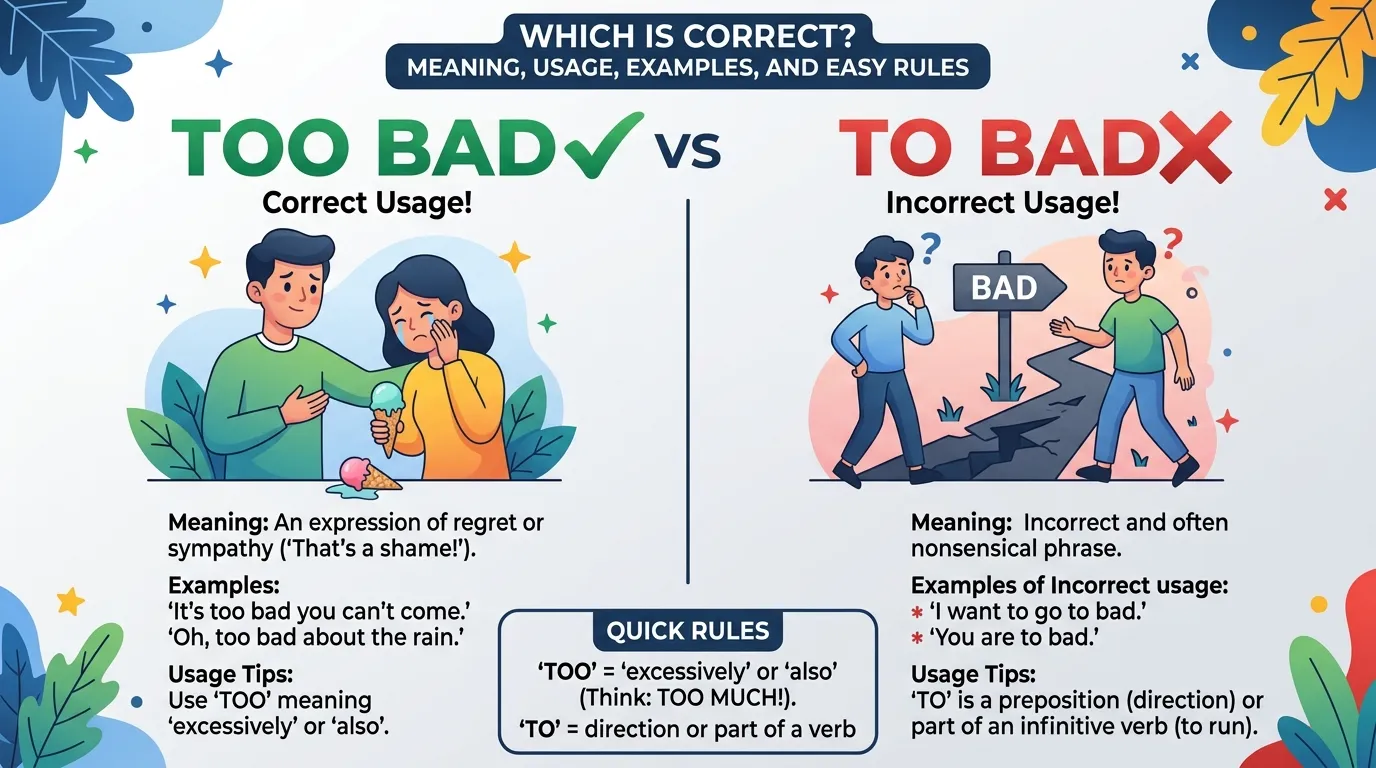
If you are wondering whether “too bad” or “to bad” is correct, the answer is simple: “too bad” is the standard expression in modern English.
The word too means “also” or “more than is desirable,” while to is usually a preposition or part of an infinitive. In the common expression meaning “unfortunate,” “unpleasant,” or “regrettable,” you should write too bad, not to bad.
For example:
Too bad you missed the bus.
Not:
To bad you missed the bus.
The confusion is understandable because to and too sound similar in many sentences. However, they perform completely different grammatical jobs.
This guide explains too bad vs to bad in detail, including their meanings, grammar, pronunciation, tone, common mistakes, formal and informal usage, examples, memory tricks, and practical rules for American English.
Quick Answer: Too Bad or To Bad?
Too bad is correct when you mean:
- unfortunate
- regrettable
- disappointing
- excessively bad
- unfortunate for someone
- “what a shame”
To bad is generally incorrect when used as the expression meaning “unfortunate” or “what a shame.”
Compare
| Expression | Correct? | Meaning |
|---|---|---|
| too bad | ✅ Yes | unfortunate, regrettable, excessively bad |
| to bad | ❌ Usually no | Not the standard expression |
| not too bad | ✅ Yes | fairly good, acceptable |
| too bad! | ✅ Yes | what a shame; sometimes sarcastic |
| too bad to… | ✅ Yes | excessively bad to do something |
| go from good to bad | ✅ Yes | here, “to” correctly connects two states |
The easiest rule
If you can replace the word with “very,” “excessively,” “also,” or “what a shame,” you probably need too.
That movie was too bad to finish.
Too bad you couldn’t come.
What Does “Too Bad” Mean?
Too bad is a standard English expression with several closely related meanings.
It can describe something that is unfortunate, disappointing, undesirable, or excessively bad.
The exact meaning depends on context.
Meaning 1: Unfortunate or regrettable
Too bad you couldn’t join us.
This means:
It is unfortunate that you couldn’t join us.
Meaning 2: Disappointing
It’s too bad the concert was canceled.
The speaker is expressing disappointment.
Meaning 3: Excessively bad
The weather was too bad to travel.
Here, too means “more than acceptable” or “to an excessive degree.”
Meaning 4: “What a shame”
Too bad! We were hoping you would come.
This can sound sympathetic, disappointed, or sarcastic depending on tone.
Meaning 5: Sarcastic or dismissive
You forgot your umbrella? Too bad.
Here, the speaker may not actually feel sorry. The phrase can mean something like:
That’s unfortunate, but I don’t intend to help.
Therefore, too bad can be friendly, sympathetic, neutral, or sarcastic.
Why Is “To Bad” Usually Wrong?
The problem comes from confusing two different words:
- to
- too
Although they can sound similar, they have different grammatical functions.
To commonly indicates direction, destination, relationship, or an infinitive verb.
Examples:
I went to school.
Give the book to Sarah.
I want to leave.
Too, on the other hand, commonly means also or more than necessary.
Examples:
I want to come too.
This coffee is too hot.
That bag is too heavy.
Because bad is an adjective, the standard expression for saying something is excessively bad or unfortunate is too bad.
So:
It’s too bad. ✅
Not:
It’s to bad. ❌
Too vs To: The Key Difference
Understanding too vs to makes this spelling problem much easier.
What Does “To” Mean?
To has several important grammatical functions.
It can indicate direction:
We drove to Chicago.
It can indicate a recipient:
Give this letter to John.
It can form an infinitive:
I want to sleep.
It can connect one state or point to another:
The temperature dropped from 80 degrees to 50 degrees.
What Does “Too” Mean?
Too has two primary meanings.
“Too” meaning “also”
I like pizza too.
She is coming too.
“Too” meaning “excessively”
The soup is too hot.
The box is too heavy.
The test was too difficult.
In too bad, the second meaning is especially important.
The situation is too bad.
This originally carries the idea of something being excessively bad, although too bad has also developed into a common idiomatic expression meaning “unfortunate.”
“Too Bad” as an Adjective Phrase
In sentences such as:
The weather is too bad to travel.
too modifies the adjective bad.
The basic structure is:
too + adjective
Examples:
- too expensive
- too difficult
- too cold
- too loud
- too dangerous
- too late
- too bad
This construction often expresses an excessive degree.
Examples
The road is too dangerous to drive on.
The water is too cold to swim in.
The music is too loud.
The situation is too bad to ignore.
So too bad follows a normal English grammatical pattern.
“Too Bad” as an Idiomatic Expression
English speakers also use too bad as a fixed expression.
In this use, it does not necessarily mean something is literally “excessively bad.”
For example:
Too bad you missed the game.
The speaker means:
It is unfortunate that you missed the game.
Another example:
It’s too bad that she couldn’t attend.
This expresses regret or disappointment.
This idiomatic use is extremely common in everyday American English.
“Too Bad” vs “To Bad” Grammar
The grammatical difference can be summarized like this:
| Word | Part of Speech | Main Function | Example |
|---|---|---|---|
| to | preposition | Shows direction or relationship | Go to work. |
| to | infinitive marker | Introduces a base verb | Want to eat. |
| too | adverb | Means “also” | I want one too. |
| too | adverb | Means “excessively” | It’s too cold. |
Because too is the adverb that modifies bad in the standard phrase, too bad is the correct spelling.
Is “To Bad” Ever Correct?
This is where the answer needs a little nuance.
“To bad” is not the normal spelling of the expression “too bad.”
However, the individual words to and bad can appear next to each other in unusual grammatical contexts.
For example:
The change from good to bad was unexpected.
Here, to is functioning normally as a preposition connecting good and bad.
Another example might occur when bad is being used as a noun in a special or informal construction.
But these cases do not make to bad a replacement for too bad.
If you want to say:
What a shame!
write:
Too bad!
If you want to say:
Unfortunately…
write:
It’s too bad.
Too Bad vs To Bad Examples
Here are common examples showing the difference.
Correct
Too bad you weren’t there.
Incorrect
To bad you weren’t there.
Correct
It’s too bad that the store closed.
Incorrect
It’s to bad that the store closed.
Correct
The weather is too bad for a picnic.
Incorrect
The weather is to bad for a picnic.
Correct
Too bad! I was hoping to see you.
Incorrect
To bad! I was hoping to see you.
Common Sentences With “Too Bad”
The phrase appears in many everyday situations.
Expressing sympathy
It’s too bad you had to leave early.
Expressing disappointment
It’s too bad the event was canceled.
Commenting on a missed opportunity
Too bad you didn’t buy the tickets sooner.
Describing poor quality
The food was too bad to eat.
Describing excessive severity
The damage was too bad to repair easily.
Being sarcastic
Too bad. Maybe you’ll remember next time.
The same words can communicate very different emotions depending on voice and context.
Is “Too Bad” Formal or Informal?
Too bad is natural and widely understood, but its level of formality depends on how it is used.
The expression is perfectly normal in everyday English:
It’s too bad you can’t come.
However, in highly formal writing, alternatives such as unfortunate, regrettable, or disappointing may be more appropriate.
Casual
Too bad you missed it.
Neutral
It’s too bad that you missed the meeting.
Formal
It is unfortunate that you were unable to attend the meeting.
Very formal
It is regrettable that you were unable to attend.
The choice depends on your audience.
American English Usage
In American English, too bad is extremely common.
You will hear it in:
- everyday conversations
- text messages
- social media
- television
- movies
- workplace conversations
- sports discussions
- blogs
- informal emails
Examples:
Too bad we don’t have more time.
That’s too bad.
Too bad you missed the final quarter.
It’s too bad the project was delayed.
For professional writing, the phrase can still be used when the tone is appropriate.
British English Usage
British English also uses too bad.
The spelling distinction between too and to does not change between American and British English.
You may encounter alternatives such as:
- unfortunate
- what a shame
- rather unfortunate
- regrettable
- disappointing
But too bad remains standard English.
Therefore, this is not a major American-versus-British spelling difference.
Pronunciation: “Too” vs “To”
Pronunciation is one reason people make this mistake.
Too
too is normally pronounced:
/tuː/
It rhymes with:
- blue
- do
- shoe
- true
- you
To
The pronunciation of to depends on stress.
When unstressed, it is commonly pronounced:
/tə/
For example:
I want to go.
When stressed, it can be pronounced more like:
/tuː/
For example:
I said I wanted TO go.
This means to and too can sound identical in certain situations.
That is why the mistake is usually a spelling problem rather than a pronunciation problem.
Why Do People Confuse “Too Bad” and “To Bad”?
There are several reasons.
They Sound Similar
In ordinary conversation, to is often pronounced weakly, but too has the same long vowel sound as stressed to.
“To” Is Much More Common
English learners see to constantly:
to go
to school
to work
to eat
This can make it easy to automatically type to when too is needed.
“Too” Has Multiple Meanings
Learners must remember that too can mean both:
- also
- excessively
That makes it less predictable than to.
Spellcheck Does Not Always Catch It
Both to and too are legitimate English words.
A grammar checker may not understand your intended meaning.
For example:
It’s to bad.
The sentence contains real English words, but the phrase is wrong.
A Simple Memory Trick for “Too Bad”
Use the extra O rule.
Think of too as having an extra O.
That extra letter can remind you of extra or more than necessary.
too = extra / excessive
too bad = excessively bad or unfortunate
Another useful trick:
Too has an extra O because it often means more.
Examples:
too hot = more hot than acceptable
too expensive = more expensive than acceptable
too bad = excessively bad
“Too Bad” vs “Very Bad”
These expressions are not always interchangeable.
Very bad
Very bad simply increases the degree of badness.
The movie was very bad.
This means the movie was of poor quality.
Too bad
Too bad can mean excessively bad:
The weather was too bad to play outside.
It can also mean unfortunate:
Too bad you missed the movie.
Therefore, too bad has a wider range of meanings than very bad.
“Too Bad” vs “Not Too Bad”
Not too bad is a very common expression.
Interestingly, it often means something is fairly good or acceptable.
For example:
How was the restaurant?
Not too bad.
This usually means:
It was reasonably good.
It does not necessarily mean the restaurant was bad.
More examples
How are you feeling?
Not too bad.
Meaning:
I’m doing fairly well.
How did your presentation go?
Not too bad.
Meaning:
It went reasonably well.
This is an important everyday expression to learn.
“Too Bad” vs “What a Shame”
These phrases can express similar ideas.
Too bad
Too bad you couldn’t stay.
What a shame
What a shame you couldn’t stay.
Both express disappointment or regret.
However, what a shame can sound slightly more openly sympathetic, while too bad can be neutral or even sarcastic depending on delivery.
“Too Bad” vs “Unfortunately”
These also overlap.
Conversational
Too bad we missed the train.
More neutral
Unfortunately, we missed the train.
Formal
It is unfortunate that we missed the train.
For casual communication, too bad sounds natural.
For formal reports or academic writing, unfortunately or unfortunate may be better.
Formal Alternatives to “Too Bad”
When writing professionally, you can replace too bad with:
- unfortunate
- regrettable
- disappointing
- unfortunate circumstances
- regrettably
- sadly
- disappointing to learn
- unfortunate to hear
Casual
Too bad the deadline was missed.
Professional
Unfortunately, the deadline was missed.
Formal
It is regrettable that the deadline was not met.
Informal Alternatives to “Too Bad”
In casual speech, you might also hear:
- What a shame.
- That’s unfortunate.
- That’s a bummer.
- What a disappointment.
- Sorry to hear that.
- That’s rough.
- Tough luck.
- Oh, well.
These are not perfect synonyms in every situation because their emotional tones differ.
For example:
Sorry to hear that.
sounds sympathetic.
Whereas:
Tough luck.
can sound dismissive or humorous.
Tone and Context Matter
One of the most interesting features of too bad is its flexible tone.
Sympathy
It’s too bad you’re feeling sick.
The speaker is expressing concern.
Disappointment
It’s too bad the game was canceled.
The speaker is disappointed.
Neutral observation
It’s too bad the store is closed.
The speaker simply notes an unfortunate situation.
Sarcasm
You forgot your keys again? Too bad.
This may imply that the speaker is not sympathetic.
Therefore, too bad should be interpreted in context.
Is “Too Bad” Rude?
Not necessarily.
The phrase itself is not rude.
However, “Too bad.” can sound cold or dismissive when used without additional context.
Compare:
It’s too bad you couldn’t come. I really wanted to see you.
This sounds sympathetic.
With:
Too bad.
The second version could sound sarcastic.
If you want to show genuine sympathy, consider saying:
I’m sorry to hear that.
or:
That’s unfortunate.
“Too Bad” in Texting and Social Media
Too bad is common in digital communication.
Examples:
Too bad you couldn’t make it!
That’s too bad 😔
Too bad! Maybe next time.
Ah, too bad. We were just talking about you.
Text messages can make tone harder to interpret, so punctuation and emojis sometimes provide additional context.
For example:
Too bad!
could be enthusiastic sympathy or sarcasm.
Too bad 😔
is more clearly sympathetic.
“Too Bad” in Business Writing
In professional communication, use it carefully.
A sentence like:
Too bad you missed the deadline.
can sound judgmental.
A more professional alternative would be:
Unfortunately, the deadline was missed.
Or:
Unfortunately, we were unable to meet the deadline.
Better workplace alternatives
| Casual | Professional |
|---|---|
| Too bad you missed the meeting. | Unfortunately, you were unable to attend the meeting. |
| Too bad the project failed. | Unfortunately, the project was unsuccessful. |
| That’s too bad. | That’s unfortunate. |
| Too bad we can’t continue. | Unfortunately, we cannot continue at this time. |
The more sensitive the situation, the more careful your wording should be.
“Too Bad” in Academic Writing
Academic writing usually favors precise, objective language.
Instead of:
It’s too bad that the study had limitations.
Consider:
The study had several limitations.
Or:
Unfortunately, the study had several limitations.
Academic writing should focus on the factual situation rather than conversational reactions.
However, too bad is not grammatically wrong. It is simply less suitable for highly formal academic prose.
“Too Bad” in Journalism
Journalists typically prefer clear and neutral wording.
Instead of:
It’s too bad the event was canceled.
a news report might say:
The event was canceled because of severe weather.
Journalistic writing often avoids emotional language unless the quote or context specifically calls for it.
“Too Bad” in Sports
Sports conversations frequently use too bad to describe unfortunate events.
Examples:
Too bad they lost in overtime.
It’s too bad the quarterback was injured.
Too bad the team couldn’t hold the lead.
Sports writing may use stronger alternatives such as:
- disappointing
- costly
- unfortunate
- heartbreaking
- frustrating
The best choice depends on the situation.
“Too Bad” in Blogging
For blogs and conversational online content, too bad is perfectly natural.
For example:
It’s too bad you missed the sale, but there are still plenty of good options available.
Blog writing often benefits from conversational language because it feels direct and approachable.
Common Mistakes With “Too Bad”
Mistake 1: Writing “to bad”
❌ To bad you couldn’t come.
✅ Too bad you couldn’t come.
Mistake 2: Writing “to bad” in “it’s too bad”
❌ It’s to bad that the store closed.
✅ It’s too bad that the store closed.
Mistake 3: Assuming “too” always means “also”
This is incorrect.
Too can mean also:
I want dessert too.
But it can also mean excessively:
The dessert is too sweet.
Mistake 4: Assuming “to” and “too” are interchangeable
They are not.
I went to work.
I went there too.
Changing the word changes the grammar and meaning.
Awkward vs Natural Examples
| Awkward or Incorrect | Natural |
|---|---|
| To bad you missed it. | Too bad you missed it. |
| It’s to bad we lost. | It’s too bad we lost. |
| To bad the weather changed. | Too bad the weather changed. |
| That is to bad. | That is too bad. |
| It was to bad to continue. | It was too bad to continue. |
The corrected versions use too because it modifies the adjective bad.
Everyday Examples of “Too Bad”
Here are natural examples you might hear in everyday American English:
Too bad we don’t have more time.
It’s too bad that she had to leave.
Too bad you missed the sale.
That’s too bad. I hope everything works out.
The traffic was too bad to ignore.
The damage wasn’t too bad.
It’s too bad we couldn’t stay longer.
Too bad! Maybe next time.
The weather was too bad for a road trip.
That’s too bad, but we can try again tomorrow.
Common Collocations With “Too Bad”
A collocation is a group of words that naturally occur together.
Common combinations include:
- it’s too bad
- that’s too bad
- too bad you…
- too bad that…
- too bad for…
- too bad to…
- not too bad
- a little too bad
- far too bad
- way too bad
Examples
It’s too bad you couldn’t attend.
That’s too bad.
Too bad you missed the opportunity.
It was too bad to continue.
The damage wasn’t too bad.
That’s not too bad.
Related Expressions and Phrases
Several English expressions are related to too bad.
“Not too bad”
Means fairly good or acceptable.
The meal was not too bad.
“Too bad for you”
Can sound teasing or dismissive.
You forgot your lunch? Too bad for you.
“Too bad, so sad”
A playful or sarcastic expression that often means the speaker is not particularly sympathetic.
“Too bad you can’t”
A common way to mention an unfortunate limitation.
Too bad you can’t stay longer.
“It’s too bad that…”
A common structure for expressing regret.
It’s too bad that the event was canceled.
Synonyms for “Too Bad”
Depending on the meaning, useful synonyms include:
When “too bad” means unfortunate
- unfortunate
- regrettable
- disappointing
- sad
- unfortunate situation
- what a shame
When “too bad” means excessively bad
- excessively bad
- extremely poor
- unacceptable
- terrible
- severe
- awful
When it is sarcastic
- tough luck
- that’s unfortunate
- what a shame
- too bad for you
Be careful because these alternatives do not always carry the same emotional tone.
Antonyms and Opposite Expressions
Possible opposites include:
- fortunate
- lucky
- good
- excellent
- favorable
- pleasant
- satisfactory
- not bad
- great
- wonderful
For example:
It’s too bad that it rained.
Opposite:
Luckily, the rain stopped before the event.
Word History and Etymology
The word too comes from Old English tō, which developed meanings associated with excess or addition.
Over time, English developed the modern uses of too meaning:
- also
- excessively
The word to also has a long history in English and is related to an old directional or relational form.
Although to and too are historically related, modern English treats them as distinct words with different grammatical roles.
The spelling distinction is important today because English relies heavily on these small function words to communicate grammatical relationships.
Dictionary-Style Definitions
Too
Part of speech: Adverb
Definition 1: To an excessive degree.
The coffee is too hot.
Definition 2: In addition; also.
I want to come too.
To
Part of speech: Preposition or infinitive marker
Definition 1: Used to indicate direction, destination, or relationship.
She went to school.
Definition 2: Used before a verb to form an infinitive.
I want to learn.
Bad
Part of speech: Adjective, adverb, noun, or other grammatical uses depending on context
Common adjective meaning: Poor in quality, undesirable, harmful, unpleasant, or unfavorable.
That was a bad decision.
Together, too + bad forms the common expression too bad.
How to Choose Between “Too Bad” and “To Bad”
Use this simple decision process.
Step 1: Are you describing something as excessively bad?
Use too bad.
The situation is too bad to ignore.
Step 2: Are you expressing regret or disappointment?
Use too bad.
Too bad you couldn’t come.
Step 3: Are you saying “what a shame”?
Use too bad.
Too bad!
Step 4: Are you indicating direction or destination?
You probably need to, but not as part of the phrase to bad.
We went to the store.
Step 5: Are you introducing a verb?
Use to.
I want to leave.
This five-step check solves most too bad vs to bad questions.
A Fast Proofreading Trick
When proofreading, replace too with very or excessively.
If the sentence still makes sense, too may be correct.
The weather is too bad.
The weather is excessively bad.
That works.
Now try:
I went to school.
Replacing to with “excessively” clearly does not work.
Another trick is to replace too with also when appropriate:
I want pizza too.
I want pizza also.
That works.
Quick Comparison: Too Bad vs To Bad
| Feature | Too Bad | To Bad |
|---|---|---|
| Standard expression? | ✅ Yes | ❌ No |
| Means unfortunate? | ✅ Yes | ❌ No |
| Means excessively bad? | ✅ Yes | ❌ Not in this expression |
| Common in conversation? | ✅ Very common | ❌ No |
| Used in American English? | ✅ Yes | ❌ Not as the idiom |
| Used in British English? | ✅ Yes | ❌ Not as the idiom |
| Can be formal? | Sometimes | Not applicable |
| Can be sarcastic? | ✅ Yes | ❌ No |
| Common spelling mistake? | Often confused with “to bad” | Common error |
Which One Should You Use in Different Situations?
American everyday conversation
Use too bad.
Too bad you couldn’t stay.
Texting
Use too bad.
That’s too bad!
Social media
Use too bad.
Too bad we missed the concert!
Blogging
Use too bad when a conversational tone is appropriate.
Business communication
Prefer unfortunate, unfortunately, or disappointing when a more professional tone is needed.
Academic writing
Usually choose more precise and formal alternatives.
Journalism
Use objective wording unless quoting someone or deliberately expressing a reaction.
Sports conversation
Too bad is completely natural.
Technical writing
Use precise descriptive language rather than conversational expressions.
Frequently Asked Questions
Is “too bad” correct grammar?
Yes. Too bad is grammatically correct and is a very common English expression. It can mean “unfortunate,” “regrettable,” or “excessively bad,” depending on context.
Is “to bad” ever correct?
To bad is not the correct spelling of the common expression meaning “unfortunate” or “what a shame.” However, the separate words to and bad can appear next to each other in unusual constructions, such as “from good to bad.”
Is it “too bad” or “to bad”?
The standard expression is too bad.
Too bad you missed the party.
Not:
To bad you missed the party.
Why do people write “to bad” instead of “too bad”?
The main reason is pronunciation. To and too can sound the same, especially in spoken English. Because to is also much more common in writing, people sometimes choose the wrong spelling.
Does “too bad” mean very bad?
Sometimes, but not always. Too bad can mean “excessively bad,” but it can also mean “unfortunate” or “what a shame.”
The weather is too bad to travel.
means the weather is excessively bad.
Too bad you missed the flight.
means it is unfortunate that you missed it.
Is “too bad” formal English?
It is standard English, but it is generally more conversational than highly formal. In professional or academic writing, words such as unfortunate, regrettable, or disappointing may be more suitable.
What is the difference between “too” and “to”?
To is commonly used for direction, relationships, and infinitives:
Go to work.
Too means “also” or “excessively”:
I want to go too.
It is too cold.
Is “not too bad” a positive expression?
Usually, yes. Not too bad commonly means “fairly good,” “acceptable,” or “reasonably well.”
How was your day?
Not too bad.
Can “too bad” be sarcastic?
Yes. Tone and context can make too bad sound sarcastic or dismissive.
You forgot your wallet? Too bad.
The speaker may be teasing rather than expressing genuine sympathy.
Conclusion
The difference between too bad and to bad is easy once you understand the jobs of too and to.
Too bad is the standard and correct expression when you mean:
- unfortunate
- regrettable
- disappointing
- excessively bad
- what a shame
For example:
Too bad you missed the meeting.
The spelling to bad is generally a mistake when someone intends to use this expression.
Remember that to is normally used for direction, relationships, or infinitive verbs:
Go to school.
I want to learn.
Meanwhile, too means also or excessively:
I want to come too.
The box is too heavy.
The easiest memory trick is to associate the extra o in too with extra or more than necessary. When you are saying “what a shame” or describing something as excessively bad, choose too bad.
For everyday American English, the recommendation is straightforward: write “too bad,” not “to bad,” when you mean “unfortunate” or “excessively bad.” In formal, academic, business, or journalistic writing, consider whether unfortunate, regrettable, disappointing, or unfortunately communicates your meaning more precisely.
Once you remember that to and too have different grammatical roles, the too bad vs to bad confusion becomes much easier to avoid.