Disastrous vs Disasterous: Which Spelling Is Correct?

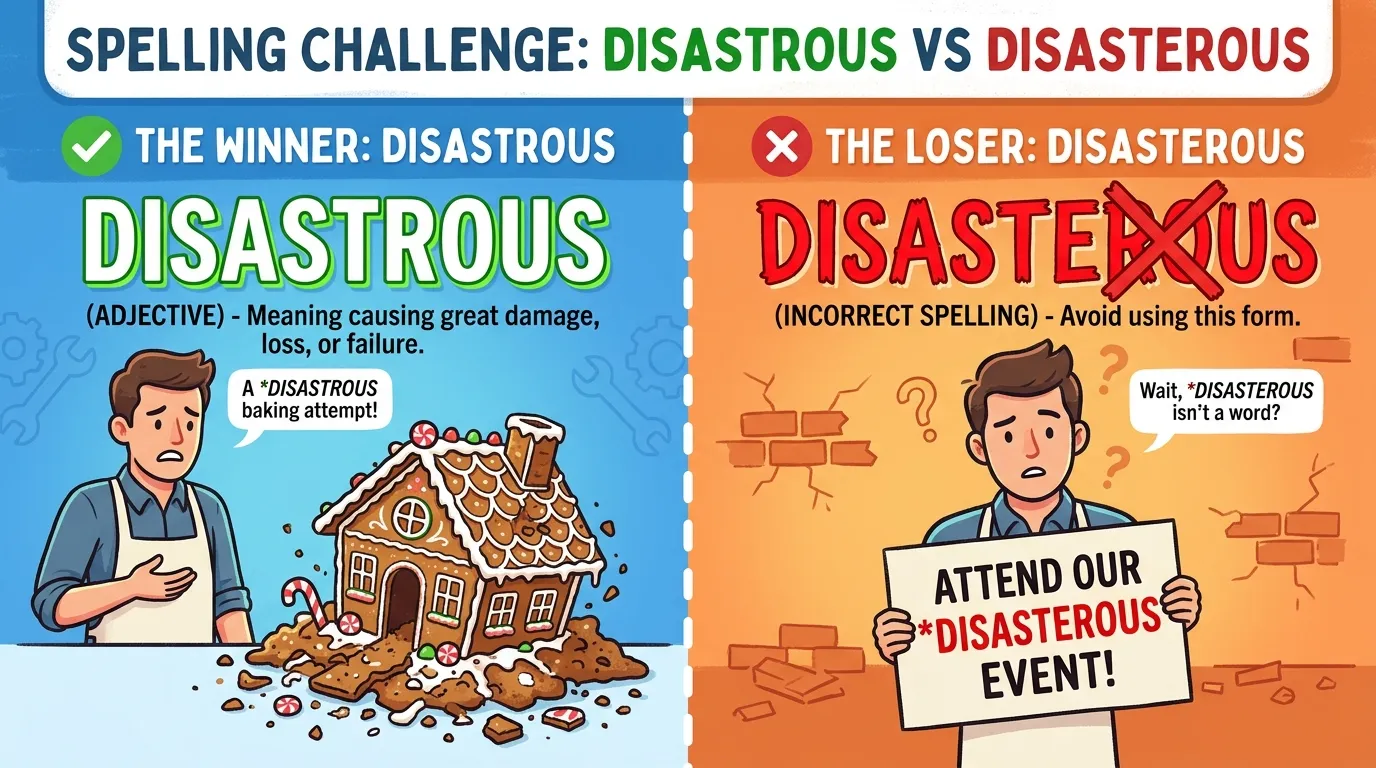
If you are wondering whether the correct spelling is disastrous or disasterous, the answer is simple: disastrous is correct.

Disasterous is a common misspelling and is not the standard spelling in American English or standard British English.

The confusion is understandable because the noun is spelled disaster, so it may seem logical to add -ous and write disasterous. However, English does not always form adjectives by simply attaching a suffix to the complete spelling of a noun. In this case, the accepted adjective is disastrous, with the spelling disastr-ous.

Quick Answer: Use disastrous. Do not use disasterous in standard English.

For example:

  • Correct: The storm caused disastrous damage.
  • Incorrect: The storm caused disasterous damage.
  • Correct: The company suffered a disastrous financial loss.
  • Incorrect: The company suffered a disasterous financial loss.

This guide explains the difference between disastrous and disasterous, including their meanings, pronunciation, grammar, word history, common mistakes, examples, synonyms, formal and informal alternatives, and practical ways to remember the correct spelling.


Quick Answer: Is It Disastrous or Disasterous?

Disastrous is the correct spelling.

Disasterous is a misspelling.

SpellingCorrect?Meaning
disastrous✅ YesCausing great damage, failure, harm, or suffering
disasterous❌ NoNonstandard misspelling of disastrous

The word disastrous is an adjective. It describes something that produces results similar to or associated with a disaster.

Examples

  • The decision was disastrous.
  • The team had a disastrous start.
  • The experiment produced disastrous results.
  • Poor planning can have disastrous consequences.
  • The storm had a disastrous effect on the region.

The spelling disasterous should be corrected to disastrous.


What Does Disastrous Mean?

Disastrous is an adjective meaning extremely harmful, unsuccessful, damaging, or destructive.

It describes something that leads to very bad consequences.

For example:

The business decision was disastrous.

This means the decision had extremely bad results.

The word can describe literal physical destruction:

The earthquake had disastrous effects on the city.

It can also describe figurative or nonphysical failure:

The presentation was disastrous.

In the second example, the presentation may not have caused a literal disaster. The speaker is using disastrous to emphasize that it went extremely badly.

Dictionary-style definition

Disastrous
adjective

  1. Causing serious damage or harm.
  2. Producing extremely bad results.
  3. Extremely unsuccessful or unfortunate.

Simple meaning

You can usually understand disastrous as:

very bad + serious consequences

Depending on context, it can mean:

  • destructive
  • catastrophic
  • ruinous
  • extremely unsuccessful
  • harmful
  • unfortunate
  • devastating

Why Is “Disasterous” Wrong?

The main reason people write disasterous is that they see the noun disaster and assume the adjective should be formed by adding -ous directly:

disaster + ous = disasterous

That looks reasonable at first glance.

However, the established English spelling is:

disastrous

The adjective uses the stem disastr-, not the full spelling disaster-.

This is one of those English spelling patterns where pronunciation and word formation can make the correct spelling less obvious.

Compare:

  • disaster → disastrous
  • danger → dangerous
  • fame → famous
  • glory → glorious
  • mystery → mysterious

English adjective formation does not always work like a simple mathematical formula. Historical word development often determines the spelling that modern speakers must learn.

So although disasterous looks logical, it is not the standard form.


Disastrous vs Disasterous: The Key Difference

The difference is primarily spelling and correctness, not meaning.

There is no standard semantic distinction between the two forms.

FeatureDisastrousDisasterous
Standard EnglishYesNo
Standard American EnglishYesNo
Standard British EnglishYesNo
Part of speechAdjective
MeaningCausing serious harm or failureIntended to mean disastrous
Recommended in writingYesNo
Dictionary-standard adjectiveYesNo

If someone writes disasterous, they almost certainly mean disastrous.

The rule to remember

Disastrous has no “e” before the “r.”

Correct:

disastrous

Incorrect:

disasterous


How Do You Pronounce Disastrous?

Disastrous is generally pronounced:

dih-ZAS-trus

A common phonetic representation is:

/dɪˈzæstrəs/

The stress falls on the second syllable:

di-ZAS-trous

The final -ous sounds like “us” rather than the long vowel sound in words such as house.

Breaking it down

disastrousdih-ZAS-trus

The pronunciation may help explain why the spelling disasterous feels tempting. The noun disaster contains a pronounced vowel sound before the final consonant, while disastrous has a different syllable structure.

Example

It was a disastrous mistake.

Say it naturally as:

It was a dih-ZAS-trus mistake.

Do not try to pronounce the incorrect spelling as though it were a separate standard word.


What Part of Speech Is Disastrous?

Disastrous is an adjective.

An adjective describes or modifies a noun.

For example:

  • a disastrous decision
  • a disastrous accident
  • a disastrous mistake
  • a disastrous campaign
  • a disastrous season
  • a disastrous outcome

Disastrous before a noun

The company made a disastrous decision.

Here, disastrous describes the noun decision.

Disastrous after a linking verb

The results were disastrous.

Here, disastrous describes the subject through the linking verb were.


Related Forms of Disastrous

Understanding the word family can make the spelling easier to remember.

WordPart of SpeechExample
disasterNounThe flood was a disaster.
disastrousAdjectiveThe flood had disastrous effects.
disastrouslyAdverbThe plan failed disastrously.

Disaster

A disaster is a catastrophic or extremely damaging event or situation.

The fire was a disaster for the community.

Disastrous

Disastrous describes something that causes or produces disastrous results.

The fire had disastrous consequences.

Disastrously

Disastrously describes how something happens.

The project was managed disastrously.


How to Use Disastrous in a Sentence

The most common structure is:

disastrous + noun

Examples:

  • disastrous consequences
  • disastrous results
  • disastrous effects
  • disastrous mistake
  • disastrous decision
  • disastrous failure
  • disastrous accident
  • disastrous outcome
  • disastrous situation
  • disastrous policy
  • disastrous performance
  • disastrous season

Examples in everyday English

Missing the final train was disastrous for our travel plans.

His attempt to fix the computer was disastrous.

The restaurant had a disastrous opening night.

The team’s first half was disastrous.

Their lack of preparation had disastrous consequences.


Common Collocations With Disastrous

A collocation is a combination of words that commonly appear together.

Knowing common collocations makes your writing sound more natural.

Disastrous consequences

The mistake could have disastrous consequences.

Disastrous results

The experiment produced disastrous results.

Disastrous effects

The drought had disastrous effects on agriculture.

Disastrous decision

Selling the property at that price was a disastrous decision.

Disastrous mistake

Forgetting the deadline was a disastrous mistake.

Disastrous failure

The launch became a disastrous failure.

Disastrous outcome

Poor communication can lead to a disastrous outcome.

Disastrous performance

The team delivered a disastrous performance.

Disastrous consequences

This is particularly common in formal writing:

Poor planning may have disastrous consequences for the organization.


Disastrous in Formal and Academic Writing

Disastrous is appropriate in formal English, but writers should use it carefully.

It is a strong word. It suggests that the consequences are serious, not merely inconvenient.

Appropriate academic example

The policy produced disastrous economic consequences.

Less appropriate use

The student forgot one comma, which was disastrous.

Unless the missing comma genuinely caused a serious problem, disastrous may sound exaggerated.

More neutral alternatives could be:

  • problematic
  • unfortunate
  • harmful
  • unsuccessful
  • ineffective
  • damaging

Academic writing tip

Use disastrous when you can support the seriousness of the claim.

Instead of:

The policy was disastrous.

A more precise academic sentence might be:

The policy resulted in significant economic losses.

Precision is often stronger than exaggeration.


Disastrous in Business Writing

The word can appear in business writing when discussing serious failures, losses, or consequences.

Examples

The company experienced a disastrous decline in sales.

The merger had disastrous financial consequences.

Poor inventory management can have disastrous effects on cash flow.

However, business communication often benefits from precise language.

Instead of:

The project was disastrous.

You might write:

The project exceeded its budget by 40% and missed three major deadlines.

The second sentence provides measurable information.


Disastrous in Journalism

Journalists may use disastrous when describing severe events or major failures.

Examples include:

  • disastrous flooding
  • disastrous fires
  • disastrous economic policies
  • disastrous election results
  • disastrous negotiations
  • disastrous military campaigns
  • disastrous sporting performances

However, journalistic style generally benefits from concrete facts rather than emotional wording.

Compare:

The government experienced a disastrous economic year.

with:

The economy contracted sharply and unemployment reached its highest level in a decade.

The second version tells readers exactly what happened.


Disastrous in Sports

Sports writers and fans frequently use disastrous figuratively.

Examples:

The team had a disastrous first half.

Their defense was disastrous in the final quarter.

The goalkeeper made a disastrous mistake.

The club suffered a disastrous start to the season.

Here, disastrous does not necessarily mean anyone died or suffered a literal catastrophe.

It simply emphasizes extreme failure or poor performance.

Sports-related collocations

  • disastrous season
  • disastrous start
  • disastrous finish
  • disastrous performance
  • disastrous mistake
  • disastrous loss
  • disastrous game
  • disastrous campaign

Disastrous in Casual Conversation

In everyday speech, disastrous can be serious or humorous depending on context.

Serious

The storm was disastrous for local businesses.

Lighthearted

I tried baking a cake, and the result was disastrous.

In the second example, the speaker may simply mean that the cake looked terrible.

This is an example of figurative or exaggerated usage.

The context determines how serious the word sounds.


Literal vs Figurative Meaning of Disastrous

One important feature of disastrous is its flexibility.

Literal or serious usage

The earthquake had disastrous consequences.

This suggests substantial real-world harm.

Figurative usage

My first attempt at painting was disastrous.

The speaker probably means the painting was extremely poor.

Humorous usage

My attempt to assemble the furniture without reading the instructions was disastrous.

The situation may have been frustrating but not truly catastrophic.

Therefore, disastrous can range from genuinely severe to playful exaggeration.


Is Disastrous Stronger Than Bad?

Yes.

Disastrous is considerably stronger than bad.

Consider this scale:

poor → bad → very bad → terrible → disastrous → catastrophic

The exact strength depends on context, but disastrous usually suggests serious negative consequences.

Compare

The meeting was bad.

This is mild.

The meeting was terrible.

This is stronger.

The meeting was disastrous.

This suggests that the meeting went extremely badly and may have caused serious problems.

The negotiations ended in a catastrophic failure.

This can be even stronger, especially when the consequences are severe.


Synonyms for Disastrous

The best synonym depends on what you are describing.

General synonyms

  • terrible
  • devastating
  • catastrophic
  • ruinous
  • damaging
  • destructive
  • calamitous
  • tragic
  • disastrous
  • unsuccessful
  • harmful
  • unfortunate

For failure

  • unsuccessful
  • disastrous
  • disastrous in scope
  • catastrophic
  • ruinous
  • disastrous

For physical destruction

  • devastating
  • destructive
  • catastrophic
  • ruinous
  • calamitous

For poor performance

  • terrible
  • awful
  • disastrous
  • dreadful
  • abysmal
  • extremely poor

Not every synonym works in every sentence.

For example, catastrophic often emphasizes scale, while unfortunate is much weaker.


Antonyms of Disastrous

Possible opposites include:

  • successful
  • beneficial
  • effective
  • favorable
  • positive
  • productive
  • fortunate
  • excellent
  • successful
  • constructive

Compare:

The first plan was disastrous.

The revised plan was successful.

Or:

The decision had disastrous consequences.

The decision had beneficial consequences.


Disastrous vs Catastrophic

These words are close in meaning but not always interchangeable.

Disastrous means causing or involving very bad results.

Catastrophic usually suggests an extremely severe event or consequence, often on a large scale.

Compare:

The company’s advertising campaign was disastrous.

This describes serious failure.

The earthquake was catastrophic.

This emphasizes enormous destruction.

A marketing campaign can be disastrous without being catastrophic.


Disastrous vs Devastating

Devastating emphasizes profound damage, destruction, or emotional impact.

The storm had devastating effects on the community.

Disastrous is broader.

The storm had disastrous effects on the community.

Both can work, but devastating often carries a stronger emotional or destructive sense.


Disastrous vs Terrible

These words can overlap in casual English.

The movie was terrible.

The movie was disastrous.

The first simply means very bad.

The second can imply that the movie’s production, reception, performance, or consequences were extremely bad.

For example:

The film received terrible reviews.

The film had a disastrous opening weekend.

The second is more specific about the scale of failure.


Is “Disasterous” Ever Correct?

In standard modern English, no.

If you are writing:

  • an essay
  • an email
  • a report
  • a blog post
  • a news article
  • a résumé
  • a business document
  • an academic paper
  • a social media post

use disastrous.

If you encounter disasterous, it is normally an error that should be corrected.

Correction

❌ The negotiations ended in a disasterous failure.

✅ The negotiations ended in a disastrous failure.

❌ The company made a disasterous investment.

✅ The company made a disastrous investment.

❌ The storm caused disasterous damage.

✅ The storm caused disastrous damage.


Why Do People Spell It “Disasterous”?

Several factors can cause this mistake.

The noun is disaster

The noun is:

disaster

So people naturally reason:

disaster + ous = disasterous

That seems logical, but it is not the established spelling.

The word looks familiar

Because disaster is so common, the eye expects to see the complete word inside the adjective.

However:

disaster → disastrous

does not preserve the noun’s spelling exactly.

Pronunciation can be confusing

The adjective has a different syllable pattern from the noun, which can make the spelling less intuitive.

English spelling is historically irregular

English contains many words whose modern spelling reflects historical development rather than a simple suffix rule.

The safest approach is therefore to memorize the standard form:

disastrous


A Simple Memory Trick for Disastrous

Here is an easy spelling trick:

Think “disastr-ous,” not “disaster-ous.”

Write:

DISASTR + OUS

not:

DISASTER + OUS

Another useful reminder is:

A disaster becomes disastrous without the “e.”

So:

disaster → disastrous

Visual memory

Remember this:

DISASTR + OUS = DISASTROUS

If you see disasterous, the extra e should immediately look suspicious.


Common Mistakes With Disastrous

Mistake 1: Adding “e”

❌ disasterous

✅ disastrous

Mistake 2: Using it as a noun

❌ The disastrous was enormous.

✅ The disaster was enormous.

Disastrous is an adjective. Disaster is the noun.

Mistake 3: Using “disastrously” incorrectly

❌ The disasterously decision caused problems.

✅ The disastrous decision caused problems.

Or:

✅ The project was managed disastrously.

Mistake 4: Overusing the word

Calling every minor inconvenience disastrous can make writing sound exaggerated.

Instead of:

It was disastrous that I forgot my pen.

Try:

It was inconvenient that I forgot my pen.

Reserve disastrous for situations that are genuinely very bad or are being intentionally described with strong emphasis.


Awkward vs Natural Examples

Awkward or IncorrectNatural or Correct
The plan was disasterous.The plan was disastrous.
We had a disasterous meeting.We had a disastrous meeting.
The error was disasterous.The error was disastrous.
It was a disasterous mistake.It was a disastrous mistake.
The results were disasterous.The results were disastrous.
The project failed disasterously.The project failed disastrously.

Formal vs Informal Alternatives to Disastrous

Depending on your audience, you may want a different word.

Formal alternatives

  • severely damaging
  • highly detrimental
  • extremely harmful
  • catastrophic
  • destructive
  • ruinous

Example:

The policy had severely damaging consequences.

Neutral alternatives

  • unsuccessful
  • harmful
  • damaging
  • very poor
  • unfortunate

Informal alternatives

  • terrible
  • awful
  • a complete mess
  • a total failure
  • a train wreck

For professional or academic writing, choose the alternative that communicates the exact degree of seriousness.


Disastrous in American vs British English

There is no meaningful standard spelling difference between American and British English here.

Both varieties use:

disastrous

The incorrect form disasterous is not an accepted alternative British spelling.

So whether you are writing for:

  • the United States
  • the United Kingdom
  • Canada
  • Australia
  • New Zealand
  • international English readers

the standard spelling is disastrous.


Disastrous in International English

English learners around the world may encounter disasterous because the spelling appears to follow an intuitive pattern.

If English is not your first language, remember that English suffixes do not always attach mechanically to the visible spelling of a base word.

For international writing, disastrous is the safest and standard choice.


Is Disastrous a Technical Term?

Generally, disastrous is not a specialized technical term.

It is a general adjective that can appear in technical contexts when describing severe outcomes.

For example:

A software failure could have disastrous consequences for the system.

In engineering:

The structural weakness had potentially disastrous consequences.

In medicine:

Delayed treatment can have disastrous consequences.

In cybersecurity:

A major security breach could have disastrous effects on the organization.

In each case, the word retains its ordinary meaning: causing extremely serious negative results.


Disastrous in Political Writing

Political writers may use disastrous to characterize policies, decisions, campaigns, or outcomes.

Examples:

Critics called the policy disastrous.

The administration faced criticism after a disastrous economic decision.

The candidate’s campaign suffered a disastrous setback.

Because disastrous is strongly negative, it can express opinion or evaluation. In objective writing, it is often better to explain the specific evidence behind the description.

Instead of simply saying:

The policy was disastrous.

A neutral writer might explain:

The policy led to higher costs, lower production, and increased unemployment.

This allows readers to evaluate the evidence themselves.


Phrases and Expressions With Disastrous

There are several common phrases containing disastrous.

Disastrous consequences

The error could have disastrous consequences.

Disastrous results

Poor planning often produces disastrous results.

Disastrous effects

The disease had disastrous effects on the population.

Disastrous mistake

Sending the email to the wrong recipient was a disastrous mistake.

Disastrous decision

Accepting the offer without checking the terms proved to be a disastrous decision.

Disastrous outcome

Nobody expected such a disastrous outcome.

Disastrous failure

The launch became a disastrous failure.

Disastrous start

The team got off to a disastrous start.


Natural Everyday Examples of Disastrous

Here are more examples across different situations:

School

Forgetting the final exam was disastrous for his grade.

Work

Missing the deadline had disastrous consequences for the project.

Travel

Losing our passports on the first day would have been disastrous.

Cooking

My first attempt at making bread was disastrous.

Technology

A server failure could have disastrous effects on the company.

Sports

The team had a disastrous second half.

Business

The investment turned out to be disastrous.

Weather

The hurricane caused disastrous damage.

Relationships

A lack of communication can have disastrous consequences for a relationship.

Personal plans

Leaving everything until the last minute was a disastrous strategy.


When Should You Use Disastrous?

Use disastrous when you want to communicate that something has produced or is likely to produce very serious negative consequences.

It works especially well when discussing:

  • major failures
  • severe damage
  • destructive events
  • serious mistakes
  • unsuccessful strategies
  • harmful decisions
  • poor performances
  • major setbacks
  • severe consequences

Avoid using it when a milder word would be more accurate.

Strong and appropriate

The flood had disastrous consequences for the town.

Probably exaggerated

Forgetting my umbrella was disastrous.

Unless the situation truly became extremely serious, unfortunate, inconvenient, or annoying would be more precise.


How to Remember Disastrous vs Disasterous

The easiest rule is:

Disastrous is correct; disasterous is incorrect.

Use the spelling:

D-I-S-A-S-T-R-O-U-S

Pay special attention to the middle:

…ASTR…

not:

…ASTER…

Quick spelling test

If you are about to write:

disasterous

stop and ask:

“Does this adjective contain the full spelling of disaster?”

No.

The standard form is:

disastrous


A Practical Editing Checklist

Before publishing or submitting your writing, check the following:

  • Is the word spelled disastrous?
  • Did you accidentally write disasterous?
  • Are you using disaster when you need a noun?
  • Are you using disastrous when you need an adjective?
  • Are you using disastrously when you need an adverb?
  • Is the word strong enough for the situation?
  • Would a more precise word communicate the idea better?

Example

The project was disastrous.

This is grammatically correct.

But if you mean it simply failed to meet its goals, you might write:

The project was unsuccessful.

If it caused major financial damage:

The project had disastrous financial consequences.

The second version provides greater precision.


Frequently Asked Questions About Disastrous vs Disasterous

Is it disastrous or disasterous?

Disastrous is the correct spelling. Disasterous is a misspelling and should not be used in standard English.

What does disastrous mean?

Disastrous means extremely harmful, damaging, destructive, unsuccessful, or unfortunate. It describes something that produces very bad results or serious consequences.

Why is disasterous incorrect?

Although disasterous may look like disaster + -ous, the standard adjective is formed and spelled disastrous. The accepted modern spelling does not contain the extra e found in the noun disaster.

Is disastrous an adjective?

Yes. Disastrous is an adjective.

For example:

It was a disastrous decision.

The adjective disastrous describes the noun decision.

How do you spell disastrous correctly?

The correct spelling is:

D-I-S-A-S-T-R-O-U-S

A useful memory trick is disastr + ous.

Is disasterous a British spelling?

No. Disasterous is not the standard British spelling. British English uses disastrous, just as American English does.

What is the difference between disaster and disastrous?

Disaster is a noun referring to a disastrous event or situation. Disastrous is an adjective describing something that causes or involves very bad consequences.

The flood was a disaster.

The flood had disastrous effects.

What is the adverb form of disastrous?

The adverb is disastrously.

The project was disastrously managed.

The noun is disaster, the adjective is disastrous, and the adverb is disastrously.

Is disastrous a strong word?

Yes. Disastrous is a strong negative adjective. It usually suggests consequences that are much worse than merely inconvenient or unsuccessful. In formal writing, use it when the evidence supports that level of seriousness.

What are some synonyms for disastrous?

Common synonyms include catastrophic, devastating, destructive, ruinous, calamitous, damaging, harmful, terrible, and extremely unsuccessful. The best choice depends on the context.


Conclusion: Disastrous Is the Correct Spelling

When choosing between disastrous vs disasterous, there is no real spelling debate in standard English.

Disastrous is correct.

Disasterous is a common misspelling.

The adjective disastrous means extremely harmful, damaging, destructive, unsuccessful, or unfortunate. It can describe literal disasters, such as storms and earthquakes, as well as figurative situations such as failed business decisions, poor sports performances, unsuccessful projects, and serious mistakes.

The most important distinction is easy to remember:

disaster → disastrous

not:

disaster → disasterous

Use disastrous in American, British, academic, business, journalistic, technical, professional, and casual writing. When appropriate, choose related forms such as disaster for the noun and disastrously for the adverb.

Above all, remember that disastrous is the standard spelling, and disasterous should be corrected whenever you encounter it.

Leave a Comment