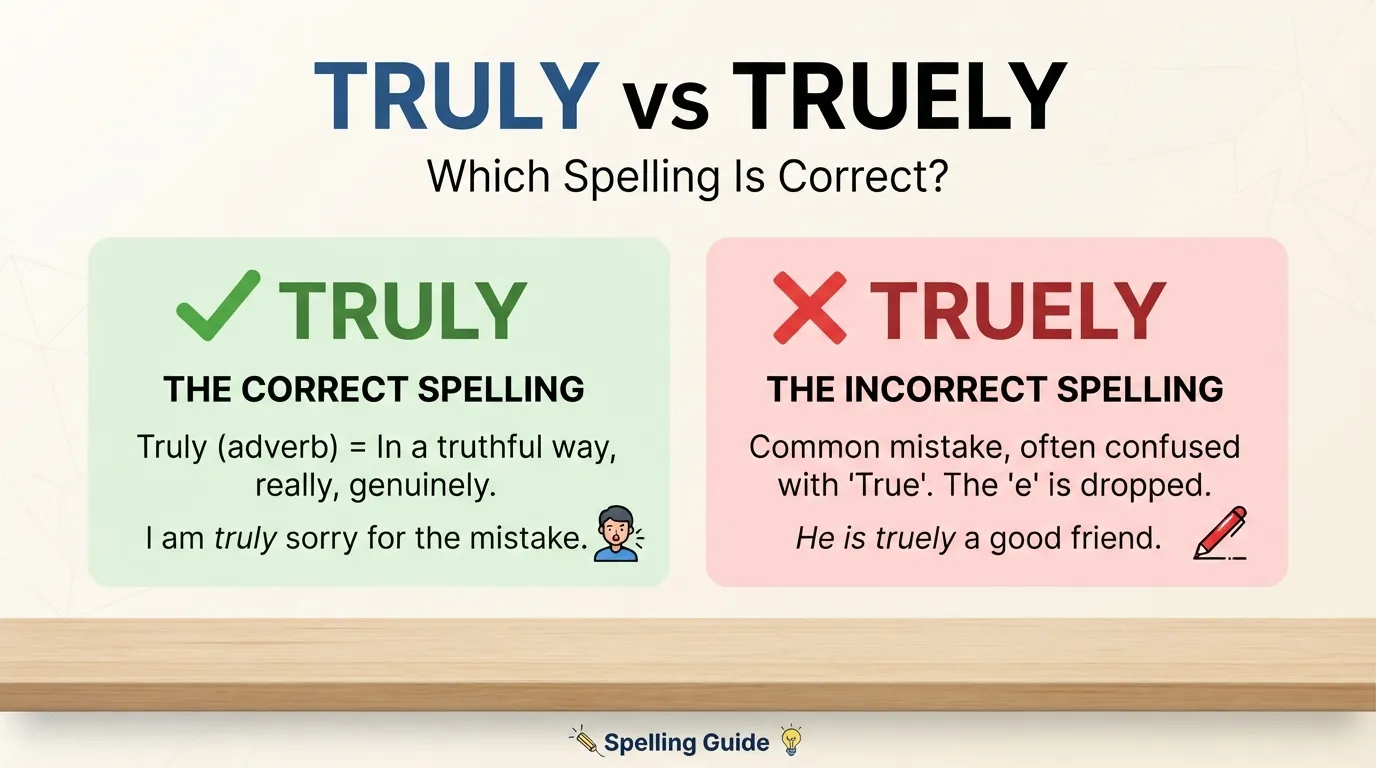
The thank-you note was perfect. Good paper, careful handwriting, a genuine message. “Thank you so much for the gift,” it read. “I truely appreciate it.” The writer had meant every word. The recipient felt every word. And one word was misspelled — the very word that was supposed to carry the sincerity. The correct spelling is truly. Truely is a misspelling. The error is one of the most common in English, and it happens because the word’s spelling breaks the pattern that its own parent seems to promise.
Truly is an adverb, one of the most used in the language. It means genuinely, sincerely, really, completely. “I truly appreciate your help.” “She truly believes in her team.” “It was a truly remarkable achievement.” The word shows up in thank-you notes, in wedding vows, in apologies, in recommendations, in every document where sincerity matters. Which is exactly why the spelling matters: a word that carries sincerity should not look uncertain about itself.
The Thank-You Note
Start with the sentence that goes wrong most often: “I truly appreciate it.” The writer knows the adjective true. The writer knows the adverb ending -ly. The writer puts them together — true + ly — and produces truely. The logic is flawless. The spelling is wrong. English, in this one word, does not simply glue the pieces together. It performs a small surgery first.
The surgery is this: when true becomes truly, the final E is removed before -ly is added. True minus E plus ly equals truly. The E that ends the adjective does not survive into the adverb. It is deleted, and the -ly attaches directly to the stem: tru + ly = truly.

This is the same silent-E rule that governs hundreds of English words. When a word ends in a silent E and you add a suffix beginning with a vowel, the E drops: make + -ing = making, shine + -y = shiny, love + -able = lovable. The suffix -ly begins with a consonant, not a vowel — so why does the E drop here? Because truly is an old, established exception to the exception: a handful of common -ly adverbs drop the E anyway, and truly is the most famous of them.
The family of E-dropping -ly adverbs is small but important: true → truly, due → duly, whole → wholly, gentle → gently, simple → simply, noble → nobly. In each case, the adjective ends in a silent E, and the adverb drops it. The pattern is consistent within its small family. Truely breaks the pattern by keeping an E that the family says to delete.
True + ly, Minus the E
Why does the hand want to keep the E? Because true is a word the hand knows deeply. It is one of the first adjectives a child learns, and it feels complete. Adding -ly to it feels like it should be simple addition: true + ly = truely. The hand resists deleting a letter from a word it trusts.
The resistance is understandable, and it is the entire error. English spelling does not work by addition alone. It works by transformation. The base word changes shape when a suffix arrives, and in the case of true, the change is the loss of the final E. The same transformation happens with due → duly and whole → wholly. Nobody writes dueley or wholely. Truely is the same kind of error, wearing a more familiar disguise.
There is a second force pushing toward truely: the pattern of regular -ly adverbs. Most adjectives form their adverbs by simple addition: quick → quickly, slow → slowly, careful → carefully, real → really. A writer who has formed a thousand adverbs by addition will apply addition to true without thinking. The habit is strong. The exception is stronger.
The fix is to file truly with its true family — the E-droppers — rather than with the addition family. True, truly. Due, duly. Whole, wholly. Three pairs, one rule, and the E is gone in all three.
Truly the Intensifier
Truly does two jobs, and knowing them helps you use the word well. The first job is sincerity: the word means “in a genuine, sincere manner.” “I truly appreciate your kindness.” “He truly regrets what happened.” “She truly believes in her team.” In this job, the word certifies the feeling. It says: this is real, not performed.

The second job is intensification: the word means “really, completely, to a high degree.” “It was a truly amazing experience.” “This is a truly remarkable achievement.” “They are truly happy together.” In this job, the word is an amplifier. It turns the volume up on the adjective that follows it. “Amazing” is strong; “truly amazing” is stronger.
The two jobs overlap, and the overlap is part of the word’s power. “I truly understand” can mean both “I sincerely understand” and “I completely understand.” The sentence carries both meanings at once, and the ambiguity is a feature, not a bug. Truly is one of the few intensifiers that adds sincerity along with force. “Really” adds force without sincerity. “Sincerely” adds sincerity without force. Truly adds both.
The word’s synonyms map onto the two jobs. For sincerity: sincerely, genuinely, honestly. For intensity: really, completely, absolutely. When you want both at once — sincerity and force — truly is the word, and no synonym replaces it exactly.
Yours Truly and Other Closings
Truly lives in a set of fixed phrases that every fluent writer should know. The most famous is the letter closing: “Yours truly.” “Yours truly, Maria.” The phrase means “I am sincerely yours,” and it has closed millions of letters, from job applications to fan mail. In American business writing, “Yours truly” is a standard formal closing, slightly warmer than “Sincerely.” In British writing, “Yours sincerely” is more common, and “Yours truly” carries a slightly old-fashioned or American flavor.
The phrase has also produced a noun: yours truly as a playful way to refer to oneself. “Yours truly will be handling the catering.” The joke is that the writer is signing off on their own sentence. It is informal, a little arch, and very much alive in spoken English.
Other fixed phrases: “truly yours” (a variant closing), “truly remarkable,” “truly sorry,” “truly grateful,” “truly amazing.” The word pairs naturally with adjectives of feeling and judgment, and in each pairing it does the same double job: sincerity plus force. “I am truly sorry” is stronger and more sincere than “I am sorry.” The adverb earns its place.
One caution: truly can sound formal or even stiff in casual conversation. “I truly like pizza” sounds more formal than “I really like pizza.” In texts and casual speech, really is usually the more natural intensifier. Save truly for the moments when sincerity is the point — the apology, the thank-you, the recommendation, the vow. The word is at its best when it means something.
Truly in Vows and Apologies
Two documents show truly at its most powerful: the wedding vow and the apology. In vows, the word certifies the promise: “I truly take you to be my partner.” “I truly promise to stand beside you.” The word does not add information. It adds weight. It says: this promise is real, and I mean it. A vow without truly is still a vow. A vow with it is a vow that has been underlined.
In apologies, the word does the same work. “I am truly sorry” is the strongest form of the apology in English — stronger than “I am sorry,” stronger than “I am very sorry,” because it adds sincerity to the force. The apologizer is not just saying the words. The apologizer is certifying that the feeling behind them is real. That is why “I am truly sorry” appears in formal apologies from public figures, companies, and institutions: the word carries a weight that no other intensifier matches.
The same logic applies to recommendations. “I truly recommend her” is stronger than “I recommend her,” because the writer is putting their own credibility behind the recommendation. The word says: I am not just going through the motions. I mean this. In every case — the vow, the apology, the recommendation — truly is doing its double job, sincerity plus force, and no synonym replaces it exactly.
The Lock-In
The memory hook is the family. True → truly. Due → duly. Whole → wholly. Three adjectives that end in a silent E, three adverbs that drop it. If you can spell duly and wholly — and almost everyone can — you can spell truly, because it follows the same rule.

And one final check for the keyboard: when the word appears in your draft, look at the middle. If you see ue — truely — the E is an intruder. Delete it. Tru + ly = truly. The thank-you note, the apology, the recommendation — they all deserve the word spelled the way it has been spelled for centuries. Truly.











