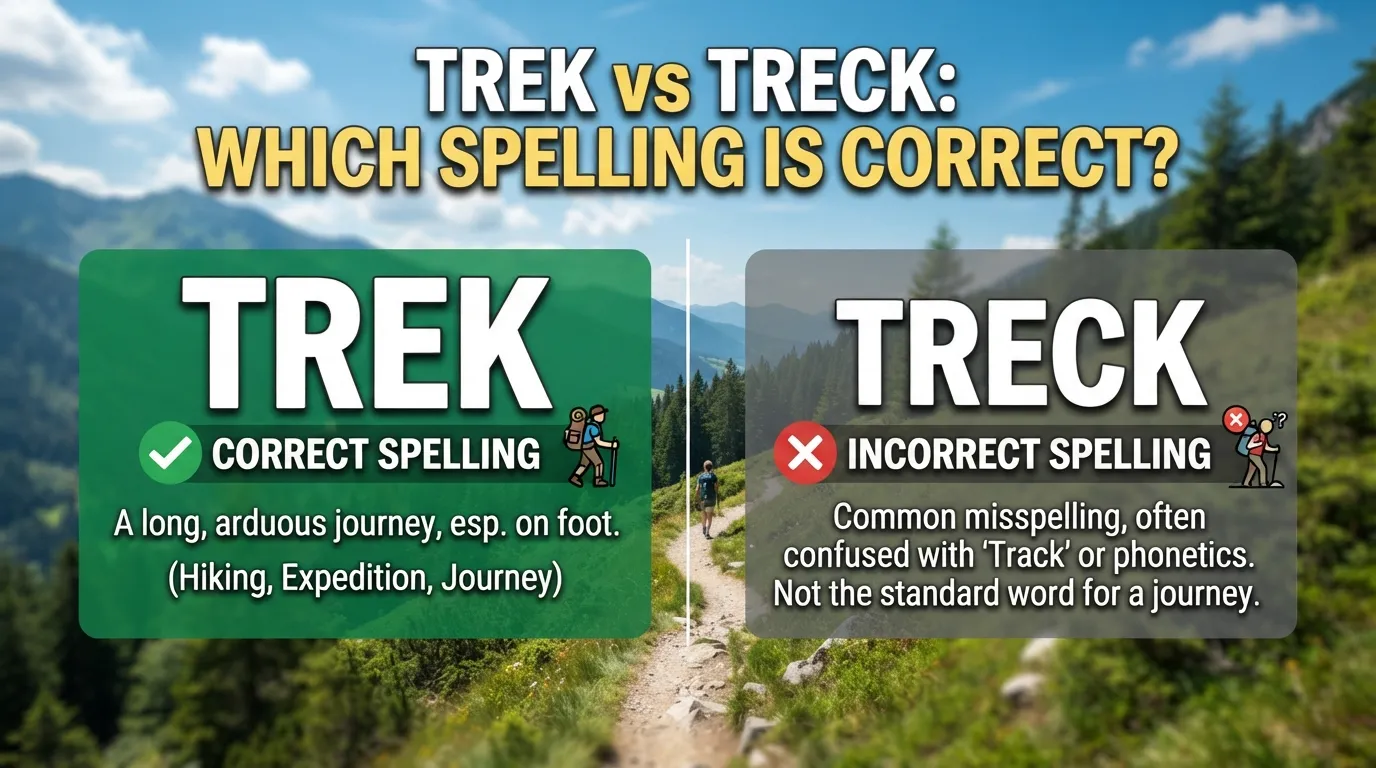
Day one: “Walked eight miles. Feet fine. Morale high.” Day three: “Rain all day. Boots soaked. Still moving.” Day six: “Reached the pass at noon. The valley below looked like the end of the world and the beginning of it.” The hiker’s journal tells the story of a trek — a long, difficult journey, usually on foot, through country that does not make it easy. The word is short, tough, and — for many writers — strangely hard to spell. The temptation is to add a C and write treck. The correct spelling is trek. Treck is a misspelling. The reason is a long walk through South African history, a Dutch verb, and a family of -eck words that have nothing to do with it.
Trek is both a noun and a verb. As a noun: “a long trek through the mountains.” As a verb: “We trekked across the valley.” In both jobs, the spelling is the same: t-r-e-k. No C. The C belongs to a different family of words, and the confusion between the families is the entire error.
Journal, Day One
Start with what the word means, because the meaning carries the history. A trek is not just a walk. It is a long, demanding journey, usually on foot, often through difficult terrain — mountains, deserts, jungles, wilderness. “The mountain trek took six hours.” “Their desert trek lasted several days.” “It is a long trek from the station to the village.” The word implies effort, distance, and endurance. A stroll is not a trek. A commute is not a trek. A trek is the kind of journey you write about afterward.
As a verb, trek means to make such a journey: “We trekked through the jungle.” “They trekked across the valley.” “She treks several miles to work each day.” The verb carries the same sense of effort. You do not trek to the corner store. You trek to somewhere far, hard, or both.

The word also has a modern, broader sense: any long, tiring journey, even a metaphorical one. “The trek through airport security took an hour.” “The team’s trek to the championship took a decade.” This sense is looser, often humorous, and very common in everyday speech. The journey does not have to involve boots. It just has to feel long.
And there is a third sense, the one that gives the word its second life in popular culture: the journey into the unknown, the expedition, the voyage. “Star Trek” — the most famous use of the word in the world — plays on exactly this sense. We will come back to the starship.
From Trekken to Trek
The word came into English through South Africa, and the route matters. In the 1800s, Dutch-speaking settlers — the Boers, later the Afrikaners — undertook the Great Trek, a mass migration inland from the Cape Colony, traveling by ox wagon across hundreds of miles of difficult country. The Afrikaans word for the journey was trek, from the Dutch verb trekken, meaning “to draw” or “to pull” — as in pulling a wagon, drawing a load.
English speakers in South Africa adopted the word, and it spread through the British Empire with the stories of the migration. By the late nineteenth century, trek was established in English as the word for a long, hard overland journey. The spelling it brought with it was the Dutch-Afrikaans spelling: trek, with a K and no C.
This history explains the spelling completely. Trek is not an English word that grew out of English sound patterns. It is a borrowed word that kept the spelling of its donor language. The K at the end is Dutch. The absence of the C is Dutch. The word looks the way it does because it came from somewhere else, and it kept its passport.
It also explains why the word feels different from its neighbors. English words that end in the /k/ sound usually spell it -ck: check, deck, neck, wreck, pack, back. Trek breaks this pattern, and the break is the point. The word is a foreigner, and it kept its foreign spelling.
The Verb That Doubles
Here is the twist that confuses even careful writers. The base word is trek, with one K. But the past tense and the -ing form double the K: trekked, trekking. “We trekked across the valley.” “She is trekking through Nepal.” The doubling follows the standard rule for one-syllable words ending in a single consonant after a single vowel: double the consonant before a vowel suffix. Run → running. Stop → stopped. Trek → trekked, trekking.

This doubling is correct, and it is the one place where the word gets an extra letter. But the extra letter is a K, not a C. Trek never gains a C in any form. Treck, trecked, trecking — all wrong, in every tense, in every context.
The noun has its own forms. The plural is treks. The compound trekker names a person who treks — originally a Boer migrant, now any long-distance hiker. “The trekkers reached base camp at dusk.” The K holds steady through the whole family, doubling only before vowel suffixes, and never, ever becoming a C.
There is a useful contrast with the -eck family. Check → checked, checking — no doubling, because the word already ends in two consonants. Trek → trekked, trekking — doubling, because the word ends in one consonant. The two families behave differently in every form, and the difference starts with the C that trek does not have.
Star Trek and the Word’s Second Life
No account of trek is complete without the starship. When Gene Roddenberry named his 1966 television series Star Trek, he was borrowing the word’s sense of a long, difficult journey into the unknown and pointing it at space. The show’s mission — “to explore strange new worlds, to seek out new life” — is a trek in the oldest sense: a journey through country that does not make it easy, with no promise of return.
The show gave the word a second life. Before Star Trek, the word belonged mostly to hikers, historians, and South Africans. After it, the word belonged to everyone, and the spelling trek became one of the most recognized in English. The show’s title is also a useful spelling anchor: it is Star Trek, not Star Treck. If you can spell the show, you can spell the word.
The show also produced a verb of its own: to trek as a fan activity, and Trekkie / Trekker as names for fans. The fan community debated the two labels for years — Trekkie as the playful term, Trekker as the serious one. Both spellings keep the K. Neither has a C. Even in fandom, the spelling holds.
Beyond the starship, the word appears in place names and phrases: the Great Trek (the historical migration), the Kokoda Track trek, the Inca Trail trek, “trekking poles,” “trekking boots,” “a trek through the Himalayas.” In every case, the spelling is the same, and the C never appears.
The Trekker’s Kit
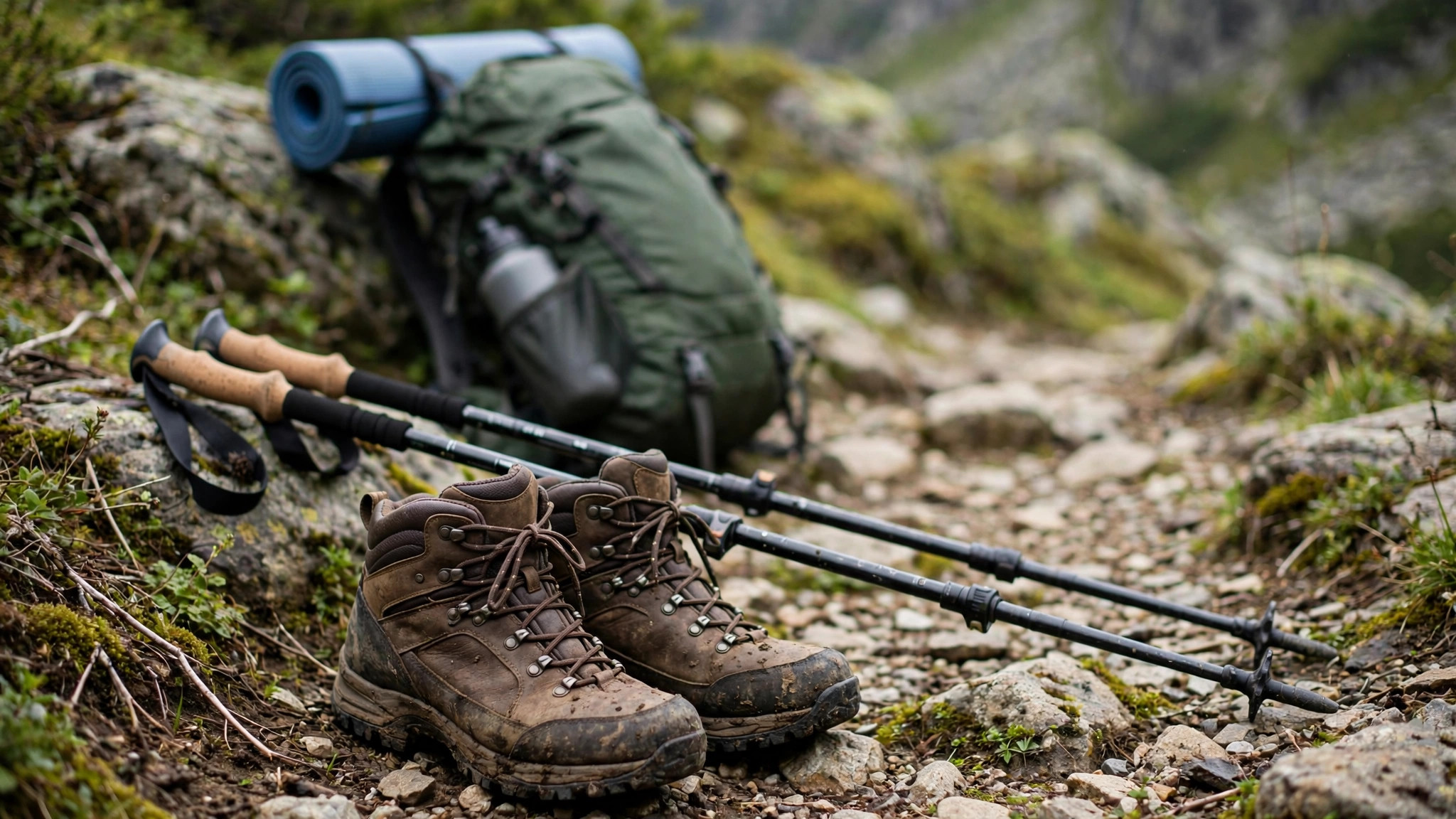
Every trek has a kit, and the kit has its own vocabulary. Trekking poles — the paired sticks that take weight off the knees on steep descents. Trekking boots — stiff, high-ankled, broken in over weeks, never new on the day of the trek. A trekking map — the route, marked with camps and water sources. A trekking permit — the paper that lets you walk in restricted country, from Nepal’s Annapurna region to America’s national parks.
The kit also includes the word’s relatives. A trekker is a person who treks. A trekking company organizes treks. A trekking season is the window when a route is passable — after the monsoon, before the snow. The vocabulary is practical, unglamorous, and precise, the way the vocabulary of any serious pursuit is precise. Nobody packs a trekking kit by accident.
There is a lesson in the kit for the spelling, too. The gear is named with the same K as the journey: trekking poles, trekking boots, trekking maps. The K doubles before the -ing, and the C never appears. The kit and the journey spell the word the same way, because they are the same word, doing the same job, on the same trail.
The -eck Trap
So why does the hand write treck? Because of the neighbors. English is full of words ending in -eck: check, deck, neck, wreck, speck, peck. All of them have a short E and a final /k/ sound, and all of them spell it with CK. A writer who hears the /k/ at the end of trek reaches for the familiar pattern and adds the C. The guess is reasonable. It is also wrong, because trek is not from the -eck family. It is from the Dutch family, and the Dutch family spells it with a K alone.
The memory hook is the journey itself. Trek came from far away — from South Africa, from Dutch, from a migration across a continent. It kept its foreign spelling the way a traveler keeps a passport. The -eck words are locals. Trek is the visitor. When the word appears in your draft, ask where it came from. If it came from the Dutch trekken, it is spelled with a K. The C belongs to the locals. The traveler kept the K.
And one final check: if you see treck in your draft, delete the C. Trek. One K, no C, every time — whether you are walking the mountains, watching the starship, or writing about either one.











