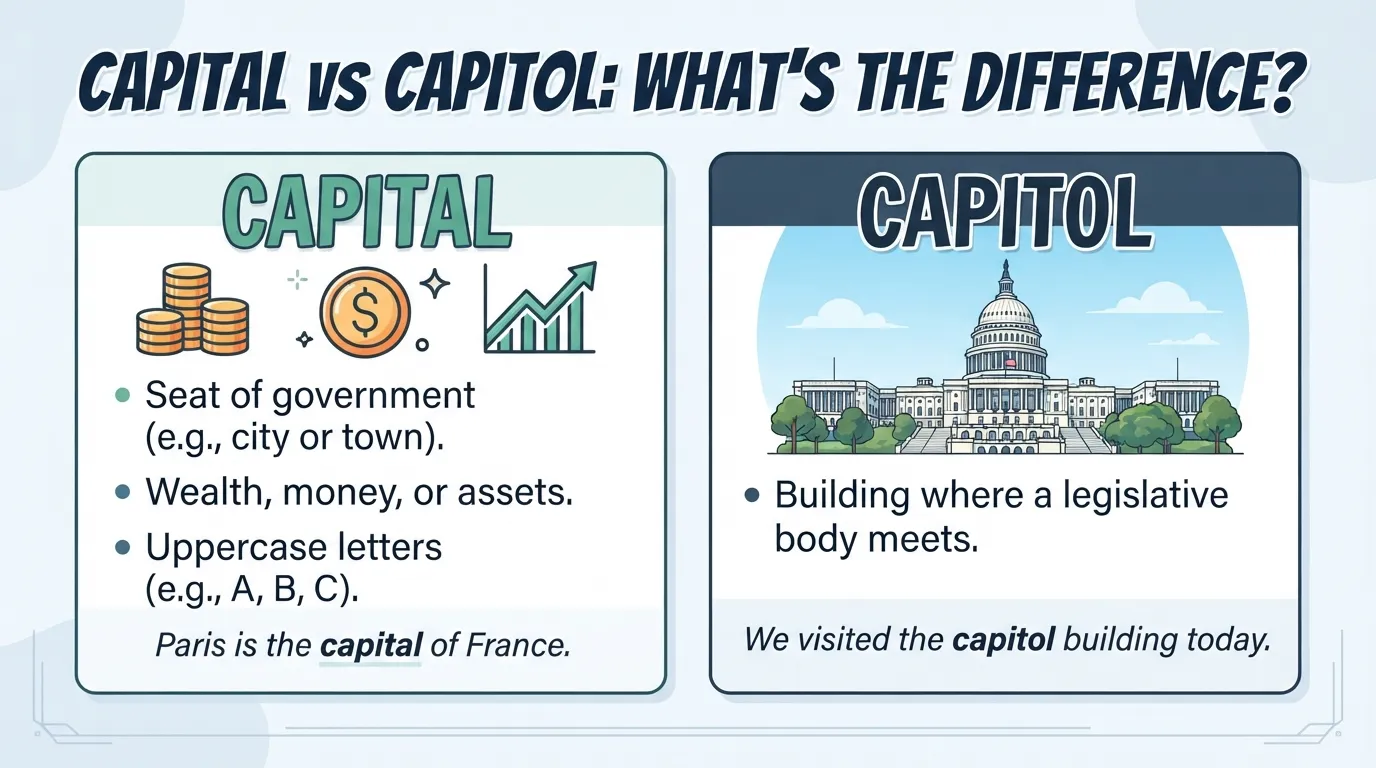
The tour guide pauses at the corner of Congress Avenue and points up the hill. “Austin is the capital of Texas,” she says. “And that building up there — the one with the dome — is the Texas Capitol.” Half the group nods. The other half reaches for their phones, because the two words just sounded identical, and they are not sure which spelling goes with which thing. The guide smiles. She has given this tour a thousand times. The answer is a walk, a dome, and one letter.
Capital and capitol are both correct English words. They sound alike, they look alike, and they are not interchangeable. Capital is the general word with several meanings. Capitol has one job: it names a government building where a legislature meets. The capital is the city. The Capitol is the building. Once you have walked the tour, you will never mix them up again.
A Walk Through Austin
Start at the river and walk uphill toward the pink granite building with the dome. Everything on the walk is the capital: the capital city, Austin, where the government of Texas is based. The restaurants, the university, the traffic, the bats under the bridge — all of it sits inside the capital. The word describes a place, a city, a seat of government.
Arrive at the building itself, and the word changes. The Texas State Capitol is the building where the legislature meets. It has a dome, a rotunda, chambers, offices, and a gift shop. It is one specific structure. You can point at it. You can walk inside it. You can take a photograph of it. The capital is a city you live in. The Capitol is a building you visit.

The same split holds in Washington, D.C. The city is the capital of the United States. The building where Congress meets is the U.S. Capitol, spelled with a capital C, because it is a proper name. “Congress meets in the Capitol.” “Washington is the capital.” Two words, two jobs, one city.
And the split holds in every state. Sacramento is the capital of California; the California State Capitol is the building in Sacramento where the legislature meets. Albany is the capital of New York; the New York State Capitol is the building. The pattern is perfectly regular: the city is the capital, the building is the capitol. If you can point at it, it is probably the capitol. If you live in it, it is the capital.
Capital Wears Four Hats
Capital is a busy word. It wears at least four hats, and all four are common.
Hat one: the city. The capital is the city where a government is based. “Paris is the capital of France.” “Canberra is the capital of Australia.” “The capital moved to the new city in 1960.” This is the most familiar sense, and the one that gets confused with capitol.
Hat two: money. In finance and business, capital means wealth, assets, or funds used to start or run something. “The company needs more capital.” “Venture capital.” “Capital investment.” “Human capital.” This sense comes from the Latin caput, meaning head — the head of a sum, the principal amount. It has nothing to do with buildings.
Hat three: the letter. A capital letter is an uppercase letter: A, B, C. “Start the sentence with a capital.” “Write your name in capitals.” This sense also comes from caput, head — the letter at the head of the alphabet’s two forms, the big one.
Hat four: the serious offense. In law, capital means punishable by death or extremely serious: “a capital crime,” “capital punishment,” “a capital offense.” This sense comes from the same Latin root — the head, the life. A capital crime is one that costs a head.

Four hats, one word, one spelling: C-A-P-I-T-A-L. The A in the middle is the letter to remember. Capital has an A. Capitol has an O. The A belongs to the general word. The O belongs to the building. We will come back to the O, because the O is the whole trick.
Capitol Has One Job
Capitol has exactly one meaning: a building where a legislature meets. “The legislature meets in the capitol.” “The protesters gathered on the capitol steps.” “The capitol dome was restored last year.” It is always a building. It is never a city, never money, never a letter, never a crime.
The word comes from the Capitoline Hill in Rome, one of the city’s seven hills, where the temple of Jupiter stood. The Romans called it Capitolium. When the United States needed a name for its legislature’s building, it borrowed the Roman word, and the borrowing stuck. Every state capitol in America is named after that hill, and after the building in Washington that was named after it.
Here is the practical rule: if you are writing about a building with a dome where lawmakers meet, the word is capitol. If you are writing about anything else — the city, the money, the letter, the crime — the word is capital. The building is the only thing that gets the O.
One more detail: Capitol is capitalized when it names a specific building — the U.S. Capitol, the Texas Capitol — and lowercase when it names capitols generally. “The state capitol is open to visitors.” “We toured the Capitol yesterday.” The capitalization follows the same rule as any proper noun: specific building, capital C; general category, lowercase.
The Dome Test
Here is the memory hook, and it is built into the spelling. Capitol has an O in it. A dome has an O in it. The building with the dome gets the O. Capital has an A in it, and the A belongs to everything else — the city, the money, the letter, the crime. Dome = O = capitol. Everything else = A = capital.

Run the test on a sentence. “The capital of Texas is Austin.” No dome in the sentence — the city, the A word. “The Texas Capitol has a pink granite dome.” Dome in the sentence — the O word. “She raised capital for her startup.” No dome, no building — the A word. “The capitol dome was lit at night.” Dome — the O word. The test works every time, because the O and the dome belong together.
There is a second hook for the finance sense, if you need one. Capital with an A is about money, and money is measured in amounts — amount also has an A. The A words travel together. But the dome test is the one that settles the building question, and the building question is the one that causes nearly all the errors.
Capital Punishment and Other Grave Phrases
The fourth hat of capital deserves a closer look, because it is the one most likely to appear in serious writing. Capital punishment means the death penalty — punishment that costs a life, a head. A capital crime is a crime punishable by death. A capital offense is the same idea in legal language. A capital case is a trial where the death penalty is on the table. All of these use the A spelling, and all of them trace back to the Latin caput, the head.
The sense extends beyond the law. A capital mistake is a serious, possibly fatal error — “a capital mistake in the surgery,” “a capital mistake in the negotiation.” Capital here means grave, fundamental, of the highest importance. The phrase is old-fashioned but still current, especially in British writing. It is the same word, the same root, the same spelling: the head, the life, the thing that matters most.
Note the contrast with the building. A capital case is tried in a courtroom. The courtroom may sit inside a capitol building. The case is capital, with an A. The building is the capitol, with an O. The sentence “The capital case was heard in the capitol” is correct, and it contains both words, spelled differently, doing different jobs, side by side. The dome test handles it: the building gets the O, the case gets the A.
Capital Letters and the Capitol
Two final notes, because they cause their own confusion. First, the phrase “capital city” is never “capitol city.” The city is always the capital. “A capital city.” “The nation’s capital.” If you write “capitol city,” you have put the building where the city belongs.
Second, the adjective capital appears in phrases that have nothing to do with government: “a capital idea” (an excellent idea, chiefly British), “capital gains,” “capital goods,” “capital markets.” All of these use the A spelling, because they are all using the general word. The O spelling appears in exactly one family of phrases: the capitol building, the capitol dome, the capitol steps, the capitol rotunda, the capitol grounds. If the phrase names a part of the building, it is the O word. If it names anything else, it is the A word.
So the next time the tour guide points up the hill, you will know. The city you are standing in is the capital. The building with the dome at the top of the hill is the Capitol. The O belongs to the dome, the A belongs to everything else, and the walk from one to the other is the shortest grammar lesson in American English.











