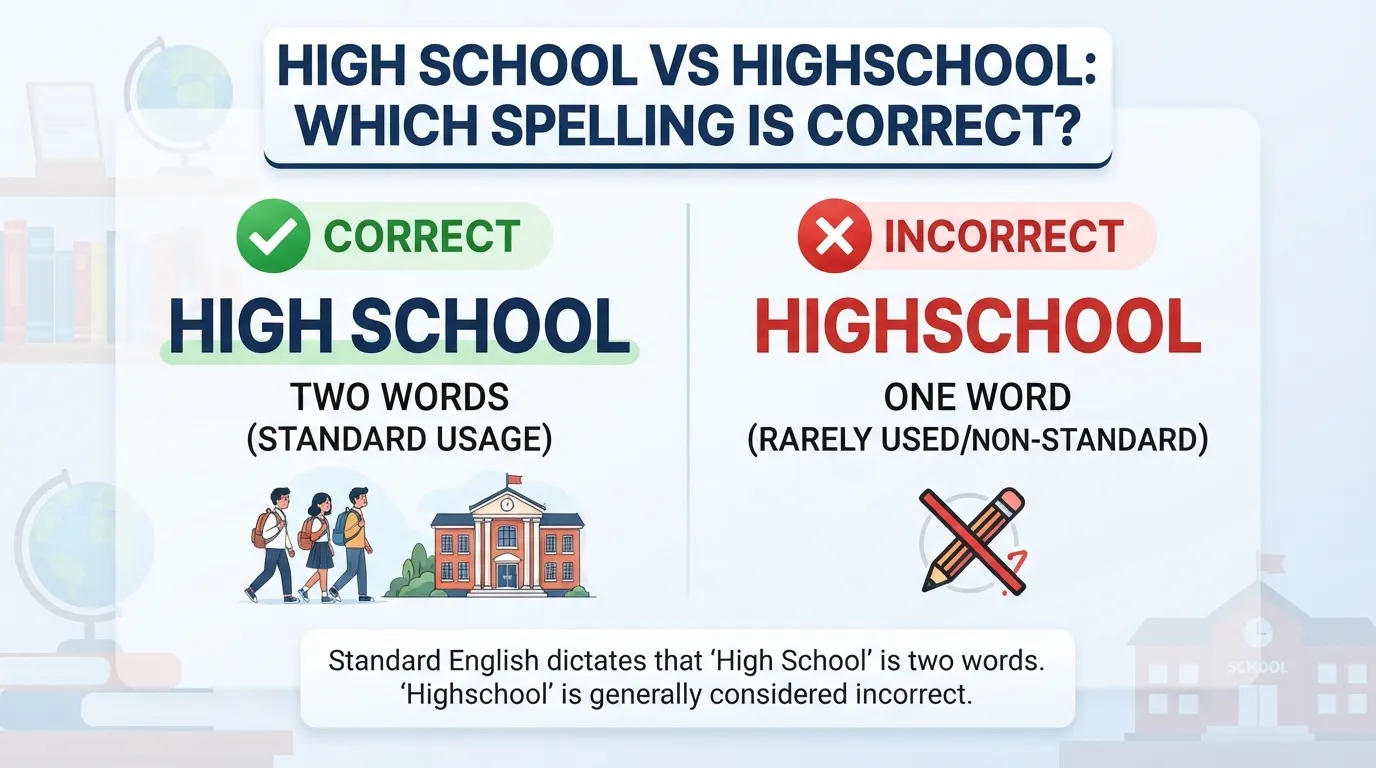
The reunion invitation arrived in the mail, printed on good card stock. “Class of 2006 — Twenty-Year Reunion,” it read. “Join your fellow highschool alumni for an evening of memories.” Half the class smiled. The other half winced, because the invitation had misspelled the very thing they were reuniting to celebrate. The correct spelling is high school — two words. Highschool, written as one word, is a misspelling. The space between the words is not decoration. It is the spelling.
High school is a noun phrase naming a school that provides education after middle school — in the United States, typically grades 9 through 12 — and, by extension, the period of life spent attending such a school. “My daughter starts high school next year.” “He is a high school teacher.” “We met in high school.” In every sentence, the phrase is two words, and the space stays.
The Reunion Flyer
Start with the flyer, because the flyer shows every form of the word in one place. “High School Reunion” — the school, two words. “High school alumni” — the graduates, two words. “High school sweetheart” — the old flame, two words. “High school diploma” — the document, two words. The phrase appears four times on a good flyer, and every time it is two words.
The misspelling highschool appears for a simple reason: the phrase feels like one thing. High school is a single institution, a single stage of life, a single idea. The mind, which thinks in ideas, wants to write it as one word. The hand obliges. The result looks natural — and it is wrong, because English compound nouns do not fuse just because they name one thing. Middle school is two words. Elementary school is two words. Graduate school is two words. Law school, medical school, business school — all two words. High school belongs to this family, and the family keeps its spaces.

There is a second reason the misspelling persists: the internet. Search engines, hashtags, and usernames reward single words. #highschool is a hashtag. “Highschool” is a username. Social media compresses phrases into single tokens, and the compression leaks into ordinary writing. A hashtag is not a spelling lesson. It is a filing system, and filing systems do not care about spaces.
The rule is simple and absolute: in standard English, high school is two words. No exception, no context where the fused form is correct. The flyer, the essay, the résumé, the email — all of them want two words.
Why the Space Stays
English compounds move through a lifecycle: open (two words), hyphenated (two words joined by a hyphen), closed (one word). Web site became web-site became website. Electronic mail became e-mail became email. High school has not moved. It is still in the open stage, and it has been there for over a century.
Why? Because the phrase is transparent. Both parts are visible and meaningful: high (advanced, upper) + school (a place of learning). The phrase does not need fusion to be understood, because its parts already explain it. Compounds fuse when their meaning drifts away from their parts — when butterfly stops being about butter and flies, or when website stops being about webs and sites. High school never drifted. It still means exactly what its parts say: a school that is high — advanced, upper-level. The space stays because the meaning stays clear.
There is also a practical reason. High school is a phrase that appears in official names: “Roosevelt High School,” “Lincoln High School.” Official names preserve the open form, and the open form in official names anchors the open form everywhere else. A word that lives on a thousand school buildings is not going to fuse in a hurry.
Compare the cousins that did fuse. Preschool is one word. Playschool is one word. Kindergarten is one word. These fused because they entered English as single concepts — preschool as a stage before school, kindergarten as a German borrowing that arrived whole. High school entered as a phrase, and it stayed a phrase. The difference is history, not logic, and history is the whole answer.
When the Hyphen Appears
There is one form where a hyphen does appear, and it confuses writers. When high school is used as an adjective before a noun, it is often hyphenated: “a high-school student,” “a high-school diploma,” “high-school football.” The hyphen links the two words into a single adjective, so the reader knows they work together to modify the noun.

The rule is the standard one for compound adjectives: hyphenate before the noun, leave open after it. “She is a high-school student” (before the noun, hyphenated). “She is in high school” (after the verb, open). “A high-school teacher” (before, hyphenated). “He teaches high school” (after, open). The hyphen is a piece of punctuation, not a spelling change. It does not fuse the words. It links them temporarily, for one sentence, and then lets them go.
Note the caution: not every style guide hyphenates compound adjectives before a noun, and some modern guides are relaxing the rule. But no style guide fuses high school into highschool. The hyphen is optional in some styles. The space is mandatory in all of them.
One more hyphenated form: high-schooler, the informal noun for a high school student. “The high-schoolers took over the diner after the game.” The hyphenated form is the more common spelling, though high schooler (open) also appears. Both are informal. In formal writing, “high school student” is the safer choice. And in no register, formal or informal, is highschooler correct.
High Schooler and Friends
The phrase has a small family of related forms, and they all keep the space. High school student — the standard noun. High school teacher — the standard noun. High school diploma — the standard noun. High school reunion — the standard noun. High school sweetheart — the standard noun. In every case, the phrase stays open.
The informal family: high schooler (a student), high schoolish (resembling high school, usually critical: “high schoolish drama”), high school dropout (a person who left before graduating). All informal, all keeping the space or the hyphen. The fused forms — highschooler, highschoolish — do not exist in standard English.
There is also the verb phrase: “to go to high school,” “to attend high school,” “to graduate from high school.” The verb phrases keep the space too. And the abbreviation: “HS” for high school, as in “HS diploma” or “HS football.” The abbreviation is informal, mostly used in notes and texts, and it sidesteps the spelling question entirely — which is sometimes the smartest move.
The High School Years
High school is not just a place. It is four years, and each year has a name. Freshman — the first year, grade 9, the year of getting lost and finding the cafeteria. Sophomore — the second year, grade 10, from the Greek for “wise fool,” a name that has described tenth graders accurately for centuries. Junior — the third year, grade 11, the year of college tests and driver’s licenses. Senior — the fourth year, grade 12, the year of graduation, prom, and leaving.
The four names are a small map of the experience. Freshmen learn the building. Sophomores learn the system. Juniors learn the stakes. Seniors learn to leave. The words are old — freshman and sophomore come from university language, borrowed down to the high school level — and they are used in every American high school, in every state, in every variety of English. The phrase high school carries all four years inside it, and the space stays through all of them.
There is also the word for the whole span: high schooler is the informal noun for any student in those four years, and high school years is the phrase for the period itself. “The high school years are the most memorable of my life.” “She was a high schooler when she wrote that.” In every form, the phrase keeps its space, and the years keep their names.
School Around the World
One reason the spelling question matters is that high school is an American phrase, and the rest of the English-speaking world uses different words for the same stage. In Britain, the equivalent is secondary school, or, for the final two years, sixth form. In Australia and New Zealand, high school is used, but secondary school is also common. In Canada, high school is standard, just as in the United States.

The international comparison is useful because it shows that the open form is not an American quirk. Secondary school is two words. Middle school is two words. Primary school is two words. The whole family of school phrases keeps its spaces, in every country, in every variety of English. The space is not a national habit. It is a feature of the phrase family.
And the final check is the simplest one in this whole article. When the phrase appears in your draft, look for the space. If the words are fused — highschool — split them. High school. Two words, one school, and the reunion invitation will be correct.











