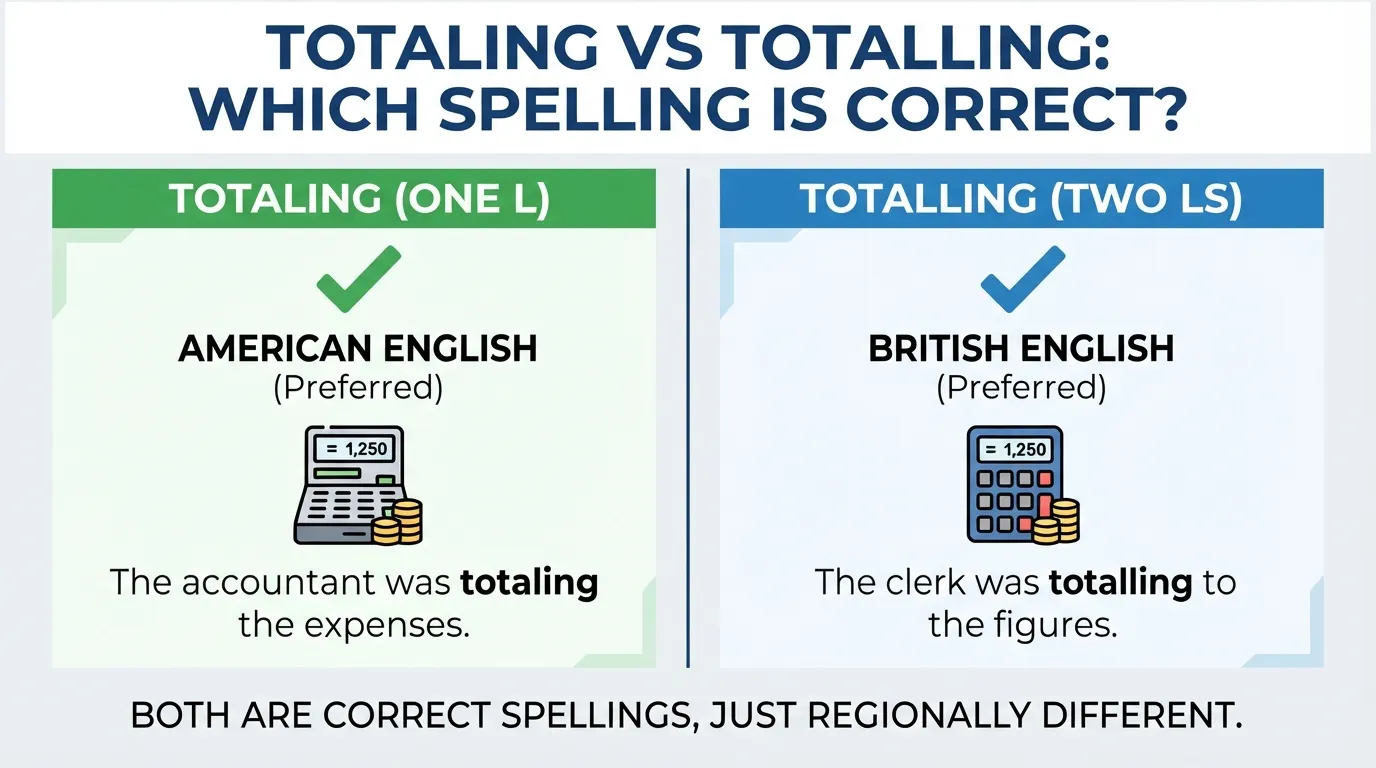
The accountant stared at the spreadsheet. The formula was right, the figures were right, and the word at the top of the column was wrong — or was it? “The expenses are totaling $2,000” in an American report. “The expenses are totalling £2,000” in a British one. Both sentences say the same thing. Both spellings are correct. The difference is a single L, and the L is decided not by the numbers but by the audience.
Totaling and totalling are both correct spellings of the -ing form of the verb total — to add numbers together, or to amount to a particular figure. American English uses totaling. British English generally uses totalling. Neither is a mistake. The choice is a matter of spelling system, and the system you follow should match your reader.
The Ledger’s Two L’s
Start with what the word does. Totaling means adding amounts together to find their total, or amounting to a particular quantity. “The three invoices are totaling $1,250.” “The repairs are totaling nearly $4,000.” “She spent the afternoon totaling the receipts.” In each sentence, the word describes figures adding up to a sum. The same is true of totalling: “The costs are totalling £5,000.” “We are totalling the figures before submitting the report.” Same verb, same meaning, one extra letter.
The word can function as a present participle — “We are totaling the expenses now” — or as a gerund — “Totaling the receipts took all afternoon.” It can also describe a sum reached: “The donations are totaling $10,000.” In all of these, the spelling question is identical, and the answer is the same: match your audience’s system.
One common misunderstanding is worth clearing up immediately. The currency does not decide the spelling. A British writer totaling dollars still writes totalling. An American writer totaling pounds still writes totaling. The dollar sign and the pound sign in the examples above are coincidences of the usual contexts, not rules. The spelling follows the writer’s English, not the money’s origin.

The Unstressed Syllable Rule
The reason for the split lies in how the two spelling systems handle a specific pattern: a verb ending in a consonant after an unstressed vowel, when adding -ing or -ed. Say total aloud: TO-tal. The stress falls on the first syllable. The final syllable, -tal, is unstressed — it is pronounced quickly, with a soft, reduced vowel.
American English applies the doubling rule strictly: double the final consonant only when the stress falls on the final syllable. Total has its stress on the first syllable, so the L stays single: totaling, totaled. The same rule gives traveled (TRAV-eled), canceled (CAN-celed), labeled (LA-beled), and modeled (MOD-eled) in American English. Contrast admit (ad-MIT, stress final) → admitted, and begin (be-GIN) → beginning. When the stress is final, both systems double. When it is not, they diverge.
British English doubles more generously. In the British system, a final consonant after a short vowel is often doubled even in an unstressed syllable — which is why British English has travelled, cancelled, labelled, modelled, and totalling. The doubled letter signals to the reader that the vowel stays short, and the British system values that signal even when the syllable is unstressed. Neither system is wrong. They are two answers to the same question: how much spelling should do the reader’s work?

The Whole Family of L’s
Totaling/totalling is not an isolated case. It belongs to a family of verbs that split the same way across the Atlantic, and learning the family makes each member easier.
- Total: American totaling, totaled — British totalling, totalled.
- Travel: American traveling, traveled — British travelling, travelled.
- Cancel: American canceling, canceled — British cancelling, cancelled.
- Label: American labeling, labeled — British labelling, labelled.
- Model: American modeling, modeled — British modelling, modelled.
The pattern is perfectly regular within each system: pick a system, and every member follows. The practical consequence is that your choice for totaling commits you to choices for the whole family. A document that writes totaling should also write traveled and canceled. A document that writes totalling should also write travelled and cancelled. Mixed systems — totaling on one page, travelled on the next — look unedited, even though every individual spelling is correct somewhere.
There are exceptions and complications, as there always are in English. American English keeps the double L in controlled and compelled, because those verbs have final-syllable stress (con-TROL, com-PEL). And words ending in -ll already, like install or distill, keep both L’s in both systems. But for the -al family — total, travel, cancel, label, model — the Atlantic split is clean and reliable.
Totaling in Financial Writing
Financial writing is where totaling appears most often, and it is also where consistency matters most. Invoices, receipts, expense reports, audit summaries, and damage assessments all use the word to report sums: “The losses are totaling millions of dollars.” “The damages are totalling several thousand pounds.” “The votes are totalling more than expected.” In each case the word is doing a precise job — reporting an amount — and the spelling should be as precise as the arithmetic.
In a financial document, the spelling system is usually set by the organization, not the writer. A company reporting under US standards writes totaling. A company reporting under UK standards writes totalling. A multinational company picks one and states it in its style guide. The individual writer’s job is not to choose the system but to follow it — and to notice when a copied paragraph from another system has smuggled in the other spelling. Copy-paste is the most common source of mixed systems in financial documents, and a quick search for “lling” and “lled” will catch most of the strays.
The past tense follows the same split: American totaled, British totalled. “The costs totaled $500” and “The costs totalled £500” are the same sentence in two systems. And the noun total itself never changes — the total is spelled identically in both systems. Only the suffixed forms split, which is why the split is so easy to miss: the base word looks the same everywhere, and the difference appears only when you add an ending.

Totaling in Everyday Life
Finance is not the only place where totaling appears. Sports writing uses it constantly: “The team’s points are totaling 75.” “The quarterback’s yards are totaling over 300.” Elections use it: “The votes are totalling more than expected.” Crowd reports use it: “Attendance is totaling 40,000 across the weekend.” Charity drives use it: “Donations are totaling $10,000 and climbing.” In each case, the word reports a running sum — a number that is still growing, or one that has just been reached.
The everyday uses share a feature with the financial ones: the sum is the news. Nobody writes “the donations are totaling” to describe a static figure. The word carries a sense of accumulation — numbers climbing toward a total, or arriving at one. That is why the -ing form is so common with this verb. Total as a finished noun (“the total is $500”) reports a result. Totaling as a participle reports a process: the adding-up itself, still underway or just completed. The spelling follows the same rule in every context, whether the numbers are dollars, votes, points, or people.
The Total Family
Total is a versatile word, and the -ing form is only one member of its family. As a noun, total names a sum: “The total comes to $500.” As an adjective, it means complete or entire: “a total disaster,” “total silence,” “total control.” As a verb, it means to add up or amount to: “Please total the expenses.” The adverb totally means completely: “I totally agree.” The noun totality means the whole of something: “the totality of the evidence.”
None of these other forms split across the Atlantic. Total, totally, and totality are spelled the same in American and British English. Only the -ing and -ed forms diverge, because only they trigger the doubling rule. That is worth remembering when proofreading: if you see totally with one L in a British document, it is not an error — it is the standard spelling everywhere. The Atlantic split is narrow, and it applies only where the doubling rule reaches.
Match the System, Then Forget It
When the word appears in your draft, ask one question: whose English am I writing? American — one L: totaling, totaled. British or Commonwealth — two L’s: totalling, totalled. Then apply the same answer to the whole family — traveling/travelling, canceling/cancelling, labeling/labelling — and the document will read as if it was written by one hand, in one system, on one side of the Atlantic. The arithmetic takes care of the numbers. The system takes care of the L’s.