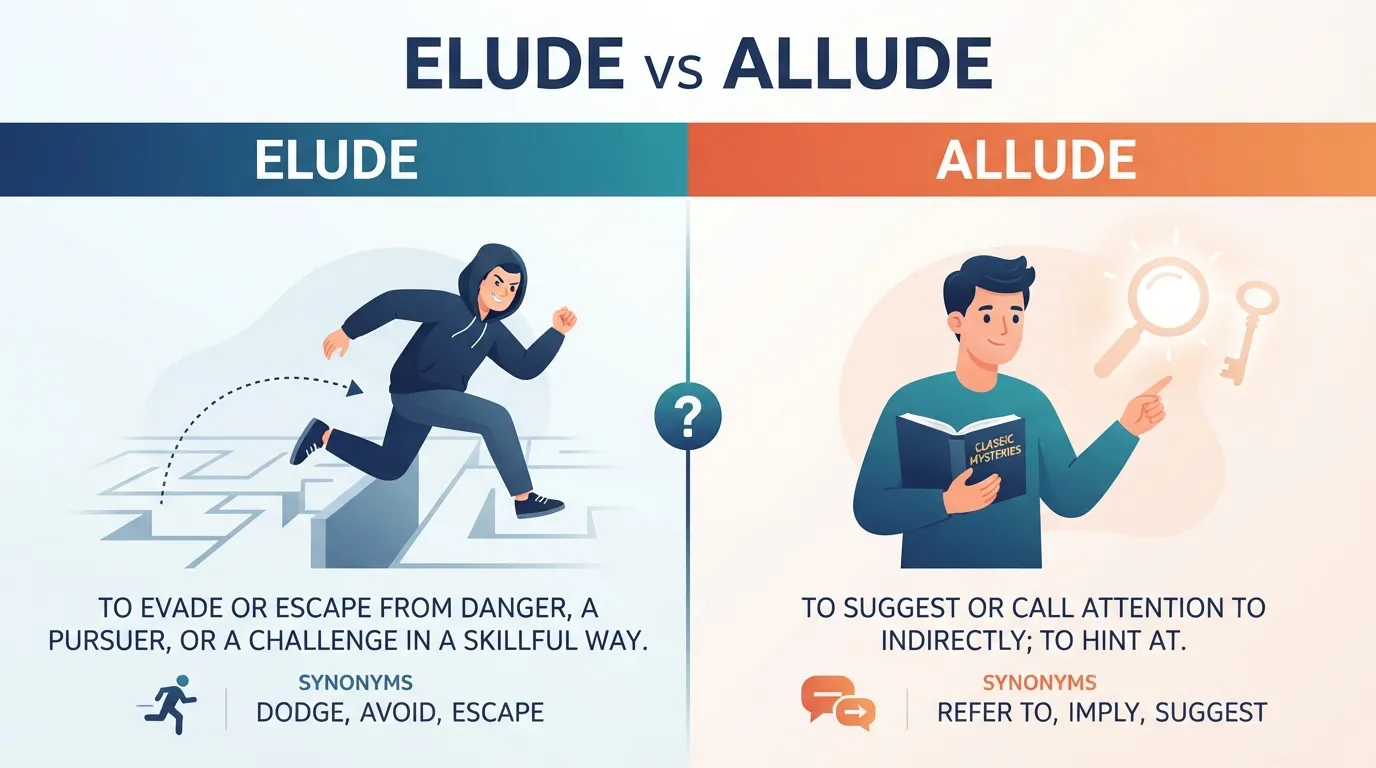
The detective had two problems. The suspect kept eluding the police — slipping out of the building before the patrol car arrived, vanishing into crowds, always one step ahead. And the witness kept alluding to a secret — mentioning “the arrangement” and “what happened last spring” without ever saying what she meant. The suspect escaped. The witness hinted. Two verbs, one investigation, and the difference between them is the difference between running away and pointing sideways.
Elude means to escape, avoid, or remain out of reach — of a person, an understanding, or a goal. Allude means to refer to something indirectly, without naming it. They sound alike, they look alike, and they both come from Latin. They describe completely different actions: one is about getting away, the other is about gesturing toward something without saying it.
The Escape Artist: Elude
Elude is a verb of escape. Its most concrete meaning is physical: to evade capture or pursuit. “The thief eluded the officers.” “The suspect eluded capture for several months.” “The runner eluded the defenders and scored.” In each sentence, someone is trying to catch, stop, or find another person — and failing. The eluder gets away.
But the word’s figurative life is even more common. Elude also describes anything that remains out of reach mentally: an answer, a memory, a solution, a night’s sleep. “The meaning of the poem eluded me.” “A clear solution has eluded the researchers.” “Sleep eluded him all night.” “Her name eluded my memory.” In these sentences there is no chase and no pursuer — only something that stays just beyond grasp. The word stretches from the physical to the abstract without changing its shape, because the shape is the same in both: something that should be reachable, and is not.
Grammatically, elude takes a direct object — the thing that escapes. You elude the police, elude capture, elude understanding. The object is the thing that fails to hold you, or the thing you fail to grasp. And the word has a quiet implication worth noticing: eluding is rarely accidental. The suspect eludes on purpose. The answer eludes despite effort. Either way, the word carries the sense of a contest — someone reaching, something slipping away.

The Whisperer: Allude
Allude is a verb of indirection. It means to refer to something without stating it openly — to hint, to gesture, to mention in passing. “The manager alluded to changes coming soon.” “The article alludes to an earlier study.” “She alluded to a difficult childhood.” “The politician alluded to corruption without naming anyone.” In each sentence, the speaker touches a subject without opening it up. The reference is real, but it is incomplete by design.
Grammatically, allude takes the preposition to: you allude to something. This is the word’s signature, and it is the fastest way to tell the two verbs apart in a sentence. Elude takes a direct object (“eluded the police”). Allude takes to plus an object (“alluded to the scandal”). If the sentence has to after the verb, it is allude. If it does not, it is almost certainly elude.
The noun form is allusion — an indirect reference. “The novel is full of allusions to Shakespeare.” “Her speech contained a brief allusion to the scandal.” An allusion can be literary (a reference to another work), historical (a reference to an event), or personal (a reference to a shared memory). In all cases it works the same way: the speaker says enough for the listener to recognize the reference, and leaves the rest unsaid. Allusion is the art of meaning more than you say.

One Root, Two Directions
Both words come from the same Latin root — ludere, meaning “to play.” That shared root is the reason they look and sound alike, and the prefixes are the reason they mean different things.
Elude is e- (out, away) + ludere (to play): to play away, to slip out of the game. The word carries the sense of escaping the field — getting out of reach. Its Latin cousins include delude (to play false, to deceive), collude (to play together, to conspire), and illusion (a playing upon the senses). Every one of them is about a game in which someone is fooled, escapes, or conspires.
Allude is ad- (toward) + ludere: to play toward, to gesture in the direction of something. The word carries the sense of pointing at the game without joining it. Its closest cousin is allusion itself, and the pair is nearly self-contained — allude and allusion are the only common words built on this branch.
The root gives you a memory image that actually works: elude is the player who runs off the field; allude is the player who points at the field from the sideline. One leaves the game. The other gestures toward it. Escape versus indication — the two directions of the same root.
The Grammar Tells Them Apart
When the two words blur in your draft, the grammar settles it in seconds. Ask two questions.
First: does the verb take a direct object, or does it take to? “The criminal eluded the police” — direct object, no to. “The criminal alluded to his past” — to plus object. If your sentence has the verb followed directly by a noun, it is elude. If it has the verb followed by to, it is allude. The error to watch for is dropping the to after allude: “He alluded his past” is not standard English. The to is part of the verb’s construction, and without it the sentence breaks.
Second: is something escaping, or is something being hinted at? If a person, answer, or opportunity is getting away, the word is elude. If a speaker is referring to something without naming it, the word is allude. The two questions agree in every case, because the grammar and the meaning are two expressions of the same distinction. The verb that escapes takes an object. The verb that hints takes to.

Elude in Literature
Literature loves the elusive — the thing that stays just out of reach. Jay Gatsby’s green light eludes him across the bay in The Great Gatsby, a dream that stays visible and unreachable at the same time. Captain Ahab’s white whale eludes him across the ocean in Moby-Dick, a quarry that becomes an obsession precisely because it cannot be caught. The elusive is a favorite subject of storytellers because it creates longing: a goal that can be seen but not grasped drives a character forward the way a reachable goal never could.
Allusion is literature’s other favorite tool, and it works in the opposite direction. Where elusion withholds, allusion hints. A novel that alludes to Shakespeare is not quoting him — it is gesturing toward his work, trusting the reader to recognize the reference and feel its weight. T. S. Eliot’s The Waste Land is famous for its allusions, dozens of references to other works that reward readers who catch them. The allusion is a bridge between the text and the reader’s knowledge. The elusion is a gap between the character and the goal. One connects. The other separates. And both come from the same Latin root for play.
The Third Cousin: Illusion
There is a third word that joins the confusion, and it is worth meeting because it completes the family. Illusion — a false impression, a trick of the senses — comes from the same Latin root, ludere, with the prefix il- (a form of in-, meaning “in” or “upon”): a playing upon. “The magician created the illusion of a floating table.” “The oasis was an illusion.” Illusion is about perception being played with.
Now the trio is complete, and each member has its own job: elude (escape), allude (refer indirectly), illusion (false impression). The classic confusion is between allusion and illusion — “a literary illusion” when the writer means “a literary allusion.” The test is the same as before: is it a reference or a trick? A reference to Shakespeare is an allusion. A trick of the eye is an illusion. And a suspect who vanishes is neither — he eludes.
There is also a rare fourth word, elusion — the act of eluding — but it is uncommon enough that most writers can safely forget it. Elude does the work itself. When you need the noun for escaping, “escape” or “evasion” will serve better than a word most readers have never met.
Escape or Hint?
Back in the investigation, the distinction held. The suspect eluded — he escaped, and the police said so plainly. The witness alluded — she hinted, and the detective had to read between the lines. Two verbs, two actions, one root split in two directions. When the words blur in your draft, ask the one question that settles it: is something getting away, or is something being hinted at? Escape is elude. A hint is allude. And if the sentence needs a to after the verb, you already know which one it is.











