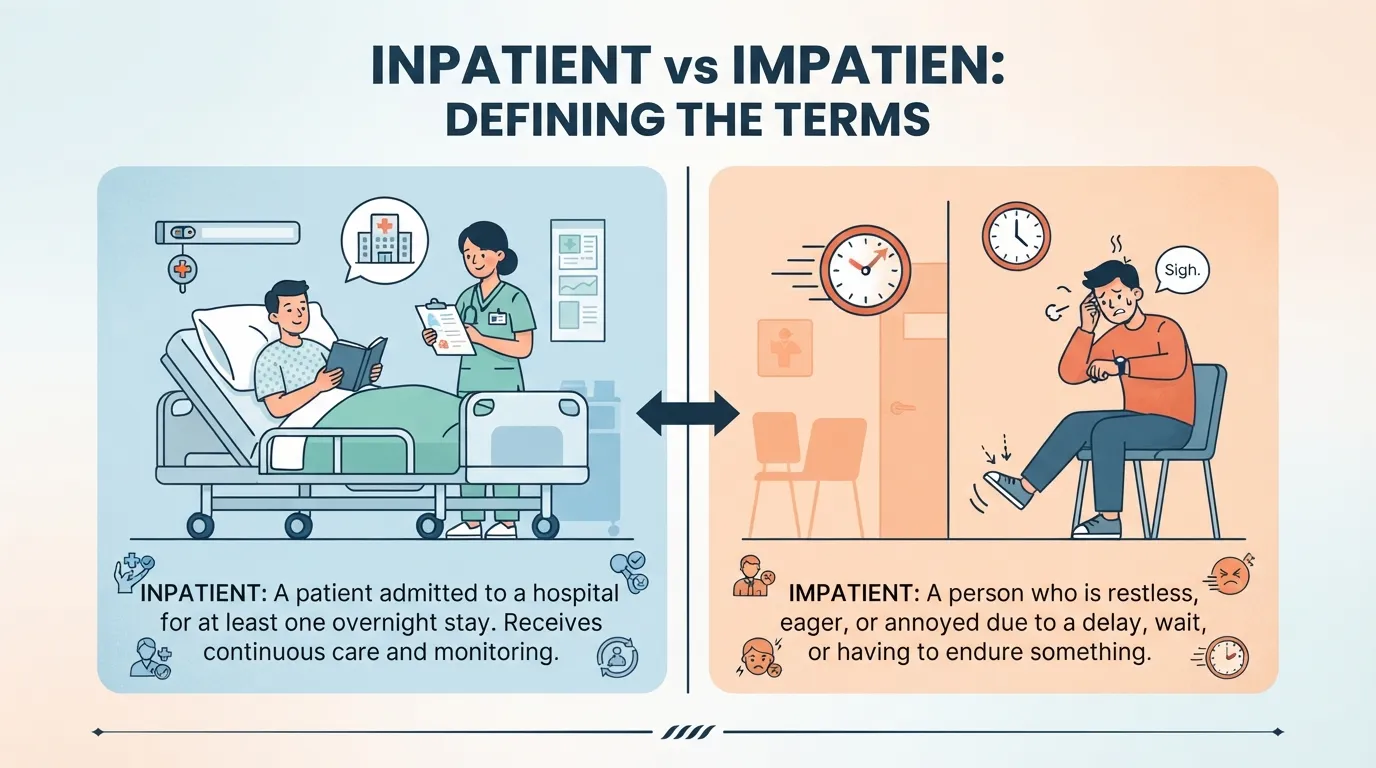
At the hospital reception desk, a form comes back with a single word circled in red. The patient wrote that she would be “impatient” for three nights. The nurse knows what she meant: inpatient — a person staying in the hospital for treatment. But the word on the form describes someone who cannot wait calmly, and in a hospital, the difference between staying three nights and refusing to wait three minutes is not a small one. One letter separates the two words. The letter changes the ward entirely.
Inpatient and impatient look alike, sound alike, and share the word patient. They mean completely different things. An inpatient is a person who stays in a hospital or medical facility for treatment. Impatient describes someone who is unable or unwilling to wait calmly. One is about healthcare. The other is about waiting. Confuse them, and the sentence changes its meaning entirely.
Ward One: Inpatient
Inpatient belongs to medicine. As a noun, it names a person who has been admitted to a hospital, clinic, rehabilitation center, or other healthcare facility and stays there while receiving treatment. “The hospital has several hundred inpatients.” “The nurse checked on every inpatient before midnight.” “The doctor reviewed the records of each inpatient.” In each sentence, the word points to a person under care, sleeping in a hospital bed.
As an adjective, inpatient describes the care, treatment, services, or facilities that involve such patients. “She needs inpatient treatment.” “The doctor recommended inpatient care.” “The hospital has an inpatient unit.” “His insurance covers inpatient services.” Here the word modifies another noun, and it always carries the same idea: the patient stays at the facility.
The word’s opposite is outpatient — a patient who receives treatment without staying overnight. “Outpatient surgery” means you go home the same day. “Inpatient surgery” means you stay. The pair is one of the most important distinctions in healthcare language, and it is decided by two prefixes: in- (inside) and out- (outside). The inpatient is inside. The outpatient goes home. The whole distinction is a matter of where the patient sleeps.

Ward Two: Impatient
Impatient belongs to everyday life, and it has nothing to do with hospitals. It is an adjective describing someone who does not want to wait, or who becomes annoyed because something takes too long. “I became impatient after waiting for two hours.” “The children were impatient to open their presents.” “She was impatient with the slow service.” “He is impatient for the results.” In each sentence, the word describes an attitude toward waiting.
Impatient people show it in recognizable ways. They complain about delays. They interrupt. They check the clock. They rush others. They demand immediate results. They have difficulty staying calm when the line is long, the download is slow, or the meeting starts late. “The impatient customer kept checking his watch” is a portrait anyone can recognize, and it has nothing to do with a hospital bed.
The word also works with three different prepositions, each with its own shade. Impatient with takes a person or a situation: “impatient with the slow service.” Impatient for takes a desired outcome: “impatient for the results.” Impatient to takes a verb: “impatient to begin.” And the word can be softened or intensified by context: “a little impatient” is a mild complaint; “wildly impatient” is a warning. The grammar is simple. The feeling is universal.

The Prefixes Tell the Story
Both words are built on patient, but they build on different senses of it, and the prefixes decide everything.
Inpatient is in + patient (noun): a patient who is in the facility. The prefix means “inside.” The word is a compound of place: the patient is inside the hospital. Think of it as an address, not a description. An inpatient is not a kind of person. It is a person in a kind of place.
Impatient is im- + patient (adjective): the opposite of patient. The prefix im- is a form of in- meaning “not” — the same im- in impossible, improper, immature. It appears as im- rather than in- because the next letter is p: English changes in- to im- before p, b, and m for ease of pronunciation, the same way in- becomes il- before l (illogical) and ir- before r (irregular). So impatient is literally “not patient.”
This is why the two words share a root and nothing else. One patient is a noun — a person receiving medical care. The other patient is an adjective — a person able to wait calmly. The prefixes attach to different roots, and the results belong to different worlds. The hospital and the waiting room share a building, but not a meaning.
The Waiting Room
Impatience deserves a closer look, because it is one of the defining feelings of modern life. The world has trained us to expect immediacy: same-day delivery, instant replies, streaming on demand, pages that load in milliseconds. When anything takes longer, the feeling arrives uninvited. The loading screen spins. The queue does not move. The reply does not come. And the word for the feeling is impatient.
Psychologists note that impatience is not only a flaw. It is also a signal — a sign that you care about the outcome, that the stakes feel high, that the wait feels unjust. The impatient parent at the school gate cares about the child. The impatient customer cares about the product. The impatient student cares about the result. The feeling becomes a problem only when it drives behavior that makes things worse: the angry email, the interrupted colleague, the dangerous lane change. Managing impatience is largely a matter of managing the story you tell yourself about the wait.
Inpatient care has its own waiting, of course — waiting for test results, for the doctor’s round, for discharge papers — and inpatients are often impatient too. A sentence can hold both words without confusion if the grammar is clear: “The inpatient grew impatient waiting for her results.” The first word names her status. The second names her feeling. The sentence works because each word is doing its own job, in its own place.

Inpatient vs Outpatient: The Bill
The distinction between inpatient and outpatient is not only medical. It is financial, and it is one of the places where the word choice has real consequences. Inpatient care — treatment that requires an overnight stay — is generally far more expensive than outpatient care, because it includes the bed, the round-the-clock nursing, the meals, and the facility itself. Insurance plans treat the two categories differently: different deductibles, different copays, different authorization requirements. A procedure classified as inpatient may need pre-approval that the same procedure classified as outpatient does not.
This is why hospitals, insurers, and patients all use the words with precision. A doctor who writes “inpatient” on an order is making a decision about where the patient sleeps and what the stay costs. A patient who hears “outpatient surgery” knows to arrange a ride home the same day. And a form that confuses inpatient with impatient is not making a trivial spelling error — it is garbling a classification that affects billing, authorization, and care. In medical writing, the stakes of getting the word right are higher than in almost any other field, because the word is also a price tag.
Two Sentences That Swap
The best way to lock in the difference is to see the two words in parallel sentences, where swapping them changes the meaning completely.
- “The inpatient was moved to another room.” — A hospital patient was transferred. A medical event.
- “The impatient customer left the store.” — A person who would not wait walked out. A retail event.
- “She needs inpatient care.” — She needs treatment that requires staying at a facility.
- “She is impatient for care.” — She wants care quickly and is frustrated by the wait.
- “The inpatients will be discharged on Friday.” — Hospital patients go home Friday.
- “The impatient drivers honked their horns.” — Drivers who would not wait made noise.
Notice the pattern: inpatient is tied to a facility, a stay, a treatment plan. Impatient is tied to a feeling, a wait, a frustration. If the sentence involves a bed, a ward, or an admission, the word is inpatient. If it involves a queue, a delay, or an attitude, the word is impatient. The test takes a second, and it never fails.
One Letter, Two Wards
When the word appears in your draft, ask the one question that settles it: hospital or waiting? If the sentence is about medical care, a stay, or a facility, write inpatient — in + patient, the patient who is inside. If it is about waiting, frustration, or unwillingness to wait, write impatient — im + patient, the person who is not patient. One letter decides the ward. Get the letter right, and the sentence goes to the right room.