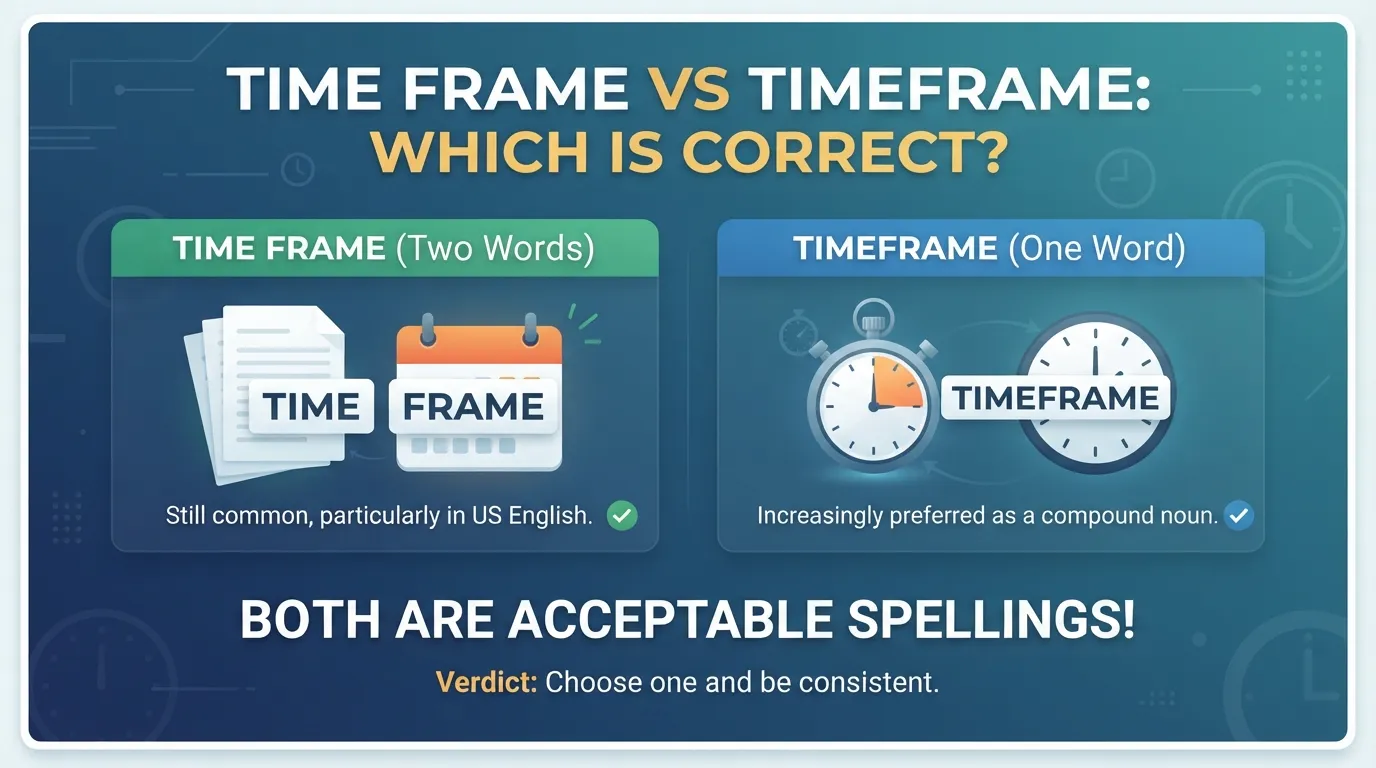
At the project meeting, someone asks the question everyone has asked a hundred times: “What is the time frame for this?” Nobody blinks. Nobody corrects the spelling. Half the room would write it as two words, half as one, and both halves would be right. Time frame and timeframe mean exactly the same thing — a period of time during which something happens, is expected to happen, or must be completed. The difference is not meaning. It is the slow, quiet process by which English glues two words together.
That process has a name, and once you see it, you will spot it everywhere: web site became website, e-mail became email, note book became notebook. Time frame is mid-journey on the same road. Which spelling you choose depends on how far along that road your readers, your style guide, and your workplace have traveled.
A Period of Time, Two Spellings
Start with the meaning, because it never changes between the two forms. A time frame is a bounded stretch of time attached to a task, an event, or a process. “The repairs should be finished within a two-week time frame.” “The company gave us a six-month timeframe to complete the project.” Swap the spellings in either sentence and nothing breaks. The period is the same; only the spacing differs.
The word works at every scale. A five-minute time frame for a quiz. A 30-day timeframe for a delivery. A ten-year time frame for a research study. A historical timeframe for an empire. It also works for deadlines, schedules, planning, research, business operations, sports, and technical processes — anywhere a stretch of time needs a name. And it is always a noun. There is no verb “to timeframe,” and no adjective form to worry about.
Both spellings are correct, and both appear in dictionaries. Merriam-Webster lists time frame as the main entry with timeframe as a variant; other dictionaries and many workplace style guides now treat the closed compound as fully standard. Neither is a mistake. The question is never “which one is right?” It is “which one fits here?”

How Two Words Become One
English has a habit. When two words get used together often enough, they drift toward each other in three stages. First they stand apart as an open compound: time frame. Then a hyphen moves in as a temporary bridge: time-frame. Finally the space closes entirely: timeframe. Linguists call this the compound lifecycle, and it explains an enormous number of spelling arguments.
Look at the words that already finished the journey. Deadline was once dead line — a literal line in Civil War prison camps that prisoners were forbidden to cross. Notebook was once note book. Lifestyle was once life style. Website was once web site, and the closed form won so completely that the open form now looks old-fashioned. Email did the same in under two decades. Each of these words passed through the same three stages, and each time, people argued about the spelling in the middle of the journey — exactly as they argue about time frame today.
Some compounds never finish the journey. High school stays open. Post office stays open. Ice cream stays open. Nobody expects them to fuse, and no style guide demands it. Whether a compound closes depends on frequency, on how the word is used, and on accidents of publishing history. Time frame sits in the interesting middle: frequent enough that the closed form feels natural, traditional enough that the open form still dominates in conservative writing.
The Hyphenated Middle Child
Between the two main spellings sits a third form, time-frame, and it is the one to be most careful with. The hyphenated version shows up in two places. Sometimes it is a writer hedging between the two spellings. Sometimes it is doing a real grammatical job: when a compound modifies a noun directly, English often hyphens it, as in “a time-frame agreement” or “a six-month time-frame.” Even there, most modern style guides would drop the hyphen and write “a six-month timeframe” or recast the phrase entirely.
The practical advice is simple: skip the hyphen. The open and closed forms cover every situation the hyphenated form covers, and the hyphenated form is the least common of the three in published writing. If your style guide specifically calls for it in attributive position, follow the guide. Otherwise, choose one of the two main spellings and let the hyphen rest.
This is a general pattern worth remembering. Hyphens are scaffolding. They go up while a compound is under construction and come down when the building is finished. E-mail kept its hyphen for years, then lost it. Time-frame is in the same position: a transitional form that most writers can safely pass by on either side.

Who Uses Which?
If both forms are correct, who chooses which — and why? The split runs along a few predictable lines.
Traditional and formal writing leans toward time frame. Academic papers, legal documents, government reports, and conservative newspapers tend to keep the space. The open form looks deliberate and unhurried, and it matches the treatment of similar phrases like time period and time limit, which have not fused.
Business, technology, and contemporary writing lean toward timeframe. Software interfaces, project-management tools, startup memos, and modern journalism use the closed form heavily. It is shorter, it matches the fused compounds of the tech world (workflow, login, download), and it scans faster in a dashboard or a status update. If your workplace writes timeframe in its templates, that is not sloppiness — it is the house style of a modern office.
Regional habits play a smaller role here than they do with words like totaling/totalling. Both American and British English accept both forms, though British style guides have historically been slightly more attached to the open compound. The bigger predictor is not geography but genre: the more digital and fast-moving the context, the more likely the closed form.
Time Frames in Contracts and Deadlines
There is one place where the choice between the two spellings carries more than stylistic weight: contracts and formal deadlines. A contract that says “within a 30-day time frame” is creating a legal obligation, and the clarity of that obligation matters more than the spelling. Lawyers tend to favor the open form, time frame, because legal writing is conservative by design — it prefers the form with the longest unbroken history, and it avoids any spelling that a reader could mistake for a typo. A judge reading a contract does not want to pause over a compound. The open form removes even that small risk.
Project management has moved the other way. Gantt charts, sprint boards, and status dashboards overwhelmingly use timeframe, because the closed form is shorter, scans faster, and matches the fused vocabulary of software (workflow, deadline, milestone). A project manager writing “the delivery timeframe is Q3” is not being informal. She is writing in the dialect of her tools. The lesson is the same as the general rule, sharpened: match the spelling to the document’s world. In a contract, write time frame. In a project tool, write timeframe. In either case, write it the same way every time it appears.
The Only Real Rule: Pick One
Since meaning is identical and both forms are correct, the one mistake available is inconsistency. Switching between time frame and timeframe inside a single document — or worse, inside a single paragraph — looks careless even though neither spelling is wrong. Readers may not be able to name the problem, but they feel it: the document seems to have been assembled from pieces that were never reconciled.
The fix is a one-second decision made before you start writing. If you are writing for a publication or a company, check the house style first; many have a stated preference. If you are writing for yourself, pick the form that matches your context: time frame for formal, traditional, or academic work; timeframe for business, tech, or contemporary writing. Then use it everywhere in that document — in headings, in body text, in captions, in tables.
The same rule applies to the whole compound family. If you write timeframe, you will probably also write workflow, login, and followup — no, wait, that last one is still usually follow-up. Compounds fuse at different speeds, and each word is on its own schedule. Consistency within a single word matters more than consistency across different words. Nobody expects your timeframe to dictate your follow-up. They only expect your timeframe to match your timeframe.

A Check Before You Send
When the word appears in your draft, run two checks. First: is it spelled the same way it was spelled the last time it appeared in this document? If not, fix the outlier. Second: does the form match the register — open for formal, closed for contemporary? If yes, you are done. There is no third check, because there is no wrong answer between the two forms.
And if a colleague corrects your timeframe to time frame, or vice versa, you can now answer with confidence: both are standard, the meaning is identical, and the choice is a matter of style and consistency. The compound lifecycle will keep turning — a generation from now, the closed form may have won outright, the way website did. Until then, either spelling is correct, and the careful writer is the one who picks one and sticks with it.











