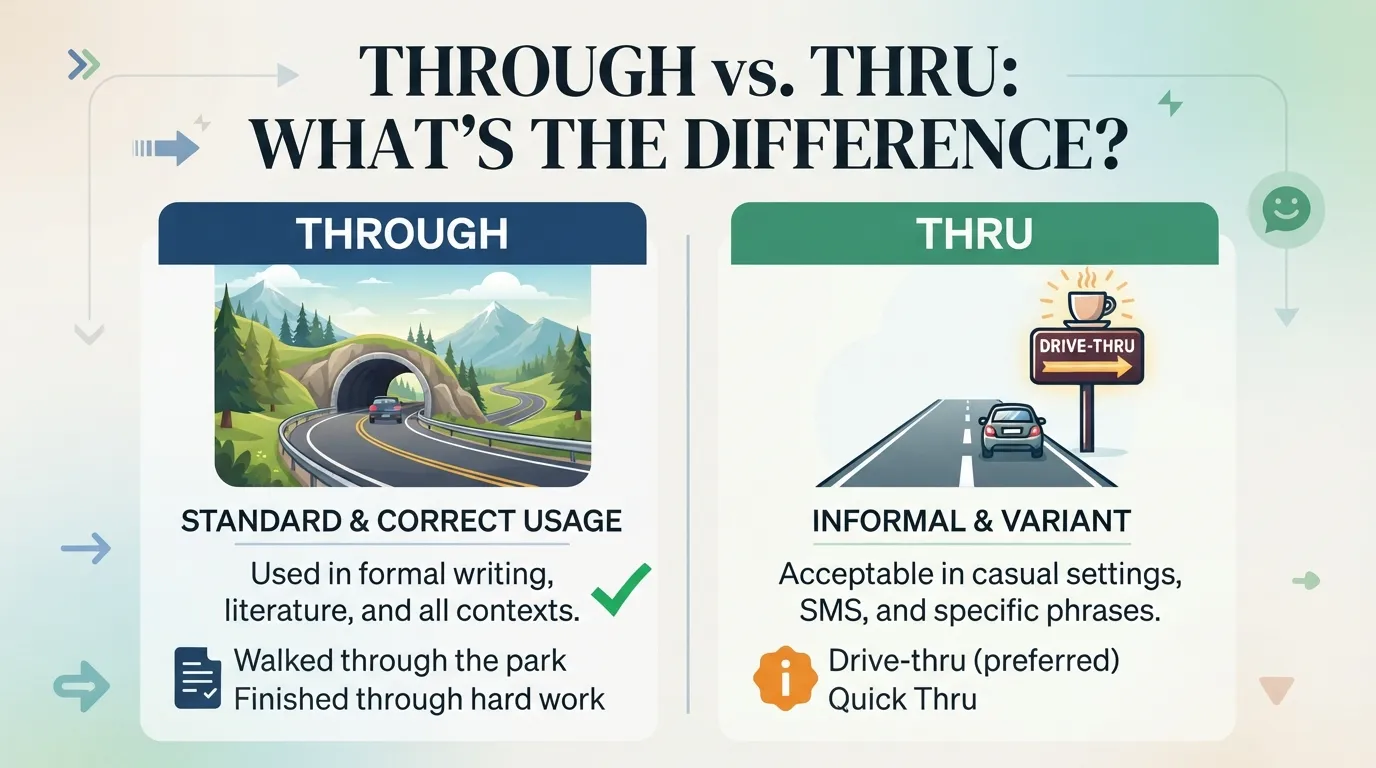
You are driving at highway speed when the sign appears: DRIVE-THRU, with an arrow. You read it without thinking, and you do not consider it a mistake. Now imagine the same spelling in a job application: “I read thru your report.” Suddenly it looks careless — maybe even illiterate. The letters are the same. The word is the same. Only the setting changed. That is the whole story of through and thru: one standard spelling for almost everything, and one shortened spelling that lives in a very specific neighborhood.
Through is the standard English spelling, correct everywhere. Thru is an informal, abbreviated spelling of the same word, at home on signs, menus, business names, and texts — and out of place in essays, reports, and formal email. They sound identical and mean the same thing. The choice between them is a question of formality, space, and audience, not of meaning.
The Sign That Started It
Thru earns its living in places where space is short and reading must be fast. A restaurant sign has a few seconds to be read from a moving car. A menu board has inches to spare. A product label has a fixed box. In all of these, thru does the same job as through with four fewer letters, and the shorter form is easier to catch at a glance. DRIVE-THRU works because a driver can read it at sixty miles an hour. DRIVE-THROUGH would work too — but the shorter version became the standard look of the fast-food world, and the look stuck.
That is why thru clusters in a small family of fixed expressions: drive-thru, walk-thru, thruway (a toll highway, especially in New York State), thru traffic. In each case the spelling is part of a brand, a sign, or an established term. A restaurant can call its window a drive-thru without anyone questioning the spelling, because the phrase itself is a piece of signage. The same restaurant, writing a formal letter to a supplier, would write “through” — and should.
Thru also appears in texts, notes, and casual messages: “I’ll be thru in ten minutes.” “We’re thru the worst of it.” In these contexts it reads as relaxed and efficient, the written equivalent of speaking quickly. It is understood instantly. It is also, in any formal setting, the wrong register — like showing up to a board meeting in shorts. Comfortable, but not appropriate.

Through, the Full Word
Through is one of the hardest-working words in English, and its length is the least of its complications. It functions as a preposition, an adverb, and an adjective, and it carries a whole family of related meanings. At its core it describes movement from one side of something to the other: “We walked through the forest.” “She walked through the door.” From that physical core, the meanings fan out.
Through can mean completion: “I read through the entire report.” “We made it through the difficult period.” It can mean a span of time: “I worked through the night.” It can mean a method or a channel: “The message came through an online platform.” It can mean involvement or connection: “They stayed together through the crisis.” It can mean passing within an enclosed space, or passing a test, or surviving an ordeal. A single short sentence can carry two of these at once: “We got through the audit through sheer persistence” — the first through is survival, the second is means.
Thru, by contrast, carries almost none of this weight in standard writing. It appears in the movement sense and the completion sense, and rarely in the rest. Nobody writes “we stayed together thru the crisis” in a wedding speech, and nobody writes “the message came thru an online platform” in a technical report. The full word owns the full range; the short form rents a couple of rooms.
A Brief History of Shortening
Thru is not a modern texting invention. It is more than a century old, and it arrived with respectable intentions. In the late 1800s and early 1900s, spelling reformers argued that English spelling was wasteful — that words should be spelled the way they sound. Noah Webster had already won some of these battles a century earlier, cutting colour to color and centre to center in American English. The reformers who followed wanted to go further: though to tho, through to thru, night to nite.
The movement’s high-water mark came in 1934, when the Chicago Tribune — one of America’s biggest newspapers — announced it would adopt simplified spellings in its pages. For decades, Tribune readers saw thru, tho, and thoro (for thorough) in print. The experiment slowly faded; the paper eventually returned to standard spellings. But thru survived in the places where brevity mattered more than tradition: road signs, restaurant windows, and business names. The reformers lost the war and won the drive-thru.
That history explains why thru feels both familiar and slightly off. It is not a mistake, and it is not slang invented by teenagers. It is a leftover from a serious, well-organized attempt to simplify English spelling — an attempt that failed in books and succeeded on signs. Knowing that history makes the choice easier: use the spelling the reformers intended for the fast lane, and the spelling everyone else kept for everything else.

The Formality Dial
Think of through and thru as two settings on a formality dial. Through is the setting for everything that matters: essays, school assignments, business reports, job applications, journalism, books, formal email, legal documents, academic writing. In all of these, through is not merely preferred — it is expected. A thru in a cover letter or a research paper reads as an error, whatever the dictionary says about informal variants.
Thru is the setting for a narrow band of casual and spatial writing: signs, menus, labels, advertising, text messages, informal notes, and established business names. If a sign says DRIVE-THRU, leave it. If a business is legally named “Thruway Auto Repair,” spell it the way the business spells it — proper nouns keep their own spelling. If you are texting a friend that you will be thru soon, nobody will object.
The border between the two is the border between permanence and ephemerality. A sign is read and forgotten; a report is filed and reread. A text vanishes into a thread; an essay is graded. When the writing will last, use through. When it needs to be read at speed and then discarded, thru is acceptable. And when in doubt, through is always safe. There is no context in which through is wrong. There are many in which thru is.
The Through Family
Part of the confusion around through comes from its look-alike relatives. English has a cluster of words built on similar letter patterns that sound nothing alike: through (throo), though (thoh), thought (thawt), thorough (thur-oh), throughout (throo-out). They share the th and the ough but diverge wildly in pronunciation and meaning. Thru does not untangle this family — it only shortens one member of it. The family has to be learned word by word, the same way every other English spelling family does.
One useful anchor: throughout is built from through + out, and it keeps the full spelling. Nobody writes thruout, even on a sign. The compound preserves the standard form, which is a reminder that through is the root and thru is the abbreviation. Abbreviations do not become the root; they point back to it.

Through in Idioms
Beyond its everyday uses, through anchors a set of idioms that no abbreviated spelling could carry. Through thick and thin means staying loyal in good times and bad — a phrase whose origins lie in forests, where travelers pushed through dense thickets and open thin woods alike. Through the grapevine means hearing something through informal channels, a phrase born in the American Civil War, when telegraph wires strung through grapevines carried rumors faster than official news. Through and through means completely, to the core: “a New Yorker through and through.” To see something through means to finish what you started, however long it takes.
Notice what these idioms share: they all depend on the physical image of passage — going through something and coming out the other side. That image is the word’s oldest meaning, and it survives in every idiom built on it. Thru never appears in these phrases, because idioms are fixed by tradition, and tradition keeps the full spelling. A writer who uses thru in an idiom — “through thick and thin” written as “thru thick and thin” — has not shortened a word. She has broken a phrase. The idioms are a reminder that through is not just the standard spelling. It is the spelling that carries the word’s history.
One Rule to Carry Away
If you remember one thing, remember this: through is the default; thru is the exception for signs and casual shorthand. Write through in every document that matters, and you will never be wrong. Use thru only where the context already uses it — on the sign, in the business name, in the quick text — and you will never be wrong there either.
The sign on the highway got it right. The job application that copies the sign gets it wrong. Same letters, same word, same pronunciation — and a completely different judgment. English is full of distinctions like this one, where the spelling is less about the word and more about the room you are standing in. Read the room, and the spelling follows.











