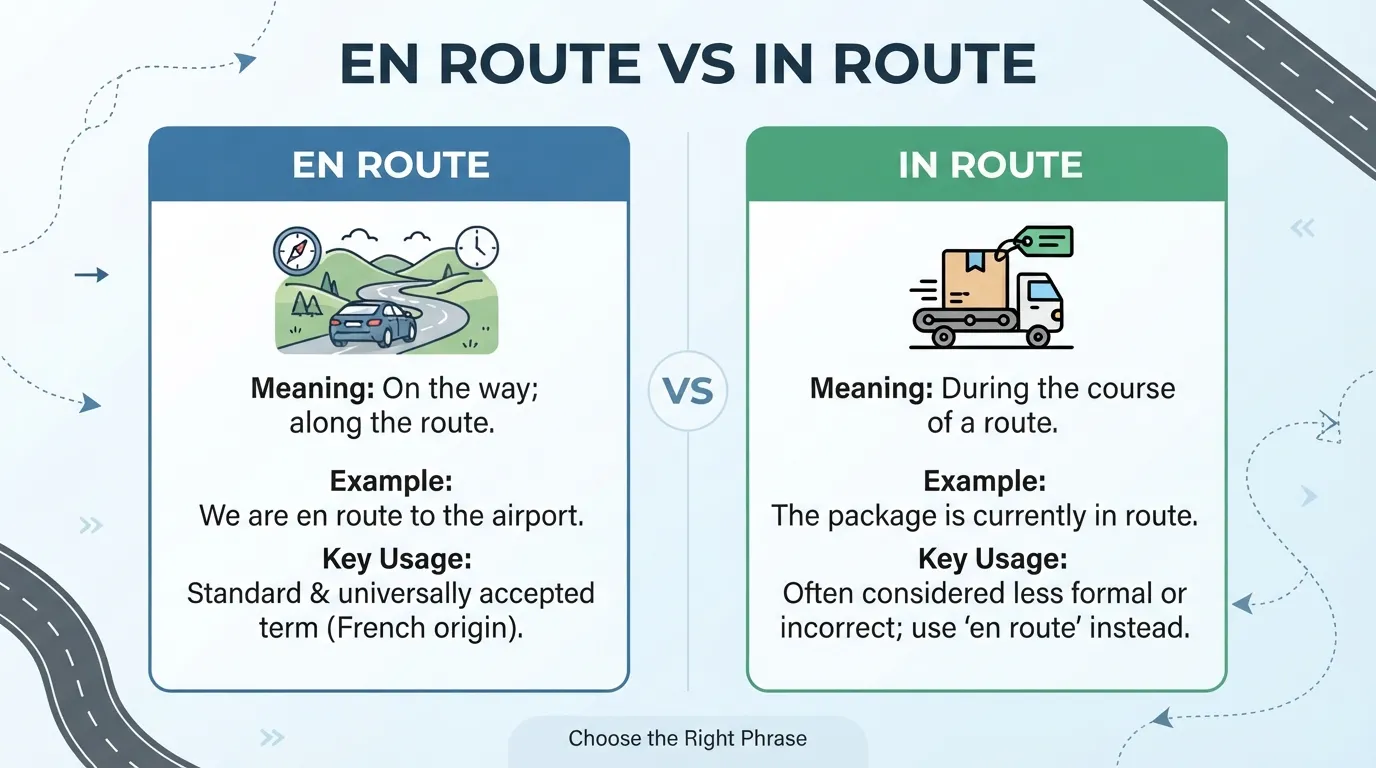
Your phone buzzes with a delivery update: “Your package is en route.” You do not pause over the spelling. You do not wonder whether it should be “in route.” You read it, you know the package is on its way, and you move on. That effortless reading is the result of a small act of borrowing: English took a French phrase whole, kept its French spelling, and uses it every day without translating it. En route means on the way — traveling toward a destination. In route is the version people write when they try to translate the borrowed phrase back into plain English, and in standard English it is a mistake.
The confusion is completely reasonable. En is not an English word, and in is one of the most common words in the language. The substitution feels like a correction. It is not. En route is a fixed phrase with a passport, and its passport says en.
What En Route Means
En route describes something — or someone — in transit between a starting point and a destination. “The doctor is en route to the hospital.” “Your order is en route and should arrive tomorrow.” “The firefighters were en route within minutes.” The phrase says nothing about arrival. It describes the middle of the journey: the package has left the warehouse, the doctor has left the office, the team has left the hotel. They are on the way, and not yet there.
The phrase works for people, vehicles, packages, and even abstract things. A project can be en route to completion. A bill can be en route to a vote. A career can be en route to a promotion. In each case the meaning is the same: movement toward a goal, with the destination named or understood. The most common construction is en route to followed by the destination: en route to Chicago, en route to the airport, en route to a solution.
It also works without a destination, as a standalone status: “The ambulance is en route.” In logistics and emergency services, that bare form is standard — it means help is coming, and the details are being handled elsewhere. The phrase is compact, professional, and instantly understood, which is why it survives in exactly the contexts where clarity matters most.

A French Phrase With a Passport
En route came to English from French, where en route literally means “on the way” — en (on) + route (way, road). English borrowed it whole in the late 1700s, during a period when French was the language of diplomacy, travel, and polite society, and thousands of French phrases entered English with their spellings intact. English kept the phrase because it was useful, and kept the spelling because the phrase arrived as a unit.
It is not alone. English is full of French phrases that kept their en: en masse (all together, as a group), en suite (a bedroom with its own bathroom attached), en garde (the fencing position, and by extension a warning to be ready), en plein air (painting outdoors), en passant (in passing, a chess move). In every one of these, the en is part of the borrowed phrase, and replacing it with in would break the phrase. Nobody writes “in masse” or “in suite.” En route follows the same rule. The en is not a typo for in. It is the phrase’s passport stamp.
This is the pattern with borrowed phrases generally: they keep the spelling of their home language. Déjà vu keeps its accents. Schadenfreude keeps its German shape. Alfresco keeps its Italian form. English is a magpie language — it steals shiny phrases from everywhere and displays them with their original plumage. Trying to “fix” a borrowed phrase by translating one word of it is like repainting one feather of a stolen bird.

Why In Route Feels So Logical
If en route is correct, why does in route feel so natural? Three forces push writers toward the mistake.
First, en looks foreign. English speakers recognize in, on, at, and toward as prepositions. En does not register as one, because it is not an English preposition. When the brain meets a word it does not recognize in a familiar pattern, it substitutes the nearest familiar word. The substitution is automatic, and it happens before conscious thought.
Second, English has a whole family of in + noun expressions that mean something is underway: in progress, in transit, in motion, in service, in flight. A writer who knows these patterns reasonably concludes that in route belongs to the same family. It looks like it should work. But en route is a fixed phrase, and fixed phrases do not follow the patterns of the language that borrowed them. They follow their own history.
Third, pronunciation hides the difference. Spoken quickly, en route can sound very close to in route, especially in American English, where the first syllable is often a soft, unstressed “en” that blends toward “in.” A writer who learned the phrase by ear — from a dispatcher, a delivery driver, a news anchor — may never have seen it written, and may reasonably guess the spelling. The ear is an unreliable witness here. The spelling has to come from the phrase’s origin, not its sound.
How to Say It
There are two common pronunciations, and both are correct. In everyday American English, the most common is en ROOT — the first syllable rhymes with pen, and route rhymes with boot. A more French-flavored pronunciation is ahn ROOT, with a nasal first syllable, which you will hear from speakers who know the phrase’s origin or who work in travel and logistics. Both are accepted, and neither affects the spelling.
The pronunciation of route itself varies by region — some Americans say rowt (rhyming with out), others say root — and that variation carries into en route. A New Yorker might say en rowt; a Californian might say en root. The phrase absorbs the local pronunciation of its second word while keeping the spelling of its first. That flexibility is part of why the phrase has lasted: it bends to fit the speaker’s accent without breaking.

En Route at Work and on the Road
En route is one of those rare phrases that works at every level of formality. It appears in emergency dispatches (“Ambulance en route”), in business email (“The documents are en route to your office”), in journalism (“The president is en route to the summit”), in shipping notifications (“Your package is en route”), and in casual texts (“I’m en route — be there in ten”). It is never too formal and never too casual, because it is doing a job — reporting movement — that every register needs.
A few usage notes keep it clean. First, en route does not take an article: you write “en route,” not “on en route” or “in the en route.” Second, the destination follows to: “en route to the airport,” not “en route for the airport” in standard usage, though for occasionally appears. Third, the phrase is not hyphenated when it follows a verb (“The shipment is en route”), though it is sometimes hyphenated when used before a noun (“an en-route delay”) — a minor style point on which guides differ, and either form is understood.
The phrase also has a useful opposite: on arrival, or simply arrived. A tracking page moves from “en route” to “delivered.” A dispatcher moves from “en route” to “on scene.” The pair gives the language a clean before-and-after for every journey, and it is worth keeping both in their standard forms.
En Route vs On the Way
If en route means “on the way,” why not just write “on the way”? Often, you should. “The package is on the way” is plainer, warmer, and understood by every reader. En route earns its place when the context wants a professional or technical register — a dispatch, a shipping notification, a news report — or when brevity matters, as on a tracking screen. The French phrase is a tool for a specific job, not a replacement for the plain English phrase.
The two phrases also differ subtly in what they imply. “On the way” can be vague — it can mean anything from “I just left” to “I’m around the corner.” En route carries a slightly more formal sense of a journey in progress, with a destination and a route already established. A dispatcher who says “the ambulance is en route” is reporting a status: the vehicle is assigned, moving, and tracked. A friend who says “I’m on the way” is making a promise. The phrases overlap, but they do not fully coincide, and the choice between them is a choice of tone: professional status report versus personal reassurance. Good writers keep both in the toolbox and reach for the one that fits the moment.
The Passport Test
When the phrase appears in your draft, apply one test: does it still have its French passport? If it reads en route, it does. If it reads in route, someone has tried to issue it a new passport, and the new one is not valid. The phrase came from France with its spelling attached, and the spelling is part of the phrase.
That is the rule for all borrowed phrases, and it is the easiest kind of rule to remember because it is a single image: a phrase arriving at customs with its papers in order. En route cleared customs two centuries ago. Its papers say en. Leave them alone, and the package — and the sentence — arrives intact.











