The stadium held seventy thousand people, and most of them were wearing friendship bracelets. They had spent weeks making them — tiny beads, knotted thread, song titles spelled out in plastic letters — and now they were trading them in the stands, wrist to wrist, stranger to stranger. A journalist covering the concert needed a word for the crowd. She wrote “Swifties.” Her editor changed it to “Swiftys.” The journalist changed it back. The editor changed it again. The argument that followed was about more than spelling. It was about how fan communities name themselves, and who gets to decide.
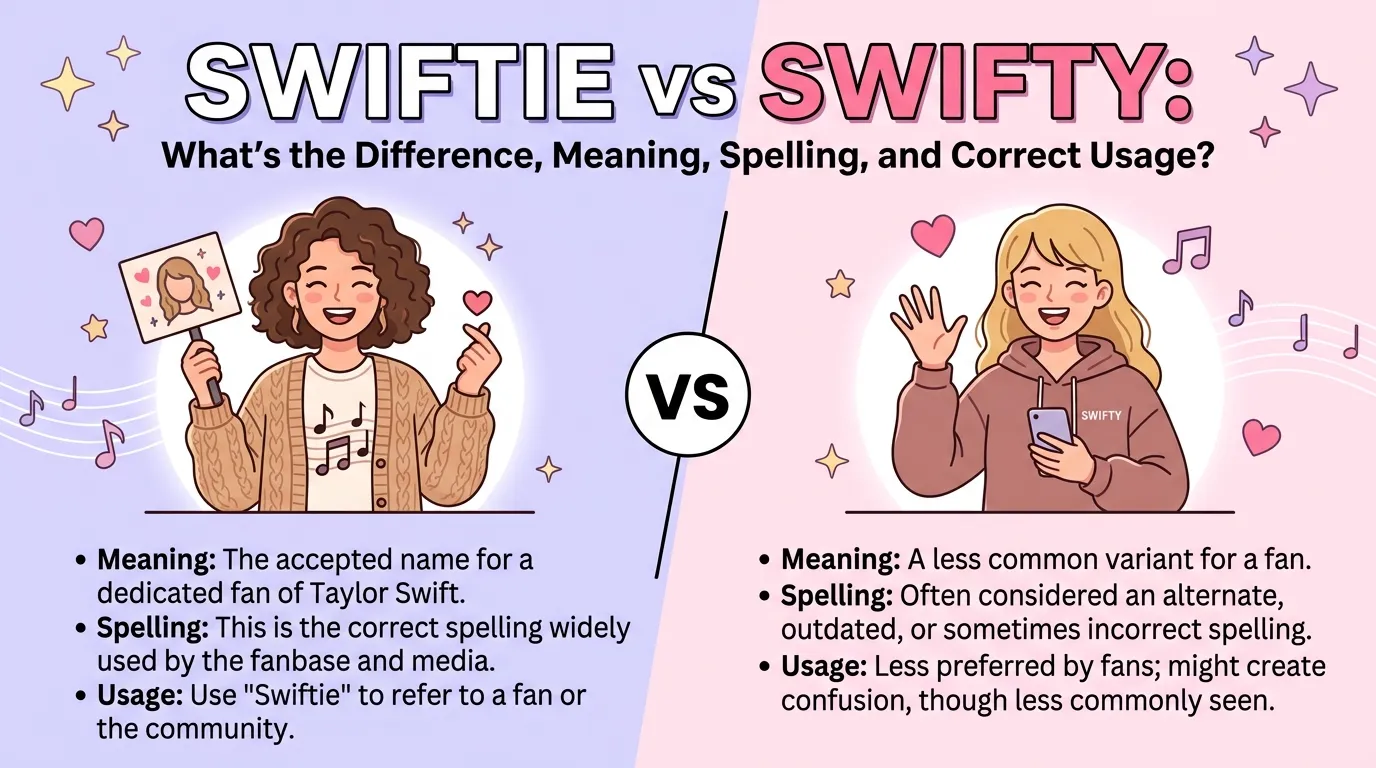
The answer is the journalist’s version. A fan of Taylor Swift is a Swiftie, spelled with -ie. Swifty, with a -y, is not the standard term for a Taylor Swift fan. The two words look alike and sound alike, but they have different meanings, different histories, and different levels of correctness. And the reason for the -ie ending is a naming tradition that goes back much further than Taylor Swift.
The Crowd: What Swiftie Means
Swiftie is a noun for a person who is a fan of Taylor Swift — her music, her performances, her creative work. It can describe a casual listener (“She is a Swiftie; she knows the singles”) or a deeply involved community member (“He is a Swiftie; he has been to twelve shows”). The plural is Swifties: “Thousands of Swifties attended the concert.” “The Swiftie community is active online.” The word is capitalized, because it is built from a proper name, and it is used in journalism, social media, academic writing about fandom, and everyday conversation.
The word’s reach is enormous. Swifties are one of the most visible fan communities in the world, known for their friendship bracelets, their lyric analysis, their Easter-egg hunting (decoding hidden clues in Swift’s videos and posts), and their economic impact — the Eras Tour, Swift’s career-spanning concert series, became the highest-grossing tour in history, and its audiences were overwhelmingly Swifties. The word has been used by Swift herself, by news outlets, and by the community, and it is the standard term in every register from casual to formal.
The word also carries an identity. Calling yourself a Swiftie is not just saying you like the music. It is claiming membership in a community with its own customs, language, and rituals. The friendship bracelets, the trading, the shared jokes, the collective decoding of lyrics — these are the practices that make a Swiftie a Swiftie, and the word names the whole package.
The -ie Tradition: How Fandoms Name Themselves
Swiftie is not an isolated invention. It belongs to a long tradition of fan names built with the -ie ending. The pattern is: take the artist’s name, add -ie, and you have a word for the fan. Justin Bieber’s fans are Beliebers. One Direction’s fans were Directioners. Beyoncé’s fans are the Beyhive (a different pattern, but the same idea). Lady Gaga’s fans are Little Monsters. BTS’s fans are ARMY. The -ie ending is the most common pattern in pop fandom, because it sounds affectionate and diminutive — a Swiftie is a little Swift, a small version of the star, a member of the family.
The -ie ending has a history beyond fandom. English uses -ie to form affectionate diminutives: doggie, birdie, auntie, sweetie. The ending signals fondness and closeness. When a fan community adopts an -ie name, it is borrowing that affection. A Swiftie is not just a consumer of Taylor Swift’s music. The word says the fan is fond of her, close to her, part of her world.
The spelling follows the pattern. The -ie ending is spelled i-e, and the plural changes -ie to -ies: Swiftie → Swifties. The same pattern appears in Belieber → Beliebers (where the -er ending keeps its form) and in ordinary words like story → stories and city → cities. The y-to-ies plural rule is one of the most consistent in English, and Swiftie follows it exactly.
Swifty: The Word That Isn’t
So what is Swifty? It is a real English word, but it is not the word for a Taylor Swift fan. Swifty has two main uses, and neither of them is the fan community. The first is as an informal adjective meaning swift or quick: “a swifty move,” “He was swifty about it.” This use is rare and colloquial, and it is built from the adjective swift + -y, meaning “characterized by speed.” The second is as a nickname or username — a personal handle, a pet name, a creative spelling chosen by an individual. It also appears as a surname.
The confusion arises because Swifty looks like the natural spelling. English has a habit of forming -y adjectives and nicknames: speedy, crafty, Tommy, Jimmy. A writer who has never seen the fan term might reasonably guess Swifty. But the fan community chose Swiftie, and the community’s choice is what makes it standard. Fan names are set by the fans, not by spelling rules, and the fans chose -ie.
There is also a literary cousin worth knowing: Swiftian, the adjective for things relating to Taylor Swift or her work in analytical writing (“a Swiftian reading of the album”), and also for things relating to Jonathan Swift, the eighteenth-century satirist who wrote Gulliver’s Travels. The shared name creates occasional ambiguity, but context resolves it: a Swiftian joke in a pop-music review is about Taylor; a Swiftian joke in an essay on satire is about Jonathan.
Capital Letters and the Editor’s Rule
Swiftie is always capitalized, because it is derived from a proper name. “She is a Swiftie.” “The Swifties arrived early.” The lowercase swiftie appears in casual texting and social media, where capitalization is relaxed, but in edited writing — journalism, academic work, publishing — the capital S is standard. The same rule applies to other fan names: Belieber, Directioner, Beyhive, ARMY all keep their capitals.
The editor in the stadium story made the classic mistake: treating a community’s chosen name as if it were a spelling error to be corrected. The correction went the wrong way, replacing the standard term with a non-standard one. The journalist was right to change it back. In cases like this, the community is the authority. Dictionaries follow the community’s usage; they do not override it.
The practical rule for writers is simple. If you mean a Taylor Swift fan, write Swiftie. If you mean something swift or quick, the word is swift itself, and Swifty is a rare informal variant. If you are writing a username or quoting someone’s handle, reproduce it exactly as they spell it — a person’s chosen name is theirs to spell. In every other case, Swiftie is the word.
Swiftie Economics: The Eras Effect
The Swiftie community has an economic footprint that economists now study. The Eras Tour, which ran from 2023 to 2024, generated billions of dollars in ticket sales, travel, hotels, food, and merchandise. Cities that hosted the tour reported surges in hotel occupancy and restaurant bookings. The U.S. Federal Reserve’s Beige Book, a survey of economic conditions, mentioned the tour’s effect on hotel revenues in Philadelphia. The phenomenon was nicknamed “Swiftonomics” by journalists and economists.
The friendship bracelets became an economy of their own. Fans bought beads, thread, and letter tiles in bulk, and craft stores reported shortages. Small businesses sold bracelet-making kits. Online marketplaces listed handmade Swiftie bracelets. The trading itself was free — bracelets were exchanged, not sold — but the materials, the travel, and the merchandise around them moved real money. A community ritual had become a supply chain.
The economic story matters for the spelling question, because it shows how large the community is. A word used by tens of millions of people, studied by economists, and printed in central bank reports is not a piece of slang waiting to be corrected. It is established vocabulary. The editor who changed Swifties to Swiftys was not fixing an error. They were overruling a community of millions, and a central bank, in favor of a spelling the community does not use.
The Bracelet Test
Back in the stadium, the journalist filed her story with Swifties in the headline, and the editor let it stand. The crowd kept trading bracelets. Each bracelet carried a song title, spelled out in beads: LOVE STORY, SHAKE IT OFF, ALL TOO WELL. The beads did not spell SWIFTY. They spelled the community’s name the way the community spells it.
The check is the bracelet test. If the word names a Taylor Swift fan, spell it the way the fans spell it: S-W-I-F-T-I-E. Swiftie. The -ie ending is not a quirk. It is the community’s signature, written in beads, in headlines, and in seventy thousand wrists in a stadium. Spell it the way they do, and the word will do its job: naming the crowd, and welcoming you into it.










