The jury room was small, windowless, and quiet in the way only a room full of people trying not to speak can be quiet. Twelve strangers sat around a table with a single question in front of them: guilty, or not guilty? They had listened to a week of testimony. They had taken notes. They had argued. Now one of them, the foreperson, picked up the verdict form and read the word at the top of it: acquit. Or was it aquit? The foreperson paused. In a courtroom, where a single word can change a person’s life, the spelling matters as much as the meaning.
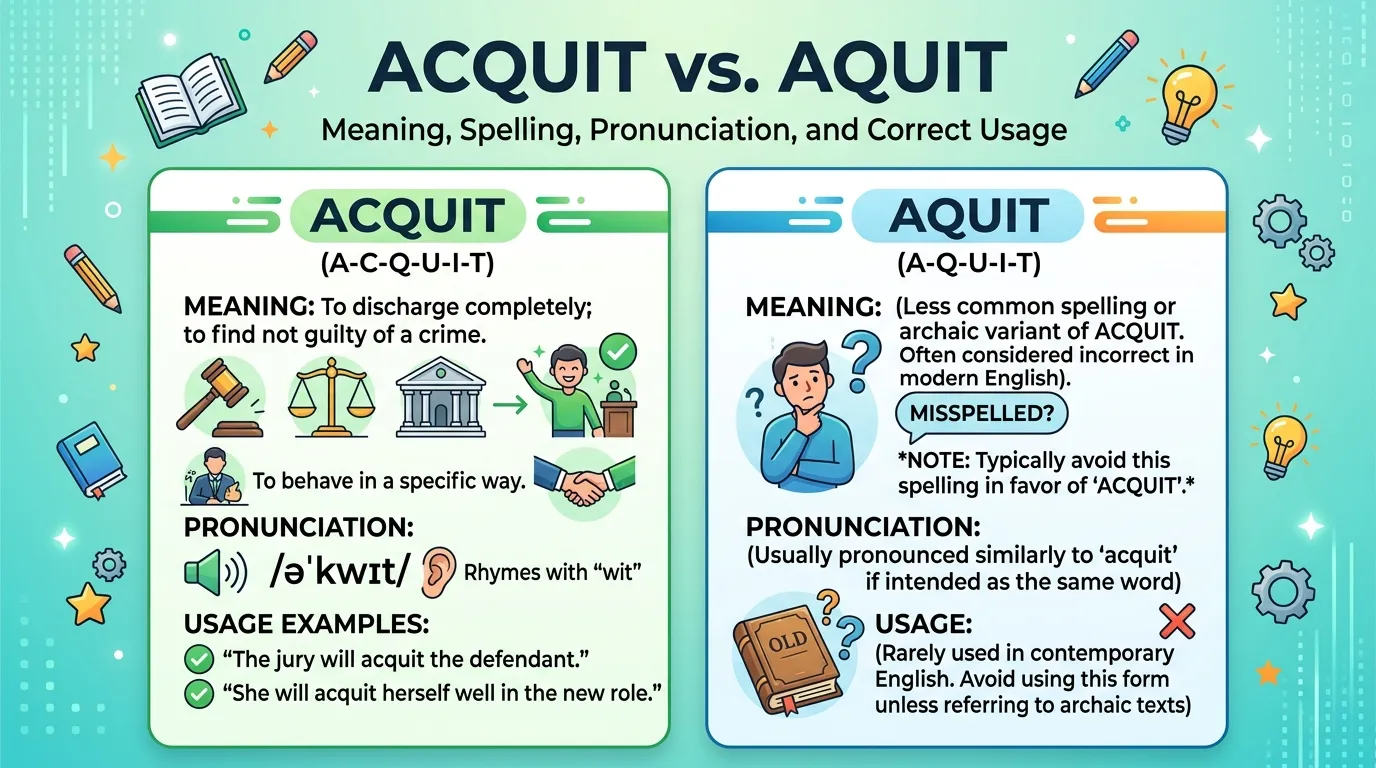
The correct spelling is acquit. Aquit, with the first c missing, is a misspelling. The word is a verb meaning to declare someone not guilty of a crime, or to free someone from a responsibility. And the reason it is spelled with ac- rather than just a- is a piece of Latin history that explains not only this word, but a whole family of words that begin with the same two letters.
The Verdict Form: Two Meanings
Acquit has two main meanings, and both appear in the jury room. The first, and the most common, is the legal one: to declare someone not guilty. “The jury acquitted the defendant.” “She was acquitted of all charges.” “The court acquitted him after a three-week trial.” In this sense, acquit is the opposite of convict. A conviction says the person did it. An acquittal says the prosecution did not prove it.
The second meaning is broader: to conduct oneself, or to perform, in a particular way. “She acquitted herself well in the interview.” “The team acquitted itself honorably in defeat.” “He acquitted himself with courage.” In this sense, the word means to behave, to perform, to carry oneself through a test. It is formal, slightly old-fashioned, and it appears most often in writing about performance under pressure — exactly the situation the jury faced.
The two meanings share an idea: release. In the legal sense, the defendant is released from the charge. In the conduct sense, the person is released from the test, having passed through it. The word’s history makes the connection explicit, and it is worth knowing, because it is the key to the spelling.
AC + QUIT: The Etymology That Spells the Word
Acquit comes from the Latin acquitare, meaning to settle a debt or free someone from an obligation. Acquitare itself is built from ad- (to, toward) + quitare (to free, to release), which comes from quietus, meaning at rest or settled. The word traveled through Old French as acquiter and into Middle English as acquiten, keeping its ac- opening all the way.
That history gives a memory trick that is unusually reliable: AC + QUIT = ACQUIT. The word is ac- plus quit. If you can spell quit, and you remember to put ac- in front of it, you can spell acquit. The misspelling aquit drops the c from ac-, leaving a- + quit. The ear cannot hear the difference — acquit is pronounced “uh-KWIT,” and the c is silent — but the eye can see it, and the dictionary requires it.
The ac- opening is a pattern, not an accident. English has a large family of words that begin with ac- because they come from Latin ad- + a root: accept, acclaim, accompany, accomplish, accuse, acquire, acquit. In each case, the d of ad- changed to match the following consonant, producing the double c. The pattern is so regular that it is worth learning as a family: when a word starts with the sound “uh-K,” check whether it belongs to the ac- family before writing a bare a-.
The Forms: Acquitted, Acquitting, Acquittal
Acquit is a regular verb with one spelling trap in its forms. The base form is acquit. The third-person singular is acquits (“The court acquits the defendant”). The past tense and past participle are acquitted — with a double t. The present participle is acquitting — also with a double t. The noun for the act is acquittal — double t again.
The double t follows the standard doubling rule: acquit is stressed on the last syllable (ac-QUIT), ends in a single t preceded by a single vowel, so the t doubles before a vowel suffix. The misspellings aquitted and aquiting make two errors at once: they drop the c and they drop a t. The correct forms are acquitted and acquitting, with the c intact and the t doubled.
The noun acquittal deserves its own attention, because it appears in headlines and legal reporting more often than the verb. “The acquittal was welcomed by the defense.” “She celebrated her acquittal.” The word keeps the full spelling — ac-, double t — and it is the word that appears on the verdict form, next to conviction. A courtroom reporter who writes aquittal has made the same error as the foreperson who writes aquit, and the error is just as visible.
Acquit vs Exonerate vs Convict
Acquit has neighbors that are easy to confuse with it, and the distinctions matter in legal writing. Convict is the direct opposite: to declare someone guilty. Exonerate is stronger than acquit: it means to officially clear someone of blame, often with new evidence, and it implies innocence, not just insufficient proof. A person can be acquitted because the evidence was weak; a person is exonerated because the evidence shows they did not do it. The difference is the difference between “not proven guilty” and “proven innocent.”
Related words sharpen the picture. A verdict is the jury’s decision. A sentence is the punishment that follows a conviction. A pardon is an act of forgiveness by an executive, which can follow a conviction. An acquittal is a verdict of not guilty, and it is final: in most systems, a person acquitted of a charge cannot be tried again for the same charge, under the rule against double jeopardy.
The figurative sense has its own neighbors. Acquit oneself well overlaps with conduct oneself well, perform well, and handle oneself well. The acquit version is the most formal of the group, and it carries a hint of the courtroom: the person is being judged, and they have passed the test. It is the right word for a performance under scrutiny — a debut, a hearing, a difficult negotiation.
Famous Acquittals
History’s most famous acquittals show how much the word can carry. In 1893, Lizzie Borden was acquitted of the axe murders of her father and stepmother in Fall River, Massachusetts. The trial was a sensation, the evidence was circumstantial, and the jury acquitted her after less than two hours of deliberation. The verdict did not end the public debate: “Lizzie Borden took an axe” became a children’s skipping rhyme, and the case remains a byword for the gap between a legal acquittal and public opinion.
In 1995, O. J. Simpson was acquitted of the murders of Nicole Brown Simpson and Ronald Goldman after one of the most televised trials in history. The acquittal divided the country along racial lines, and the case became a defining moment in American discussions of race, celebrity, and justice. Two years later, a civil jury found Simpson liable for the deaths — a reminder that an acquittal in criminal court does not prevent a civil case, because the burden of proof is different.
In 2011, Amanda Knox was acquitted on appeal of the murder of Meredith Kercher in Perugia, Italy, after four years in prison. The case had drawn intense international attention, and the acquittal was followed by years of further legal proceedings before the Italian Supreme Court definitively acquitted her in 2015. The Knox case shows that an acquittal can be provisional — appealed, overturned, reinstated — and that the word’s finality depends on the legal system that pronounces it.
These cases share a pattern: the acquittal ended the criminal proceedings, but not the argument. A verdict of not guilty is a legal fact, not a statement about what happened. The public, the press, and history may reach different conclusions. The word acquit does its legal job — it frees the defendant — and leaves the rest to everyone else.
The Jury Returns
The foreperson in the jury room looked at the verdict form once more, and wrote the word carefully: A-C-Q-U-I-T. Acquit. The c was there. The verdict was read. The defendant was acquitted, and the word on the form was spelled the way the law spells it.
The check is simple enough to carry out of the courtroom. The word is ac- plus quit. If the spelling you have written starts with aq-, the c is missing. Add it back. And if you are writing the past tense, remember the double t: acquitted, not aquited. The word that frees a person from a charge deserves its full spelling — every letter, including the silent ones.










