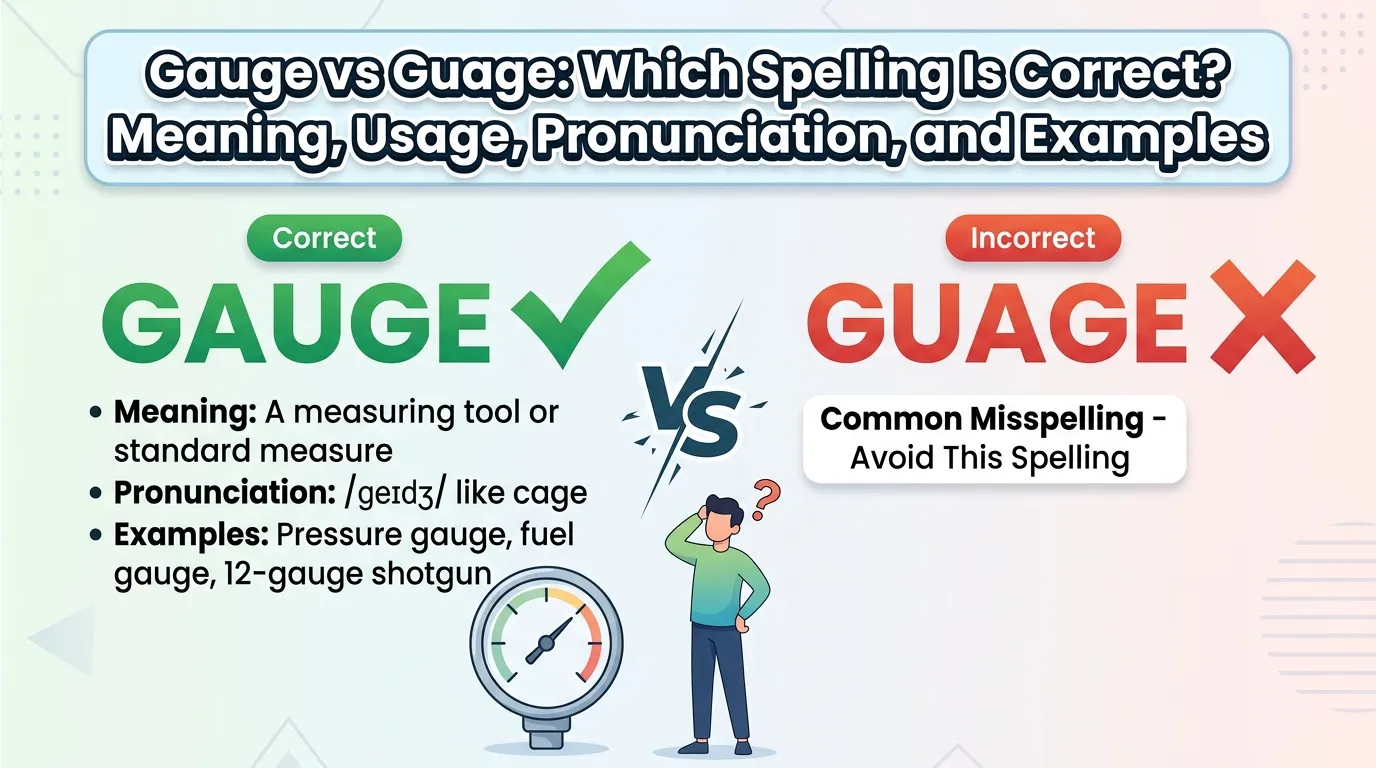
The tire shop had a waiting room with a coffee machine that never worked and a poster that did. The poster showed a tire with an arrow pointing at a small round dial, and underneath it, in big friendly letters, it said: CHECK THE GUAGE. The mechanic who owned the shop walked past it a hundred times a day and never saw the problem. A customer did. She pointed at the poster and said, “You mean gauge, right?” The mechanic laughed, and then he looked closer, and then he stopped laughing. The correct spelling is gauge. Guage is a misspelling — and it is one of the most common misspellings in English, because the correct spelling looks wrong and the wrong spelling looks right.
The Dial on the Wall
A gauge, in its oldest and most concrete sense, is an instrument that measures something. The fuel gauge in your car tells you how much gas is left. The pressure gauge on a tire tells you how much air is inside. A rain gauge measures rainfall. A speedometer is a gauge. A thermometer is a gauge. In all of these, the word names a thing you look at to get a number: a dial, a display, a scale, a readout. “Check the gauge before starting the machine.” “The fuel gauge is almost empty.” “The pressure gauge shows that the tank is full.”
But the word does a second job, and this is where it gets interesting. As a verb, gauge means to measure, estimate, or judge something — not with an instrument, but with your mind. “We need to gauge customer interest.” “It is hard to gauge her reaction.” “The doctor used a small instrument to gauge the pressure.” In the third sentence, the word is doing both jobs at once: the doctor is using a physical gauge to gauge the pressure. The noun and the verb are the same word, doing related work. The noun is the tool; the verb is the act of using it, whether the tool is real or mental.
There is a third sense, more technical, that shows up in engineering and manufacturing: a gauge can be a standard of measurement, or a size. Wire gauge describes the thickness of a wire. A shotgun’s gauge describes the diameter of its barrel. The standard gauge of a railway is the distance between its two rails. In all of these, the word means a fixed measure against which things are compared. The pattern is the same: a gauge tells you where something stands against a scale.
Why the Letters Fight You
Now look at the spelling, because it is genuinely strange: g-a-u-g-e. The au comes first, then the g. The pronunciation is “gayj” — one syllable, rhyming with cage and page. Nothing about the sound tells you the au comes before the g. If you spell the word the way it sounds, you get “gayge,” and if you spell it the way the sound feels, you get “guage” — the u first, the a second, the g third, matching the order your mouth makes them. That is exactly why guage is everywhere: on posters, in emails, in search queries, in social media posts, in poorly edited documents. It is the spelling the word would have if English spelling followed sound.
But English spelling follows history, and the history of gauge explains the odd order. The word came into English from Old French gauge (also spelled jauge), meaning a measuring rod or a standard of measure. The French word itself probably came from a Germanic root connected to measuring. The au in the French spelling was pronounced as a long “o” sound in Old French, and English kept the letters while changing the sound. The result is a word whose spelling is a fossil of a French vowel that no longer exists in either language. The au stays because history put it there, not because the sound requires it.
That is why the misspelling is so persistent. Guage is not a random typo. It is a rational correction of an irrational spelling — the kind of error a smart person makes when they trust their ear over their memory. The fix is not to trust your ear more. It is to memorize the shape: g-A-U-g-e. The au rides second, before the g. Say it as “g-AU-ge” and the oddity becomes the handle.
A Tour of the Gauges
The word’s range is wider than the dashboard, and seeing it in different trades makes its meanings concrete. In railways, gauge is the distance between the rails: standard gauge is 1,435 millimeters, and the whole history of railway engineering is partly a history of arguing about gauge. In firearms, gauge describes a shotgun’s bore: a 12-gauge shotgun has a barrel whose diameter matches a lead ball weighing one-twelfth of a pound. In wire, gauge runs backwards from intuition: a higher gauge number means a thinner wire, because the gauge originally counted how many times a wire had been drawn through a die. In weather, a rain gauge is a simple cylinder that catches rain. In medicine, a gauge can be the needle’s thickness: a 22-gauge needle is thinner than an 18-gauge needle.
As a verb, the word’s range is even wider. You gauge interest, gauge reactions, gauge the mood of a room, gauge whether someone is ready, gauge the success of a project. In all of these, the verb means something like “take a reading.” The metaphor is the instrument: you are doing with your judgment what a dial does with a needle. The figurative uses are so common that most speakers forget the instrument behind them. When a manager says “let me gauge the room,” she is not thinking about tire pressure. But the word is thinking about it for her.
The word also appears in fixed phrases that are worth collecting. “Gauge the market” means to assess demand. “Gauge the temperature” can be literal (a thermometer) or figurative (the mood of a negotiation). “Take the gauge of” is an older phrase meaning to estimate someone’s character. And in engineering, “go/no-go gauge” is a physical tool that checks whether a part fits a specification — it either goes or it does not. The vocabulary of measurement is the vocabulary of judgment, and gauge sits at the center of both.
Guage in the Wild
Search for guage online and you will find it everywhere: in forum posts, in product listings, in DIY instructions, in comments sections. Its frequency is part of the problem. The more often people see a misspelling, the more normal it looks, and the more likely they are to reproduce it. Guage has reached the point where some writers are unsure which version is correct, because they have seen both so often. The answer is unambiguous: every major dictionary lists gauge as the standard spelling and guage as a misspelling. Spellcheckers flag guage. Style guides do not accept it. It has no separate meaning and no dialect where it is the preferred form.
The word’s relatives do not help much, because there are not many. Gauging is the present participle: “She is gauging the response.” Gauged is the past tense and past participle: “He gauged the crowd’s mood.” Both keep the au before the g. There is no word family to anchor the spelling the way school anchors schedule. The word stands alone, with its odd letter order, and it has to be memorized on its own terms.
One comparison does help: gauge is not the only English word with an au that looks out of place. Because has an au that no one pronounces. Beauty has an eau that collapses into one sound. Gauge belongs to this family of words where the spelling records a history the pronunciation has forgotten. The au is not a mistake. It is a souvenir.
The One-Second Check
Here is the practical rule, reduced to a single glance. Write the word. Look at the second and third letters. If they read ua, you have written guage, and the u has jumped ahead of the a. Swap them. The correct order is au: g-au-ge. Think of it as the u riding in the back seat. It belongs after the a, not before it.
Another hook that works for many people: gauge begins with ga, like gas — and what does a fuel gauge measure? Gas. The first two letters of gauge are the first two letters of the thing its most famous instrument measures. It is a coincidence, but coincidences make good memory hooks, and this one is hard to forget once you have noticed it.
The tire shop fixed its poster eventually. The mechanic ordered a new one, and this time the spelling was right: CHECK THE GAUGE. He told me he still has to stop himself from writing it the other way, because his hand wants to write what his ear hears. That is the whole story of this word. The ear says guage. The dictionary says gauge. Trust the dictionary — and check the second letter.










