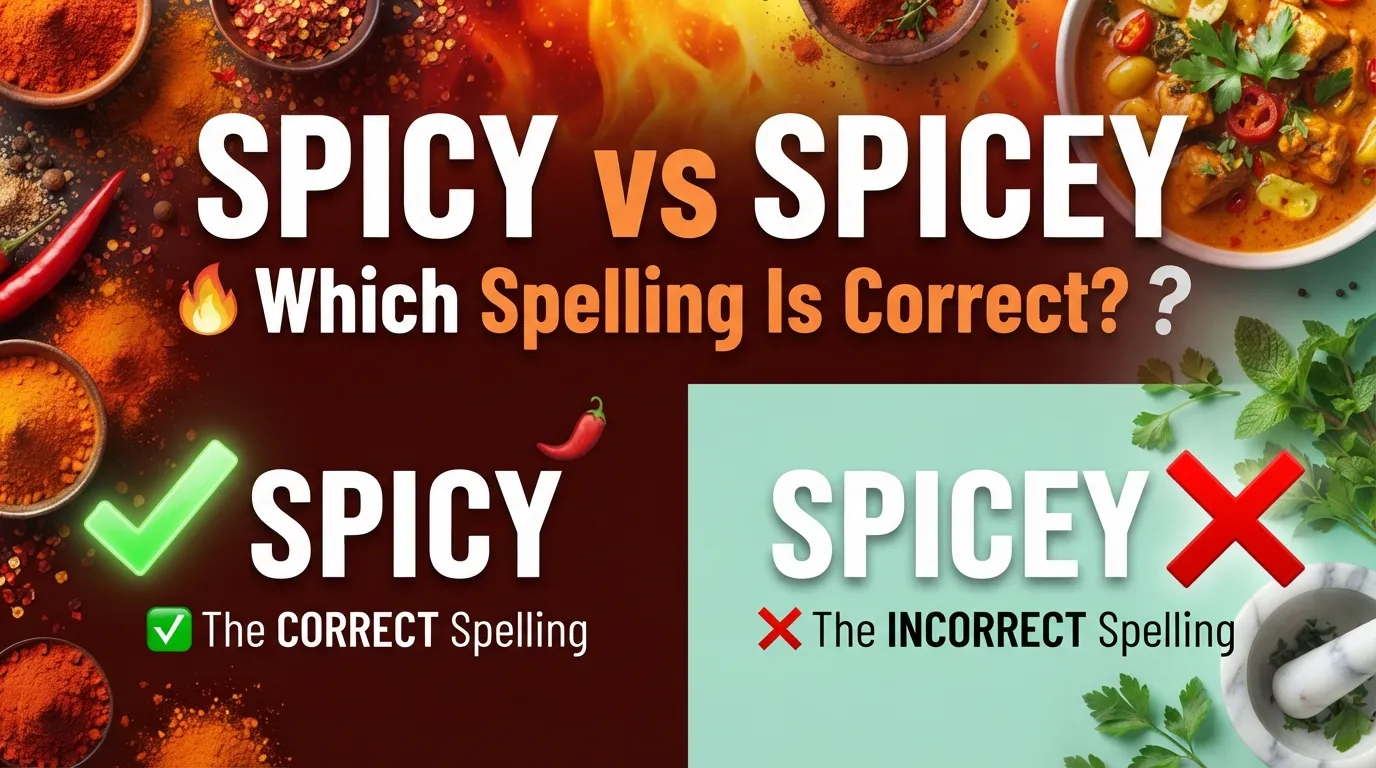
The food review was glowing: the curry was rich, the service was warm, the room was beautiful. And then the reviewer typed the word that undid a little of the polish: “The curry was spicey.” Every reader understood. Nobody was confused. But the spelling was wrong, and in a review about food, the wrong spelling of a food word lands with a small, audible thud. The correct spelling is spicy. Spicey looks logical, sounds identical, and is a misspelling in standard English.
The error is easy to forgive, because it follows the most natural instinct in spelling: build the word from its parts. The word comes from spice, and adding -y to spice should give spicey — if English spelling worked by assembly. It does not. English spelling works by convention, and the convention here drops a letter.
The Menu Test
Spicy is the standard spelling in every variety of English — American, British, Australian, Canadian — and in every register, from street-food stalls to academic papers. “This chicken is spicy.” “I love spicy noodles.” “Be careful — that sauce is extremely spicy.” The word is an adjective: it describes food that contains or tastes strongly of spices, especially ingredients that create a hot, burning, or pungent sensation.
Spicey, by contrast, has no standard dictionary entry as the adjective. It appears online in informal posts, in typos, in usernames, and in business names — but not in standard writing. A spellchecker will flag it. An editor will correct it. A reader who notices it will register it, consciously or not, as a mistake. There is no difference in meaning between the two forms, because spicey has no meaning of its own. It is spicy with a letter that should not be there.
The practical rule is absolute: in any writing that matters — school assignments, business documents, food reviews, blog posts, social media captions, professional documents — write spicy. There is no context in standard English where spicey is the preferred spelling of the adjective. The one exception is proper nouns, which get their own section below, because names play by different rules.
The Silent-E Dropout
The reason spicy is correct is a spelling rule about the silent E. When a word ending in a silent E takes a suffix beginning with a vowel, the E usually drops. Spice + -y → spicy. The E is silent, the suffix supplies the vowel, and the E — having no sound left to protect — leaves.
The rule is everywhere once you look for it. Noise + -y → noisy. Taste + -y → tasty. Ice + -y → icy. Juice + -y → juicy. Grease + -y → greasy. Bone + -y → bony. Stone + -y → stony. In every case, the silent E drops before the -y, and the result is the standard spelling. Spicey is the odd one out only because the writer assembled it letter by letter instead of applying the rule.
The rule has exceptions, and they are instructive. The E stays when dropping it would create confusion or an awkward spelling. Dye + -ing → dyeing, not dying — because dying already means something else. Singe + -ing → singeing, not singing — same reason. Eye + -ing → eyeing (or eying), because dropping the E would leave an unpronounceable stump. And age + -ing → ageing in British English, a conservative holdover. None of these exceptions apply to spicy: dropping the E creates no confusion, no ambiguity, no awkwardness. The E goes, and the word is spicy.

Why Spicey Looks Right
If the rule is so regular, why does spicey feel so natural? Because the brain builds words by assembly. You know spice. You know the suffix -y turns nouns into adjectives (salt → salty, sun → sunny, spice → spicey?). The assembly is logical, and the result looks like a word. The problem is that English spelling is not assembly. It is a historical record, and the record says the E drops.
The same assembly instinct produces other familiar errors: useable for usable, loveable for lovable, moveable for movable. In each case, the writer kept a letter that the rule removes, and the result looks plausible because the base word is visible inside it. The errors are understandable, and they are still errors in standard writing. The rule — drop the silent E before a vowel suffix — is the correction for the whole family.
There is a second reason the error survives: pronunciation gives no clue. Spicy and spicey are pronounced identically — SPY-see, first syllable like spy, second like see. You can hear the word correctly all your life without knowing how it is spelled. The error lives entirely on the page, which is why it survives in handwriting, in fast typing with spellcheck off, and in the minds of writers who learned the word by ear. The ear cannot arbitrate. Only the rule can.
Spicy Beyond the Plate
Spicy has grown well beyond food. In modern informal English, it describes anything exciting, provocative, controversial, bold, or slightly risqué. “The interview became spicy after the two politicians disagreed.” “She posted a spicy opinion online.” “The movie has some spicy scenes.” “That was a spicy debate.” In each case, the word borrows the heat of the food sense and applies it to conversation, media, or opinion. The metaphor is so natural that it barely registers as a metaphor: a spicy take is one that burns a little.
Back on the plate, the word covers a spectrum. A dish can be mildly spicy, medium spicy, or extremely spicy, and the scale has a real measurement behind it: the Scoville scale, which rates the heat of chili peppers in Scoville Heat Units. A jalapeño sits around 8,000 units. A habanero reaches 350,000. A Carolina Reaper — one of the hottest peppers on record — tops 2 million. When a menu says “spicy,” it is usually promising the lower end of that scale. When it says “extremely spicy,” it is warning you. Either way, the spelling is the same.
The word also appears in fixed expressions. Spicy food is the default collocation. Spicy sauce, spicy curry, spicy noodles, spicy chicken — the adjective travels with the cuisine. And in cooking, spicy is distinct from hot: a dish can be spicy without being hot (heavy on aromatic spices like cumin and coriander) and hot without being spicy (a single chili’s burn with little flavor behind it). Cooks know the difference. So do eaters, usually after one bite.
How Spicy Is Too Spicy?
Heat tolerance is one of the most variable things about human beings. A dish that is pleasantly warm to one person is unbearable to another, and the difference is partly biology. The heat in chilies comes from capsaicin, a chemical that triggers the mouth’s pain receptors. People who eat spicy food regularly build tolerance — their receptors become less sensitive, and they need more heat to feel the same burn. People who rarely eat it feel the full force of a single jalapeño. Children, who have the most sensitive receptors, often reject spicy food outright, and many acquire the taste only in adolescence or adulthood.
There is also a practical fact worth knowing: water does not help. Capsaicin is an oil, and water spreads oil rather than washing it away — which is why a glass of water after a too-hot bite seems to make things worse. Milk, yogurt, and other dairy products help, because they contain casein, a protein that binds to capsaicin and carries it away. Starchy foods — rice, bread, potatoes — help by absorbing the oil. The next time a dish is too spicy, reach for the yogurt, not the water. And remember that the word for the dish that got you into trouble is spelled with one E dropped: spicy, not spicey.
Spicey’s Second Life
There is one place where spicey is legitimate: proper nouns. Business names, restaurant names, brand names, and usernames can spell themselves however they like. A restaurant called “Spicey Kitchen” is not making a spelling error — it is making a branding choice. A username like SpiceyQueen is not a mistake — it is a handle. Proper nouns are exempt from spelling rules, because they are names, not words. You spell a name the way its owner spells it.
This exemption is the source of a small amount of confusion. A reader who sees “Spicey” on a restaurant sign may reasonably conclude that the spelling is standard. It is not — it is a name. The sign is correct as a name and would be incorrect as an adjective in a sentence. The distinction is the same one that lets a band call itself “Def Leppard” without making leppard a word, or a shop call itself “Kwik Fit” without changing the spelling of quick. Names play by their own rules. Sentences play by the language’s.
Drop the E
The next time the word appears in your draft, remember the rule that governs it and the family it belongs to. Spice + -y → spicy, the silent E drops, the same way it drops in noisy, tasty, icy, and juicy. The assembly instinct that produces spicey is understandable, and it is wrong in standard writing. Drop the E, and the word is right every time — on the menu, in the review, and in every sentence where the heat is on.