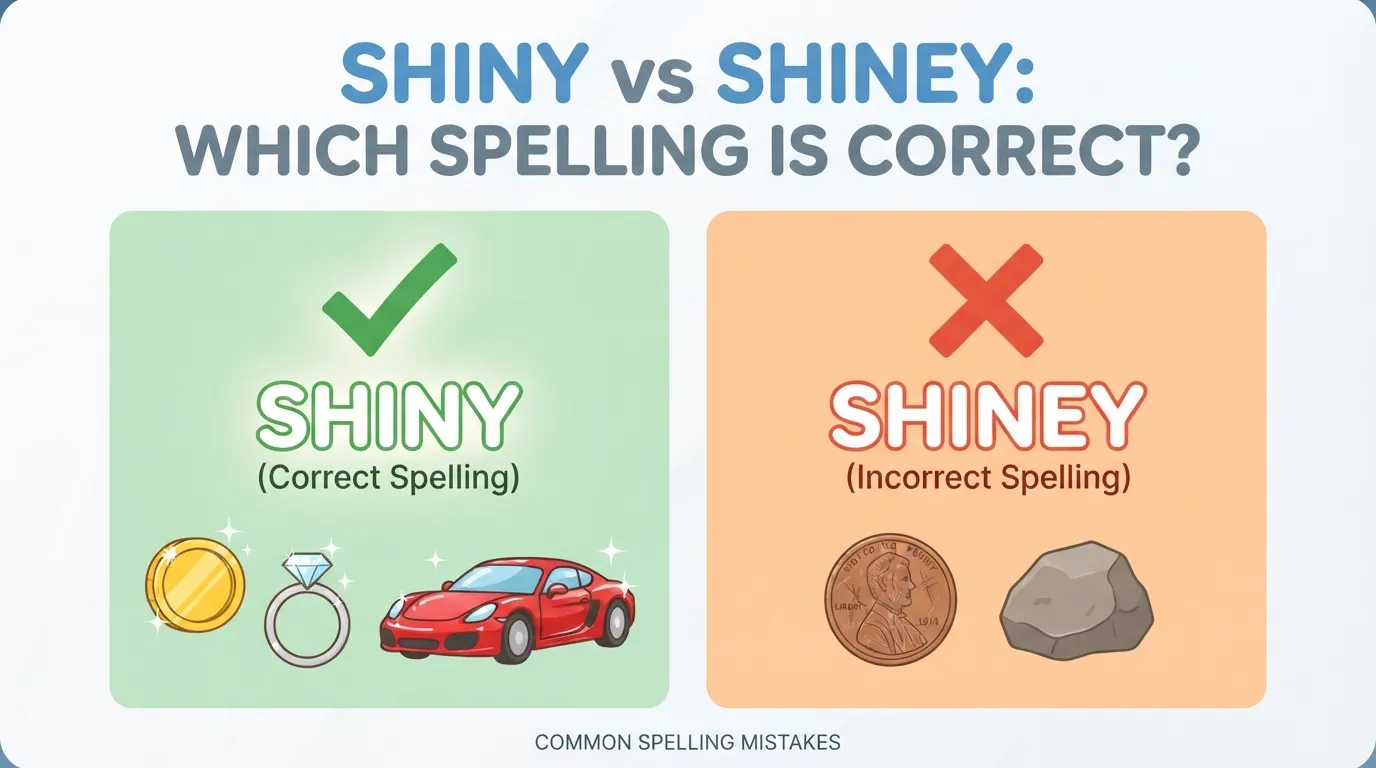
It is closing time, and the jeweler is locking up. The street is dark, the shop window is lit, and a necklace on black velvet catches the light from a passing car. It throws the light back in a bright, clean flash — the kind of flash that makes a person stop walking. The jeweler would call it shiny. A passerby, reaching for the same word in a text, might write shiney. The necklace does not care. The dictionary does. The correct spelling is shiny. Shiney is a misspelling. And the reason is one of English’s most reliable little machines: the silent E that vanishes when a suffix arrives.
Shiny is a small word with a big job. It describes anything that reflects light strongly — polished metal, clean glass, new paint, healthy hair, a fresh coin. It is also, in modern slang, a word for anything new and attention-grabbing: a “shiny new toy,” a “shiny new feature.” The spelling question is narrow — one letter, one E — but it opens onto a rule that governs hundreds of English words.
The Window at Night
Start with what the word means, because the meaning explains why the word is everywhere. Shiny is an adjective. It describes a surface that reflects light: “shiny shoes,” “shiny hair,” “a shiny new car,” “the floor looks shiny after cleaning.” The surface can be naturally reflective, like water or metal, or made reflective by polishing, like a shoe or a table.
The word also carries a second, figurative sense: new, attractive, attention-grabbing. “A shiny new phone.” “A shiny new job.” “Shiny object syndrome” — the tendency to chase every new distraction. In this sense the word is doing social work, not optical work. It says: this thing gleams, and the gleam is pulling your eye.

There is a third sense, older and more technical: in materials and finishes, shiny is a measurable quality, opposed to matte. A glossy photograph is shiny; a matte photograph is not. A satin finish sits between them. Designers, printers, and painters use the word with precision, because the amount of shine changes how a thing looks and feels.
All three senses spell the word the same way: s-h-i-n-y. No E. The E belongs to the parent word, shine, and when the suffix -y arrives, the E leaves. That is the whole story, and it is worth telling in full, because the same story explains a whole shelf of English words.
Shine + y, Minus the E
Here is the rule. When a word ends in a silent E and you add a suffix that begins with a vowel — -y, -ing, -ed, -er, -est, -able — the silent E drops out. Shine + -y becomes shiny, not shiney. Make + -ing becomes making, not makeing. Love + -able becomes lovable, not loveable. The E has done its job — it was holding the vowel long — and once the suffix arrives, it is no longer needed, so it goes.
The same rule produces a family of -y adjectives that all behave the same way: spice → spicy, noise → noisy, ice → icy, taste → tasty, ease → easy, rose → rosy, haze → hazy, stone → stony. In every case, the E drops and the Y attaches directly to the stem. Shiney breaks this pattern by keeping an E that the rule says to delete.
Why does the hand want to keep the E? Because shine is a familiar word, and the hand wants to preserve it whole. The instinct is the same one that produces spicey and noisey — keep the base word intact, then add the suffix. The instinct is understandable. It is also wrong, because English suffix rules do not preserve the base word. They transform it. The E is a scaffolding letter: it holds the vowel long while the word stands alone, and it comes down when the building is finished.
There is one exception worth noting, and it proves the rule. When the suffix begins with a consonant — -ly, -ness, -ment, -ful — the E usually stays: shame + -ful = shameful, care + -less = careless. The E drops only before a vowel suffix. -y begins with a vowel sound, so the E drops. That is the complete rule, and shiny follows it exactly.
Shiny in the Showroom and the Lab
The word does different work in different rooms. In the showroom, shiny sells things. Car dealers polish cars until they are shiny. Phone makers advertise shiny finishes. Jewelers arrange lights so the stones look their shiniest. The word carries desire: shiny things attract the eye, and the eye pulls the wallet.

In the lab, shiny measures things. A metallurgist describes a “shiny fracture surface.” A printer distinguishes shiny (gloss) paper from matte paper. A photographer talks about shiny highlights. In these contexts the word is precise, and the spelling matters more, because a technical document with a misspelling loses credibility faster than a text message does.
In everyday speech, shiny also describes people and hair and eyes: “shiny hair,” “shiny eyes,” “a shiny face.” Healthy hair shines; tired hair does not. The word is a small health report disguised as an adjective. And in the phrase “shiny happy people,” borrowed from the R.E.M. song, the word means something like bright-eyed and cheerful — the gleam transferred from surface to mood.
The word’s opposites are worth knowing: dull, matte, flat, lackluster. “The old coin was dull, not shiny.” “She chose a matte finish over a shiny one.” Each opposite names a different kind of non-shine, and choosing among them is a matter of precision: dull for light that fails to reflect, matte for a finish designed not to reflect, flat for paint, lackluster for a disappointing absence of gleam.
Shiny vs Glossy, Polished, Mirror
Shiny has close neighbors, and keeping them distinct sharpens a sentence. Glossy describes a smooth, reflective surface, usually a manufactured finish: glossy paper, glossy lips. Polished describes something made shiny by rubbing or finishing: polished shoes, polished marble. Mirror-like describes the extreme end: a surface so reflective it shows an image. Shiny is the general word that covers all of them. When you want precision, pick the neighbor. When you want the general quality, pick shiny.
The word also has a comparative and superlative: shinier, shiniest. “The new coin is shinier than the old one.” “This is the shiniest floor in the building.” The Y becomes I before -er and -est, following the standard rule for words ending in consonant + Y. The spelling holds: no E anywhere in the family.
And a note on the slang sense: “shiny new object” is now a fixed phrase in business and tech writing, naming the distraction of the latest tool or trend. “Don’t chase every shiny new object.” The phrase works because the literal sense — the gleam that pulls the eye — maps perfectly onto the figurative one. The spelling is the same in both. The E never comes back.
The Shiny Trap: When New Isn’t Better
There is a downside to shine, and modern English has a phrase for it: “shiny object syndrome.” The phrase describes the habit of chasing every new tool, trend, or idea — the new app, the new framework, the new diet — and abandoning the old one before it has had a chance to work. The syndrome is named for the way a bright object pulls the eye: the gleam promises something, and the promise is usually bigger than the payoff.
The phrase is popular in business and tech writing because the pattern is so common there. A team adopts a new project-management tool, then abandons it for a shinier one three months later, then abandons that one too. A marketer chases every new platform. A student buys every new study system. In each case, the shine is doing the choosing, not the judgment. The word shiny, in this phrase, carries a gentle warning: what gleams is not always what works.
The warning is worth hearing because the word’s positive sense is so strong. Shiny things attract us for good evolutionary reasons — clean water gleams, healthy skin gleams, a sharp blade gleams. The attraction is real. But a polished surface can hide a dull edge, and a glossy package can hold a mediocre product. The shine is information about the surface, not the substance. The wise buyer, like the wise writer, looks past the gleam to what is underneath — and spells the word correctly while doing it.
The One-Line Check
When the word appears in your draft, run one check: did you write shine + y with the E still in it? If so, delete the E. Shine minus E plus Y equals shiny. The rule is the same one that gives you spicy, noisy, icy, and tasty. The E did its job in the parent word. In the child word, it is gone — and the shine is brighter without it.