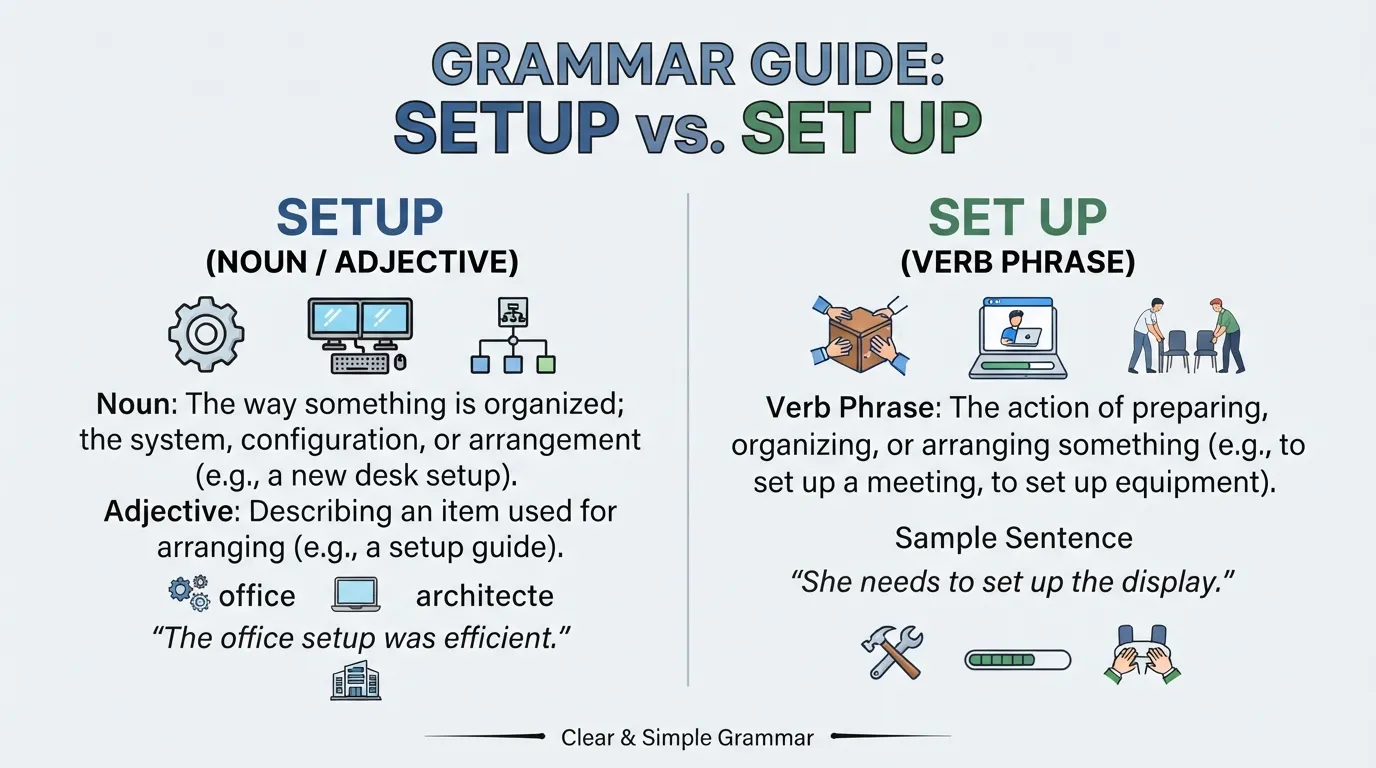
Morning: you set up the desk. You unbox the monitor, you plug in the keyboard, you arrange the lamp, you coil the cables. Evening: you step back and admire your new setup. Same letters, same sounds, two different jobs — and the space between the words is what tells you which job each one is doing. Set up is the action. Setup is the thing the action produces. Get the space right, and the sentence reads itself.
The rule is grammatical, and it is one of the cleanest in English: setup is a noun — an arrangement, a configuration, a system. Set up is a verb phrase — to arrange, prepare, establish, or install. “The computer setup is ready.” “I need to set up the computer.” One names a thing. The other describes doing something. Everything else in this article is a consequence of that single distinction.
Morning: The Action
Set up is a phrasal verb, and like all phrasal verbs it describes something someone does. “Please set up the meeting room.” “I need to set up my new phone.” “They will set up a new business.” “She set up an online account.” In each sentence, set up tells you what someone is doing: arranging, preparing, installing, establishing, organizing.
Phrasal verbs have a trick that single-word verbs do not: they can split around their object. You can write “set up the meeting” or “set the meeting up” — both are correct, and both mean the same thing. You can write “set it up” but never “set up it”: when the object is a pronoun, it must go in the middle. This split is the phrasal verb’s signature, and it is also the fastest diagnostic in this article. If you can put a word between set and up and the sentence still works, you are dealing with the verb — and the verb is always two words.
The verb also conjugates like any other verb: set up, sets up, setting up, set up (past tense and past participle are the same as the base form, because set is irregular). “He sets up the equipment every morning.” “We are setting up the exhibition.” “They set up the tent before dark.” The up stays attached to the action in every form, and the space stays open.

Evening: The Thing
Setup, the noun, names the result: the arrangement itself. “The office has a simple computer setup.” “Her gaming setup includes three monitors.” “The camera setup took an hour.” “The new security setup is more reliable.” In each sentence, setup is a thing you could point at — a configuration of equipment, a workspace, a system, a situation.
The noun has its own diagnostic, just as reliable as the verb’s. If you can put the, a, my, or your in front of it, it is the noun: the setup, a setup, my setup. If you can put an adjective before it — a simple setup, an elaborate setup, the current setup — it is the noun. If you can make it plural — two setups — it is the noun. Verbs do none of these things. You cannot write “the set up” or “two set ups” and mean the same thing.
The noun also carries a meaning the verb never has: setup can describe a situation that has been arranged in advance, including a trap. “It was a setup” means the situation was rigged — the game was fixed, the arrest was staged, the meeting was a trap. This is the noun at its most figurative, and it is a sense the two-word verb form cannot express. You cannot write “it was a set up” and mean a rigged situation in standard English; the noun owns that meaning outright.

The Split Test
When the two forms blur in your draft, run the split test. Take the sentence and try to insert an object between set and up. If it works, the verb is correct and the space stays open: “We need to set up the office” becomes “We need to set the office up” — grammatical, so set up is right. If it fails, you have the noun: “The office setup looks professional” cannot become “the office set the up looks professional” — nonsense, so setup is right.
A second test is the article test. Try putting the or a before the word. “The setup is complete” works — noun. “I need to the set up the equipment” fails — verb. Between the two tests, almost every case is settled in seconds. The tests work because they are not tricks. They are the grammatical facts themselves, restated as questions: can this word take an article? Can this phrase split? The grammar knows the answer even when you do not.
There is one place where even careful writers hesitate: the -ing form. “Setting up the exhibition” is the verb’s present participle — two words, space open, because it describes an action in progress. “The setting-up of the exhibition” is occasionally hyphenated as a noun phrase, but the cleaner modern choice is to recast: “the setup of the exhibition” or “setting up the exhibition.” When the -ing form describes an action, keep the space open.
The Whole Family
Setup/set up is not an oddity. It belongs to a large family of English pairs in which a two-word verb phrase fuses into a one-word noun: login/log in, backup/back up, checkout/check out, makeup/make up, pickup/pick up, breakdown/break down, followup/follow up. In almost every pair, the same rule holds: the fused form is the noun, the open form is the verb. “Log in to your account” (verb) versus “enter your login” (noun). “Back up your files” (verb) versus “keep a backup” (noun). “Check out the new café” (verb) versus “the checkout line” (noun).
Each pair has its own quirks. Follow-up often keeps a hyphen as a noun (“a follow-up meeting”), where setup does not. Makeup has a meaning — cosmetics — that has drifted far from the verb make up. Pickup can be a truck, a line in a play, or a casual date. But the core pattern is stable, and learning it once pays off across the whole family. When you meet a new pair, ask the same two questions: does it name a thing, or describe an action? The answer tells you the spelling.

Setup in Software
Software gave setup one of its most familiar homes. A setup file — often literally named setup.exe — is the program that installs another program. A setup wizard walks you through the installation step by step: choose a folder, accept the terms, pick your preferences. A setup process is the whole sequence from download to first launch. In all of these, setup is a noun naming the installer or the process, and the verb for running it is set up: “Set up the software by running setup.exe.” The sentence holds both forms, each doing its own job, and it reads perfectly naturally to anyone who has installed a program.
The software world also uses setup for configuration: your setup is the arrangement of settings that makes the software behave the way you want — your privacy setup, your notification setup, your display setup. And the verb covers the act of creating it: “Set up your account,” “Set up two-factor authentication,” “Set up a new workspace.” The distinction is the same as in the physical world, and it is just as important. A user who reads “set up your profile” knows to do something. A user who reads “your profile setup” knows to look at something. The space between the words is the space between instruction and result.
Setup Culture
In the last decade, setup has grown a life of its own. “Desk setup” and “gaming setup” are now genres — whole videos, forums, and photo threads devoted to showing off a workspace: the monitor arrangement, the keyboard, the lighting, the cable management. A setup in this sense is not just an arrangement. It is a statement of identity. Your setup says what you value: minimalism, performance, comfort, aesthetics.
The same noun travels into every technical field. A camera setup is the arrangement of lenses, lights, and settings for a shoot. A network setup is the configuration of routers, servers, and access points. A lab setup is the apparatus for an experiment. A stage setup is the placement of instruments, monitors, and lights before a show. In each case the noun names a complete, working arrangement — the thing you build when you set up.
And the verb keeps its own territory: you set up meetings, accounts, businesses, tents, exhibitions, and experiments. You set up a fund, a foundation, a committee, a date. The verb is about bringing something into existence. The noun is about what exists afterward. Morning belongs to the verb. Evening belongs to the noun.
Thing or Action?
The next time the two forms blur, ask the one question that settles it: thing or action? If the word names an arrangement you could photograph, it is setup — one word, closed, a noun. If it describes the act of arranging, it is set up — two words, open, a verb. The split test and the article test will confirm it in seconds. Morning: set up. Evening: setup. The space between the words is the space between doing and done.