The copy editor stared at the headline: “City Combating Homelessness.” Something about it felt unfinished. Should the T be doubled? Combatting looked more complete — more like admitting, beginning, plotting. But the single-T version looked like every headline she had ever read. Both forms sat on the screen, both seemed defensible, and the deadline was in ten minutes. She made the right call — combating — and the reason is a single question about stress.
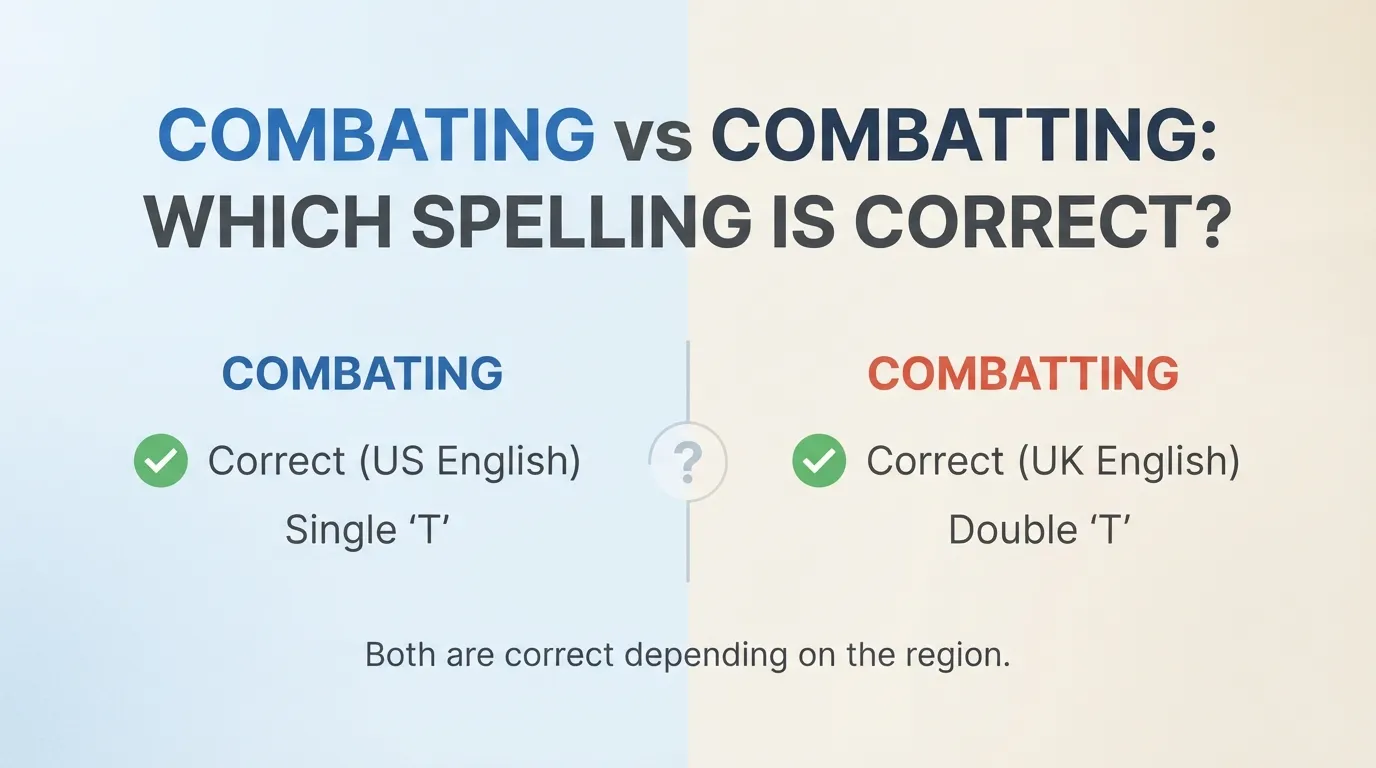
Combating and combatting are both correct spellings of the present participle and gerund of combat. They mean exactly the same thing: fighting against, resisting, opposing. The difference is regional and stylistic. Combating is the standard and far more common form in American English, and it is widely used internationally. Combatting is an accepted variant, more common in British English and in varieties that favor doubling the final consonant. If you write for an American audience, combating is the safer choice. If you write for a British audience, either will pass — but consistency matters more than the choice itself.
The Headline Test
Before the rule, the usage. Combating is the form you will meet in American newspapers, government reports, and corporate statements: “The organization is combating poverty.” “Scientists are combating climate change.” “The team is combating misinformation.” The word is at home in exactly the contexts where the stakes are highest — policy, public health, cybersecurity — because the figurative use of combat has become one of the most common verbs in modern public English. You combat disease, fraud, corruption, addiction, pollution, inflation, discrimination. Physical fighting is the oldest meaning; the figurative fight is the one that fills the headlines.
Combatting appears in the same contexts, usually in British, Australian, and other Commonwealth writing: “The council is combatting fly-tipping.” “The charity is combatting loneliness.” A reader who meets combatting in a British publication will not pause. A reader who meets it in an American one may feel a small hitch — not because the spelling is wrong, but because it is unexpected. That hitch is the whole practical difference. The words are twins; the audiences have preferences.

The Stress Question
The rule that separates the two spellings is the doubling rule, and it turns on a single question: where does the stress fall? When you add -ing (or -ed) to a verb that ends in a consonant-vowel-consonant pattern, you double the final consonant only if the stress falls on the final syllable.
Test it with familiar verbs. Admit is stressed on the final syllable — ad-MIT — so it becomes admitting and admitted, with a doubled T. Begin is be-GIN, stress final, so beginning. Prefer is pre-FER, stress final, so preferred — though American English has begun to accept prefered in some contexts, which shows the rule softening at the edges.
Now say combat aloud: COM-bat. The stress falls on the first syllable, not the final one. By the standard American rule, the final T does not double: combating, combated. The same rule gives you visiting (VIS-it, stress first), targeting (TAR-get), and budgeting (BUD-get). The T in combat sits in an unstressed syllable, and unstressed syllables do not earn a double letter.
This is why the copy editor’s instinct — “it looks like admitting” — was misleading. Admitting doubles because its stress is final. Combat does not double, in American English, because its stress is initial. The two words look alike on the page and behave differently in the rule, because the rule listens to stress, not to spelling.

Why Britain Doubles Anyway
British English applies the doubling rule more generously. In British spelling, a final consonant is often doubled after a short vowel even when the stress falls on an earlier syllable — which is why British English has travelled, cancelled, labelled, modelled, and combatting, where American English has traveled, canceled, labeled, modeled, and combating. The difference is not a mistake on either side. It is two spelling systems applying the same rule with different thresholds.
The British habit has a logic of its own: doubling the consonant preserves the short vowel sound of the base word. Combat has a short a in its second syllable, and doubling the T signals to the reader that the vowel stays short. American English relies on the reader to know the vowel already, and drops the extra letter. Both systems work. They simply disagree about how much help the reader needs.
This is also why combatting is not a misspelling in any variety. It is the regular product of the British system, the same way travelled is. An American editor who “corrects” combatting in a British document is not fixing an error — she is imposing a different system. The correct move is to match the document’s system, not to impose your own.
Combat’s Family
The verb combat brings a family with it, and the family is worth knowing because it shows how the word works in real sentences. The noun combat means fighting or armed conflict: “The soldier was injured during combat.” The adjective combative describes someone ready or eager to fight — or, in debate, someone aggressive in argument: “a combative witness.” The noun combatant names a person who fights, especially in war: “enemy combatants.” The noun combativeness names the quality itself.
None of these forms involve doubling. Combative has one T. Combatant has one T. The doubling question arises only with the -ing and -ed forms — combating/combatting and combated/combatted — because only those forms trigger the doubling rule. The rest of the family is stable across both spelling systems, which is one more reason the -ing form causes so much hesitation: it is the only place where the two systems visibly diverge.
The word’s figurative range is what makes it indispensable. You combat a disease by researching it, a rumor by refuting it, inflation by policy, misinformation by education. In each case the verb carries the same structure: an adversary, an effort, and the implication of an ongoing fight rather than a single blow. That is why the -ing form is so common — combating is almost always an ongoing action, a campaign rather than a moment.

Combating in Sports and Games
The word combat has a second home outside headlines and policy papers: sports and games. Combat sports — boxing, wrestling, mixed martial arts, fencing — are sports built around fighting, and the word there is literal. A combatant in a boxing ring is not fighting poverty or fraud. He is fighting another person, under rules, in front of a crowd. The figurative use of combating in policy writing borrows its seriousness from this literal core: when a government says it is “combating” a problem, it is claiming the urgency and discipline of a fight.
Games use the word too. Video games have combat systems — the rules that govern fighting — and combatants in strategy games are units that fight. Tabletop role-playing games devote whole chapters to combat, with rules for initiative, damage, and retreat. In these contexts the word is technical, not metaphorical, and the spelling follows the same rule as everywhere else: combating in American English, combatting in British English. The spelling system does not change when the subject changes from policy to play. The stress stays on the first syllable, and the rule follows the stress.
Which One for Your Document
The decision is simple once the rule is clear. Writing for an American audience? Use combating and combated. Writing for a British, Australian, or Commonwealth audience? Combatting and combatted are acceptable, and combating is also widely used — British writing is more tolerant of the single-T form than American writing is of the double-T form. Writing for an international audience? Combating is the safer default, because it is the more common form globally and the one least likely to be flagged by an American spellchecker.
Whatever you choose, keep it consistent. A document that uses combating on page one and combatting on page three looks unedited, even though both spellings are correct. The same goes for the past tense: pick combated or combatted and stay with it. Consistency is the one rule that no spelling system exempts you from.
And if a spellchecker flags combatting, remember that the flag is a statement about the checker’s dictionary, not about the word. American spellcheckers flag British spellings routinely — colour, travelled, organise — and none of those flags mean the words are wrong. The checker is enforcing a system. You are choosing one.
Stress First, Then Spell
Back in the newsroom, the headline ran as “City Combating Homelessness,” and nobody wrote in to complain. The rule that saved it fits in a sentence: stress the word, then spell it. COM-bat, stress first, single T in American English. If you ever hesitate again, say the word aloud, feel where the stress lands, and let the stress decide. The doubling rule listens to the voice, not the eye — and the voice says combating.











