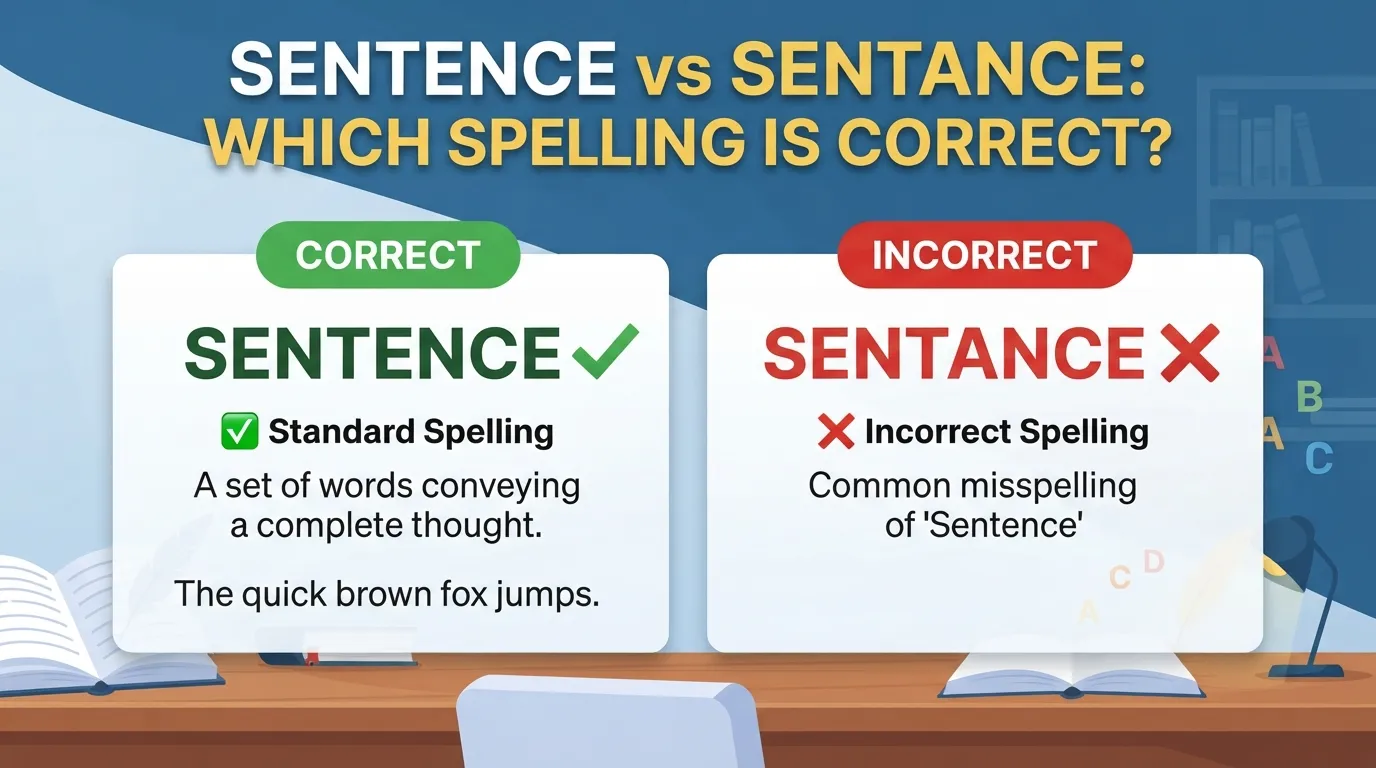
This article is made of sentences. So is the one you are reading now, and so is the note you left on the fridge this morning. Every piece of writing you have ever produced is built from them. And yet one of the most common spelling errors in English is the word for the thing itself: sentance, written with an A, where the correct spelling is sentence, with an E.
The error is almost poetic. The word that names the basic unit of writing is itself so often written wrong. But the mistake has clean causes, and the fix has a clean logic. This is a sentence about sentences — and about why the second vowel in the word is an E, not an A.
A Sentence, Defined by Itself
A sentence is a group of words that expresses a complete thought. In grammar, it normally contains a subject and a predicate — someone or something, and what they do or are. “The dog is sleeping.” Subject: the dog. Predicate: is sleeping. That is the whole machine, and every sentence you write is a variation on it.
Sentences come in four kinds, and each kind does a different job. A declarative sentence makes a statement: “The rain stopped.” An interrogative sentence asks a question: “Did the rain stop?” An imperative sentence gives a command: “Stop the rain.” An exclamatory sentence expresses strong feeling: “What a storm!” The punctuation at the end — period, question mark, exclamation point — is the signal of which kind you have written.
There is a useful irony here. The word sentence is doing its own job in this section: every example in the paragraph above is itself a sentence. The word is self-demonstrating. You cannot explain it without using it. That is part of why the spelling matters so much. A writer who misspells the word for the unit of writing has misspelled the tool they are using to make the mistake visible.

The Judge’s Sentence
Sentence has a second life, completely separate from grammar, and it is one of the oldest meanings of the word. In law, a sentence is a punishment formally imposed by a court after a conviction. “The judge announced the sentence.” “The defendant received a five-year sentence.” “The court sentenced him to community service.”
The two meanings share an ancestor. Both come from the Latin sententia, meaning an opinion, a judgment, a way of thinking. A grammatical sentence is a judgment expressed in words — a thought, stated. A legal sentence is a judgment expressed in punishment — a verdict, imposed. The same root grew two branches: one in the classroom, one in the courtroom.
The verb form belongs to the legal branch. To sentence someone is to impose a punishment: “She was sentenced to community service.” The past tense is sentenced, the present participle is sentencing. There is no grammatical verb to sentence — you do not “sentence a paragraph.” The verb belongs to the judge, not the grammarian.
This double life is worth knowing because it explains why the word feels so weighty. It is not just a schoolroom term. It is a word that has decided fates. The spelling carries that history: the same letters, the same E, in both the classroom and the courtroom.
The -ence Family vs. the -ance Family
Now the spelling. The mistake — sentance with an A — comes from the fact that English has two large families of words ending in a soft -ns sound, and the ear cannot reliably tell them apart.
The -ance family includes importance, appearance, performance, attendance, assistance. The -ence family includes sentence, difference, evidence, experience, confidence, existence, reference. Both families are large. Both endings sound nearly identical in normal speech — a soft, unstressed -ns. The ear votes for whichever family the writer happens to be thinking of, and it often votes wrong.
There is no perfect rule for choosing between -ance and -ence. But there are anchors. Sentence belongs with evidence and experience — words that share its Latin root in -entia. If you can spell evidence, you can spell sentence: same ending, same E, same family. The -ance words, by contrast, mostly come from a different Latin ending, -antia.
A second anchor is the word’s own structure. Sentence breaks into sent- (to feel, to think, to judge — the same root as sense and sentiment) plus -ence. The sent- root is spelled with an E. The ending is spelled with an E. The word is E’s all the way down, and the A has no place in it.

Sentences in the Writer’s Workshop
Getting the spelling right is only half the job. Using sentences well is the other half, and it is where the word earns its keep in the writer’s vocabulary. Good writing is not a pile of identical sentences. It is a rhythm — short sentences for punch, long sentences for flow, questions for curiosity, fragments (used sparingly) for emphasis.
Consider the difference. “The meeting ended. Everyone left. The room was empty.” Three short sentences, three hammer blows. Now the same information in one long sentence: “When the meeting ended, everyone left, and the room, which had been full of argument minutes before, stood empty.” Same facts, different feeling. The first version is blunt. The second is reflective. The choice between them is a sentence-level choice, and it is one of the most powerful tools a writer has.
Variety is the rule. A paragraph of all short sentences feels choppy. A paragraph of all long sentences feels exhausting. The writers readers love — journalists, novelists, essayists — mix lengths the way musicians mix notes. The sentence is the note. The paragraph is the phrase. The page is the song.
Run-Ons, Fragments, and Comma Splices
Knowing what a sentence is also means knowing what it is not. Three common errors haunt writers, and each one is a sentence that has gone wrong in a specific way.
A run-on sentence crams two complete thoughts together without the punctuation or conjunction to join them. “The rain stopped we went outside.” The sentence has two subjects, two verbs, and no bridge between them. The fix is a period, a semicolon, or a conjunction: “The rain stopped, and we went outside.” The run-on is the sentence that tried to do too much at once.
A fragment is the opposite: a piece of a sentence pretending to be whole. “Because the rain stopped.” The words form a dependent clause — a thought that leans on a main clause that never arrives. Fragments appear constantly in advertising, fiction, and casual writing, where they create punch and rhythm. “Rain. Silence. Morning.” But in formal writing, a fragment is an error: a sentence that stopped before it started.
A comma splice joins two complete sentences with only a comma. “The rain stopped, we went outside.” The comma is not strong enough to hold two sentences together. The fix is the same as for the run-on: a period, a semicolon, or a conjunction. The comma splice is the most common sentence error in English, and it survives because it looks so harmless — a tiny mark doing a job it was never meant to do.
The three errors are related. Each one is a sentence boundary drawn in the wrong place — too late, too early, or with the wrong tool. Learning to spot them is learning to hear where sentences begin and end, which is the most basic skill in writing.
The Longest Sentences Ever Written
At the other extreme are sentences that refuse to end. Molly Bloom’s soliloquy in James Joyce’s Ulysses runs for thousands of words with almost no punctuation — a single sentence that lasts for pages, mimicking the flow of thought itself. Legal documents are famous for sentences that run for hundreds of words, stacking clauses with and and provided that until the reader loses the thread. The longest sentence in English literature is a matter of debate, but the candidates all share a feature: they are sentences that test the definition of a sentence.
The lesson is not that long sentences are bad. It is that a sentence is a unit of thought, and the unit must hold together. A short sentence holds together by force. A long sentence holds together by structure — by parallel clauses, by careful punctuation, by a subject and a verb that stay in sight. The longest sentences work because their grammar is sound, even when their length is extreme. The shortest sentences work because they say one thing, cleanly, and stop.
The Lock-In
When the word appears in your draft, run two checks. First, the family check: does it belong with evidence and experience? Yes — -ence, with an E. Second, the root check: does the sent- root take an E? Yes — like sense and sentiment. Two checks, both pointing to E, and the A is out.
And if you want a sentence to remember it by, here is one: “Every sentence the judge sentences carries the same E.” The grammar and the law, the classroom and the courtroom, the word and its meaning — all of them spelled with an E, all of them sentences, all of them correct.


The word is the unit. The unit is spelled S-E-N-T-E-N-C-E. Write it that way, and every sentence you write — declarative, interrogative, imperative, exclamatory — will carry its own name correctly.










