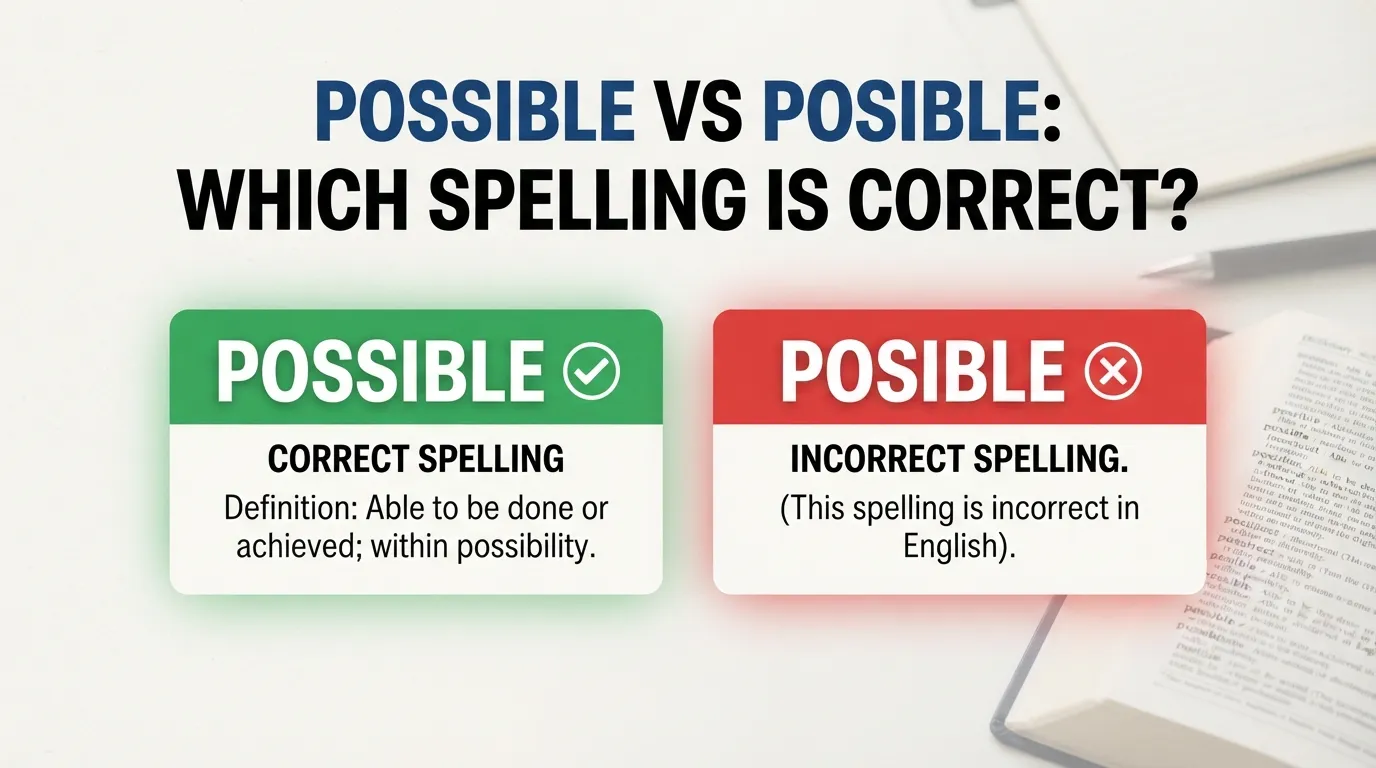
“Is it possible to finish today?” The question is small, but the word inside it is enormous. Possible is the word English uses to open doors — to say that something could happen, could exist, could be done, could be true. It is the word of invitations, of plans, of moon landings, of every sentence that begins with “what if.” It is also one of the most commonly misspelled words in English, usually by dropping one of its two S’s and producing posible.
The misspelling is easy to understand. The ear hears one S sound, and the hand writes one S. But the word has two, and the reasons reach back through Latin, through the whole family of -ible words, and through the idea of possibility itself. This is the story of a word that says “it could be” — and of the extra letter that keeps it honest.
Possible, Probable, Plausible: Three Cousins
Possible is often confused with two near-neighbors, and sorting them out is the first step to using the word precisely.
Possible means something can happen, can exist, can be done, or may be true. It is the widest of the three. “It is possible that it will rain” says only that rain is within the range of things that could occur. It says nothing about how likely rain is.
Probable is narrower. It means something is likely to happen. “Rain is probable” says rain is expected — more likely than not. Everything probable is possible, but not everything possible is probable. A snowstorm in July is possible in some climates; it is not probable.
Plausible is narrower still, and it works differently. It means something seems reasonable or believable. “Her explanation was plausible” says the story held together, that a listener could believe it. A claim can be possible without being plausible — a far-fetched story might be technically possible and still not believable — and plausible without being probable.
The three words form a gradient: possible (it could be), plausible (it seems believable), probable (it likely will be). Writers who keep them apart write more precisely, because each one makes a different claim about the world. Possible is the most generous of the three. It asks for the least evidence and opens the widest door.

Possible in Science and Philosophy
Science lives on the distinction between possible and probable. A hypothesis is possible if it does not contradict what is known. It becomes probable only when evidence supports it. The history of science is full of ideas that were possible for decades before they became probable — plate tectonics, the existence of exoplanets, the idea that a virus could cause cancer. Possibility is the waiting room of knowledge. Probability is the promotion.
Philosophers took the word further. In the seventeenth century, Gottfried Wilhelm Leibniz imagined “possible worlds” — complete universes that could have existed but do not. Our world, he argued, is one possible world among infinitely many. The idea became a whole branch of philosophy, modal logic, which studies what is possible, necessary, and impossible. In that vocabulary, possible has a precise meaning: true in at least one possible world. Necessary means true in all of them.
The word also anchors one of the most famous sentences in modern history. When John F. Kennedy said the United States would land a man on the Moon, he was declaring that something most people considered merely possible was now a goal. The gap between possible and actual is where engineering, politics, and human effort live. Possibility is the starting line. Actuality is the finish.
Possible in Everyday Speech
In daily life, possible does quieter work. It appears in the fixed phrases that grease conversation and business. “As soon as possible” — the most common of them — is a polite urgency: do it quickly, but no faster than reality allows. “Make it possible” means to create the conditions for something to happen. “Do the impossible” is praise for achieving what seemed beyond reach.
The word also does diplomatic work. “Is it possible to change the reservation?” is softer than “Change the reservation.” It asks whether the change is within the range of what can be done, and it gives the other person room to say no. That softness is part of the word’s power. Possible does not demand. It inquires.
And then there is the word’s famous partner: impossible. The two words frame the whole range of human expectation. “Nothing is impossible” is the slogan of optimism. “Mission: Impossible” is the title of a franchise built on the thrill of doing what cannot be done. Between possible and impossible lies the entire field of human ambition.
When Possible Becomes a Promise
Possible has a peculiar power: it can sound like a promise even when it is only a statement of fact. “It is possible to finish by Friday” is, strictly, a claim about feasibility. But a listener hears commitment. A manager hears a deadline. A client hears a guarantee. The gap between what possible means and what it implies is one of the most common sources of misunderstanding in business communication.
The confusion happens because possible is doing two jobs at once. Logically, it says: nothing prevents this. Socially, it says: I am willing to try. When a colleague says “Is it possible to get the report by Thursday?” they are not asking a philosophical question about the nature of possibility. They are asking for the report by Thursday, politely. The word is a softener wrapped around a request.
Careful communicators learn to separate the two jobs. If you mean “it can be done,” say “It is possible.” If you mean “I will do it,” say “I will do it.” If you mean “it can be done but I am not committing,” say “It is possible, but I cannot promise it.” The extra words cost nothing and prevent the most common possible misunderstanding: the one where a statement of feasibility is mistaken for a promise.
The word also carries the whole weight of motivation culture. “Anything is possible” is the slogan on gym walls, startup offices, and self-help books. Taken literally, it is false — you cannot breathe underwater unaided, and you cannot be in two places at once. Taken as encouragement, it is powerful: it says the range of what you can do is wider than you think. Possible is the word of the pep talk, the halftime speech, the comeback story. It does not describe the world as it is. It describes the world as it could be, if you act.
The Missing S
So why does the word have two S’s? The answer is in its ancestry. Possible comes from the Latin possibilis, which came from posse, meaning “to be able.” The double S was already there in Latin, and English kept it. The pronunciation never had two separate S sounds — the double letter is a fossil of the word’s origin, not a record of its sound. English is full of such fossils: necessary, successful, possession, discussion. In each case, the ear hears one sound and the spelling keeps two letters.
The word belongs to a family that makes the double S easier to remember. English has a large group of adjectives ending in -ible: visible, terrible, credible, flexible, responsible, accessible. Possible is the most common member of that family, and it follows the family’s spelling pattern. The -ible ending is spelled with one I, one B, one L, one E — and in possible, the stem before it carries the double S.
One practical note: posible is the correct spelling in Spanish, where the word has one S. Spanish speakers writing in English are especially likely to drop the second S, because their own language spells it that way. If Spanish is your first language, the double S in English possible is worth a deliberate second look. The two languages share the word; they do not share the spelling.

The Lock-In
Hold the word in its Latin shape: poss-ible. The stem poss — to be able — carries the double S. The ending -ible follows. Two S’s, one word, one idea: it can be done.
And when you write it, let the meaning check the spelling. If you are saying something could happen, could exist, could be done, or could be true — the door is open, the word is possible, and it carries two S’s through that door with it. One S is Spanish. Two S’s is English. The door opens either way, but the spelling tells the reader which language you are standing in.


That is the word: a door-opener with a double S. It says what could be, it leaves room for what might be, and it carries its Latin history in its spelling. Two S’s, every time — the small price of keeping the door open.










