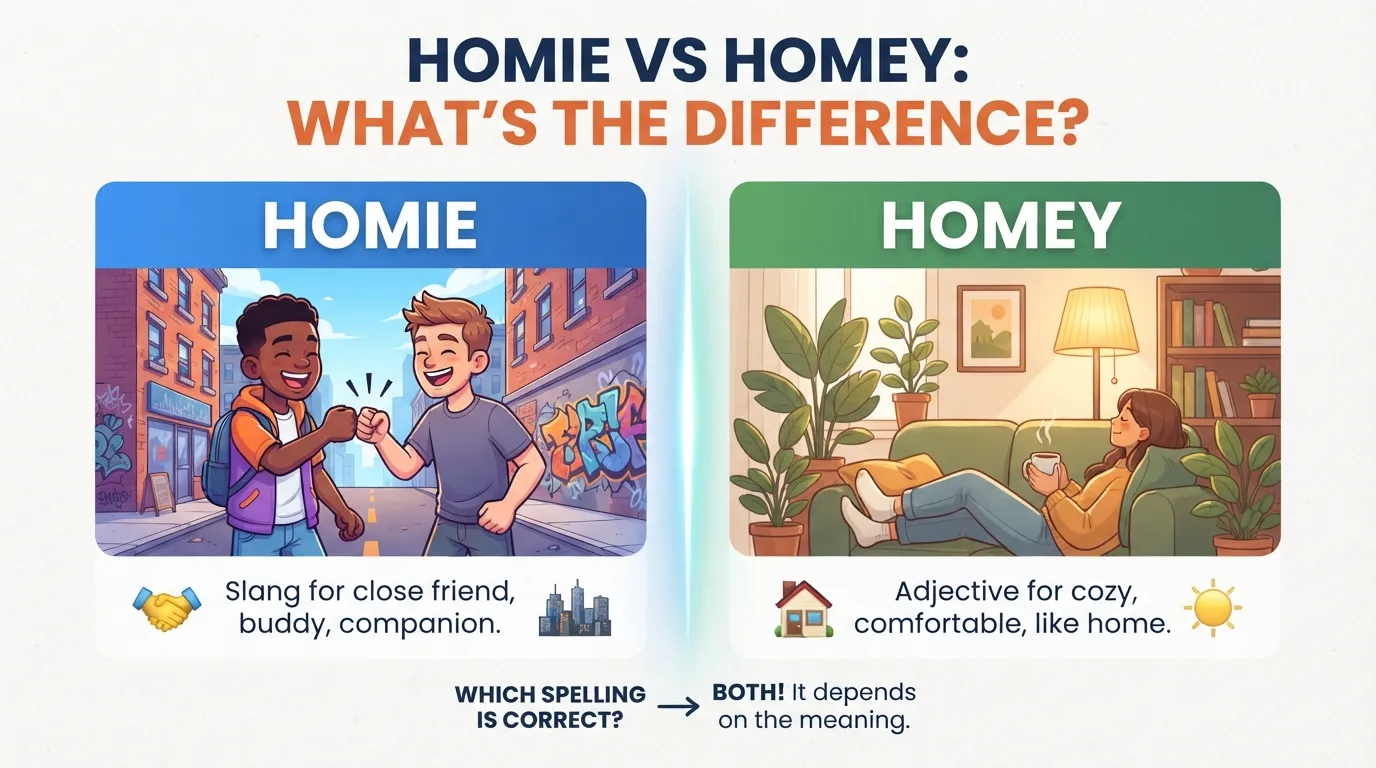
It is a Saturday afternoon on a block where everyone knows everyone. On one porch, a man calls out, “What is up, my homie?” — his close friend, his trusted companion, the person who has had his back since high school. On the next porch over, a woman arranges cushions and says, “I want this place to feel homey” — warm, comfortable, welcoming, like home. Two porches, two words, one letter apart. Homie is a person. Homey is a feeling.
The two words grew up on the same street — the word home — and they still get mistaken for each other. The confusion is understandable: they look almost identical, they sound almost identical, and they both carry the warmth of home. But they do different jobs in a sentence, and swapping them produces sentences that are either funny or confusing. This is the story of two words that share a street and live in different houses.
Homie: The Person
Homie is a noun, and it means a close friend — especially a trusted friend, a longtime companion, or someone from your neighborhood or social group. “My homie gave me a ride home.” “I have known that homie since high school.” “A few of my homies are coming over tonight.”
The word grew out of African American Vernacular English and spread through hip-hop culture in the 1980s and 1990s, carried by songs, films, and everyday speech until it became one of the most widely recognized slang words in American English. Its root is homeboy — a person from your home neighborhood, your home turf — shortened and softened into homie. The word kept the loyalty of its origin. A homie is not just any friend. A homie is someone you trust, someone from your circle, someone who knows where you come from.
The word is informal by nature. It belongs in conversation, in texts, in lyrics, in dialogue. It does not belong in a job application or a formal report — not because it is wrong, but because it is casual the way a nickname is casual. It signals closeness, and closeness is not the register of every occasion.
Note the plural: homies. “My homies are coming over.” The word takes a regular plural, the way most slang nouns do. And note what it does not mean: a homie is not necessarily a best friend, and not necessarily a neighbor. It is a trusted member of your social group — the circle you count as yours.

Homey: The Feeling
Homey is an adjective, and it means comfortable, cozy, familiar, and welcoming in the way that home feels. “The little café has a homey atmosphere.” “I like the apartment because it feels warm and homey.” “Soft lighting makes the room feel more homey.”
The word describes an environment, an experience, a quality — not a person. A homey restaurant is one where you relax the moment you sit down. A homey hotel room is one that feels lived-in rather than sterile. A homey kitchen is one where people gather without being asked. The word carries the whole emotional content of home — safety, warmth, familiarity — and applies it to places that are not home.
The word has a long, quiet history in design and real estate. Estate agents call a house “homey” when they mean it feels welcoming. Interior designers chase homeyness with soft textures, warm light, and personal objects. Café owners cultivate it with wooden tables and the smell of coffee. Homey is a selling point, a compliment, and a design goal all at once.
Grammatically, homey behaves like any adjective. It takes comparative and superlative forms: homier, homiest. “This cabin is homier than the last one.” It pairs with adverbs: “surprisingly homey,” “warmly homey.” It modifies nouns: a homey atmosphere, a homey kitchen, a homey welcome.
The Crossover: When Homey Means Homie
Here is where the street gets complicated. Homey can also be used as an alternate spelling of homie — a noun meaning a close friend. “What is up, homey?” In this usage, homey is doing homie‘s job, and it is not a mistake. It is a recognized variant spelling, especially common in song lyrics, casual texts, and dialogue written to sound like speech.
This crossover is the main source of confusion between the two words. A reader who sees “homey” in a text cannot always tell whether it means “cozy” or “friend” without the context. “This place feels homey” is clearly the adjective. “What is up, homey?” is clearly the noun. But “Hey, homey” in a message could be either a greeting to a friend or — much less likely — a comment about coziness. Context decides.
The practical advice is simple: in your own writing, keep them apart. Use homie for the person and homey for the feeling. Reserve the homey-as-friend spelling for quoting lyrics, mimicking speech, or writing dialogue where the ambiguity is part of the flavor. In every other setting, the clean split — person versus feeling — will keep your sentences clear.

Homey Is Not Homely
There is a third word on the street, and it causes its own trouble: homely. In American English, homely usually means plain or unattractive in appearance — “a homely face.” In British English, homely often means cozy and comfortable, much like American homey. The same word, two meanings, split by an ocean.
The confusion between homey and homely is a spelling trap with real consequences. “A homey cottage” is a compliment in American English. “A homely cottage” in American English is an insult — or at least a backhanded remark. In British English, “a homely cottage” is a compliment. If you are writing for an international audience, homey is the safer word for “cozy,” because its meaning does not flip across the Atlantic.
Keep the three words in their houses: homie the friend, homey the cozy feeling, homely the word that means different things on different shores. Three words, one street, three addresses.
Homie in Music and Film
Homie traveled from neighborhood speech to global culture on the back of music. In 1980s and 1990s hip-hop, the word was everywhere — in lyrics, in shout-outs, in the language of loyalty that the music celebrated. Rappers called their friends, their crews, their neighborhoods their homies, and the word carried the whole ethic of the culture: loyalty, belonging, having someone’s back. When hip-hop went global, homie went with it, carried into languages and countries where English was a second language but the word needed no translation.
Film did the rest. Movies set in Los Angeles, New York, and Chicago put homie in the mouths of characters audiences recognized, and the word became shorthand for a whole world — the block, the crew, the code. Comedies played with it. Dramas leaned on it. By the 2000s, the word had crossed into advertising, into sitcoms, into the speech of people who had never lived on the blocks where it was born. It had become a global slang word with a local soul.
The journey changed the word’s meaning slightly. In its original use, homie carried weight — it meant someone you trusted with real things. In its global use, it lightened: it became a casual greeting, a friendly label, a word for any friend. “What is up, homie?” in a text between college students is a different speech act than “my homie” in a song about loyalty and survival. Both are correct. But the word’s history is worth remembering, because it explains why the word still feels warmer than friend and looser than brother. It carries the block with it, wherever it goes.
The Friend-or-Cozy Test
When the two words blur, run the substitution test. If you can replace the word with friend or buddy, you want homie: “Marcus is my homie” becomes “Marcus is my friend.” If you can replace it with cozy or comfortable, you want homey: “The cabin is homey” becomes “The cabin is cozy.” The test works every time, because the two words belong to different parts of speech — a noun and an adjective — and the substitution exposes which job the sentence needs.
And if you ever write the sentence “My homie has a homey apartment,” congratulate yourself. You have used both words correctly in a single breath — a friend, and a feeling, on the same street, in their proper houses.


Two words, one street, one letter apart. Homie is the person you trust. Homey is the feeling you get when you are home. Keep the person and the feeling in their proper houses, and the street stays friendly.










