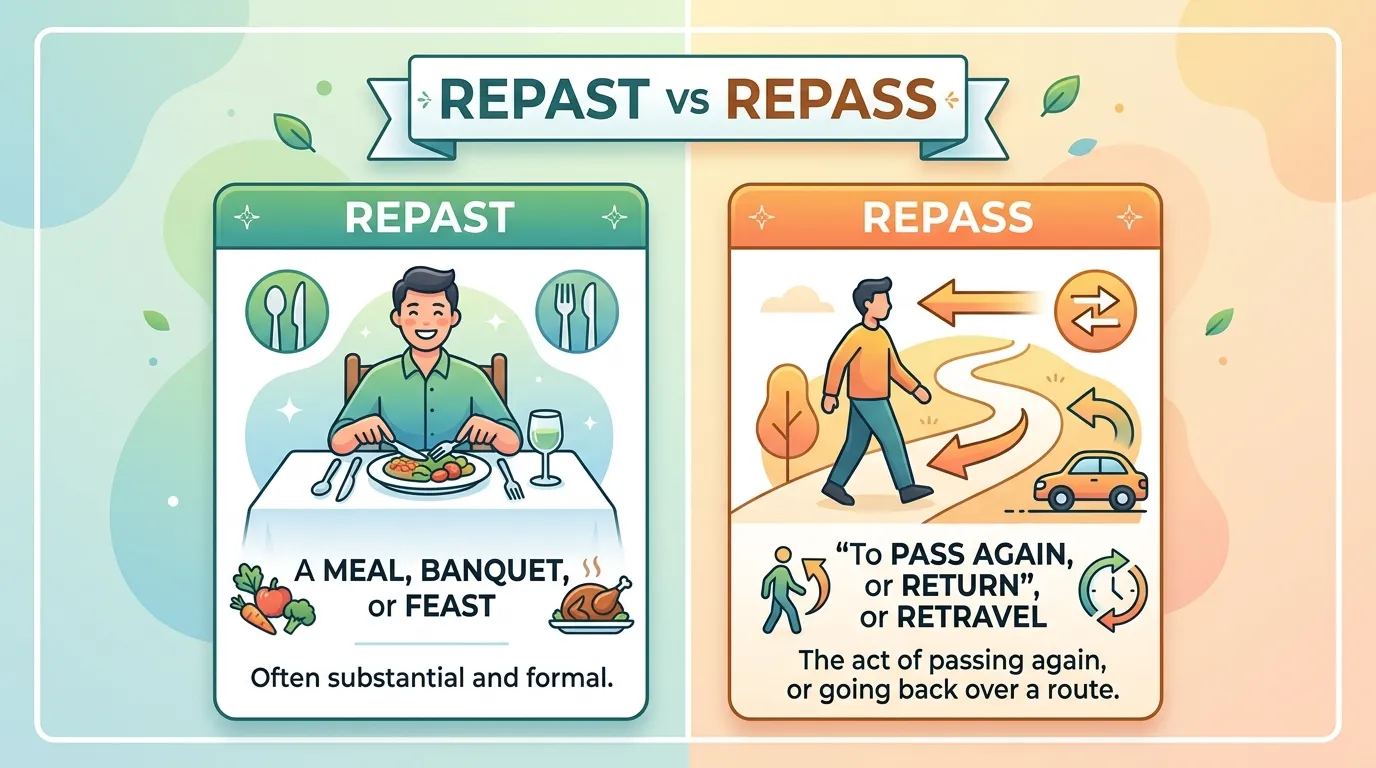
The banquet hall is lit by candles. The guests have been traveling all day, and the table is set with bread, roast meat, wine, and fruit. The host stands and says, “Please, join us for a repast.” Nobody at the table reaches for a dictionary. Everyone understands: a meal is about to be served, and it is going to be a good one. Three hundred miles away, at a border checkpoint, a guard looks at a passport and says, “You’ll have to repass through the inspection.” Nobody reaches for a dictionary there either. Everyone understands: the traveler is going to have to go through the process again. Two sentences, two words, one letter apart. Repast is a meal. Repass is to pass again. The confusion between them is a spelling accident — and the fix is knowing that they have nothing to do with each other.
The Banquet: What Repast Means
Repast is a noun meaning a meal, especially a meal eaten in a formal, literary, or traditional context. “The travelers stopped for a simple repast.” “A warm repast awaited the guests.” “They gathered around the table for an evening repast.” “The family shared a quiet repast.” In all of these, the word names food served and eaten as a meal. It is a relatively uncommon word in everyday American English. Most people say meal, dinner, lunch, or food. Repast appears in literature, historical writing, formal prose, religious writing, storytelling, and descriptions of traditional meals — places where the writer wants the meal to sound elevated, ceremonial, or old-fashioned.
The word’s tone is part of its meaning. Compare: “We had a meal” is neutral. “We shared a repast” is formal, literary, slightly old-fashioned. The difference is register, not definition. A repast is a meal described with ceremony. The word is most at home in historical novels, in religious writing (the Last Supper is sometimes called a repast), in funeral contexts (the meal after a funeral service is often called a repast in some communities), and in formal descriptions of feasts. In ordinary conversation, it sounds affected. In the right context, it sounds exactly right.
The word’s history explains its tone. Repast comes from Old French repast, from the verb repaistre, meaning “to feed again” or “to eat,” from Latin re- (again) + pascere (to feed, to graze). The root pascere also gives us pasture (a field where animals graze) and pastor (one who feeds a flock). The word’s ancestry is pastoral and ancient: it carries the image of feeding, of being fed, of a meal as an act of care. That is why it sounds literary. It is a word with old roots, used for old rituals.
The Checkpoint: What Repass Means
Repass is usually a verb meaning to pass again, to go through something again, or to go back over something. “We had to repass through the checkpoint.” “The bill must repass the committee.” “The student will repass the exam.” “The document required a repass through the review process.” In all of these, the word names a second passage: going through something a second time. The prefix re- means “again,” and the root pass means “to go through.” The word is transparent: re + pass = pass again. Anyone who knows the two parts knows the whole.
The verb’s uses are practical and modern. In education, a student repasses an exam they failed. In legislation, a bill repasses a committee that rejected it. In manufacturing, a product repasses inspection. In computing, data repasses through a filter. In all of these, the word means a second attempt, a second review, a second passage. It is the language of process, not of poetry. Where repast is literary and ceremonial, repass is technical and procedural.
Repass can also be a noun, though this use is less common. “The document required a repass through the review process.” Here, repass names the second passage itself: a second going-through. The noun sense is rare in everyday writing, and it is most often found in technical or administrative contexts. In most sentences, repass is a verb, and the noun sense can usually be replaced with second pass or review without losing anything.
Two Histories, One Coincidence
The two words look alike by accident. They share the first four letters — repa- — and they differ only in the last letter: st versus ss. But their histories are completely separate. Repast comes from Old French repast, from Latin re- + pascere (to feed). Repass comes from re- + pass, from Latin passus (a step). The shared re- prefix is a coincidence of English word-building, not a sign of relationship. The two words are false friends: they look like relatives, but they are strangers who happen to share a hallway.
The pronunciation is nearly identical, which is why the confusion persists. Repast is pronounced “ri-PAST” — two syllables, stress on the second, rhyming with past and last. Repass is pronounced “ri-PASS” — two syllables, stress on the second, rhyming with pass and class. In most accents, the difference is a single consonant at the very end: t versus s. In fast speech, even that difference can blur. The ear cannot reliably tell them apart. Only the spelling — and the context — can.
There is also a grammatical difference worth noting. Repast is almost always a noun. It names a thing: a meal. Repass is almost always a verb. It names an action: passing again. The two words do different jobs in a sentence, and the job is the surest guide to the spelling. If the sentence needs a noun naming a meal, the word is repast. If the sentence needs a verb naming a second passage, the word is repass. The grammar decides, even when the ear cannot.
Where Each Word Lives
The two words live in different worlds, and seeing those worlds side by side makes the distinction concrete. Repast lives in the world of food, ceremony, and literature. It appears in historical novels (“The knights gathered for a hearty repast”), in religious writing (“the repast of the Passover”), in funeral programs (“a repast will follow the service”), in formal descriptions of banquets and feasts. Its synonyms are meal, feast, banquet, dinner, supper, spread — words that name food served with intention.
Repass lives in the world of process, review, and repetition. It appears in school policies (“students who fail may repass the exam”), in legislative procedure (“the bill must repass the Senate”), in quality control (“the part must repass inspection”), in software (“the data will repass through the filter”). Its synonyms are retake, redo, repeat, revisit, go through again — words that name doing something a second time. The two words’ synonyms do not overlap at all. That is the clearest proof that they are different words: they cannot be substituted for each other in any sentence without changing the meaning completely.
One more distinction matters: frequency. Repast is uncommon but recognized; most educated readers know it, even if they rarely use it. Repass is also uncommon, but for a different reason: it is a technical word, used in specific professional contexts. Both words are the kind that writers encounter in reading more often than in speech. And both are the kind that spellcheckers accept, because both are correctly spelled English words. The error — writing one when you mean the other — is invisible to spellcheckers and visible to every careful reader.
Repast in the Funeral Home
There is one modern context where repast is not literary at all, but practical and communal: the meal after a funeral. In many African American, Southern, and church communities, the repast is the gathering where family and friends eat together after a burial or memorial service. It is organized, expected, and deeply meaningful — a time for the bereaved to be fed, literally and figuratively, by their community. Church bulletins announce it plainly: “A repast will follow the service in the fellowship hall.” In this context, the word is not old-fashioned. It is the standard term, used by everyone, understood by everyone, and carrying a weight that meal does not quite convey. The repast is not just food. It is care, delivered on plates.
The Feast and the Second Pass
Here are the memory hooks, one for each word. For repast: the word ends in -past, and a repast is a meal you remember — something in the past that you look back on. A feast becomes a memory. The t at the end is the past tense of the meal: it happened, it was eaten, it is now in the past. Repast ends in past because a meal, once eaten, is past. The spelling contains its own memorial.
For repass: the word contains pass, whole and visible, right there in the middle. Re + pass. If you can see pass inside the word, you know what it means: to pass again. The ss at the end is the ss of pass, doubled and unmistakable. There is no pass in repast. There is a past. One word holds a journey; the other holds a meal. The letters tell you which is which.
So the next time you write about a banquet or a checkpoint, you will know. The candles, the bread, the wine, the guests who traveled all day: that is a repast. The guard, the passport, the inspection, the second time through: that is a repass. One letter apart, two different worlds — and now you know which door each spelling opens.










