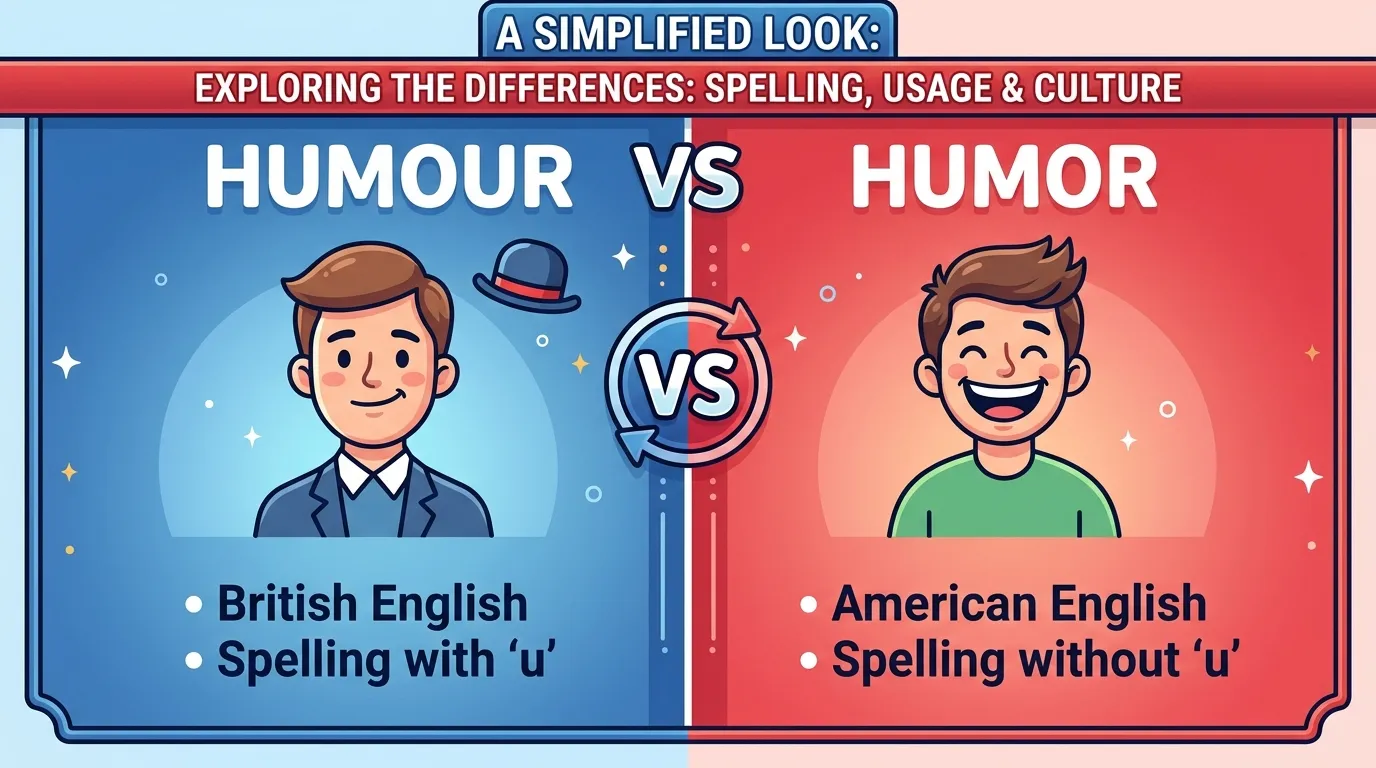
The comedian is halfway through his set when he points at a man in the front row and says, “You’ve got a great sense of humour.” The crowd laughs. The joke lands. And somewhere in the back of the room, an American tourist is quietly wondering why the club’s poster spells it with a u — humour — when back home it would be humor. Same joke, same word, one extra letter. Nobody in the room thinks either spelling is wrong, because neither one is. The difference between humor and humour is not meaning, and it is not correctness. It is geography.
Both spellings name the same thing: the quality of being funny, the ability to see or create what is amusing, and a person’s way of looking at the comic side of life. The pronunciation is the same. The meaning is the same. What changes is the audience. American English writes humor. British English writes humour. And the reason the word has two spellings at all is a story that runs from ancient medicine through a spelling reformer’s dictionary and into the present day.
A Night at the Comedy Club
Start with what the word actually does. As a noun, humor or humour is the quality that makes something funny: “The essay is full of humor.” “His humour is dry and understated.” It also names a person’s capacity for amusement: “She has a wonderful sense of humor.” “He lost his sense of humour after the long winter.” And it covers a style or type of comedy: “British humour leans toward understatement.” “American humor often goes bigger and louder.”
The word also works as a verb, and this is where people sometimes hesitate. To humor someone is to go along with them, to indulge a request or a mood: “She humored him by listening to the whole story.” “He humored the toddler’s demand for one more song.” The verb takes the same regional spelling as the noun — humor in American writing, humour in British writing — and it always carries a slight sense of indulgence, of granting something that is not strictly necessary.
Then there is the family around the word. A humorist is someone who writes or performs comedy professionally. Humorless describes a person or a piece of writing without any comedy in it — and notice that humorless drops the u even in British English, because the suffix -less attaches to the American-style base. Gallows humor is comedy about grim subjects, the kind of joke people make to survive terrible situations. And humor me is the conversational request: “Just humor me and hear me out.” All of these keep the regional spelling of their root, which is why a British writer produces humourless far less often than you might expect — the u tends to vanish once suffixes pile on.
The Four Humours: When Humor Meant Medicine
Here is the part of the story most people never hear. For more than a thousand years, humour had almost nothing to do with comedy. It was a medical word. Ancient Greek physicians, following Hippocrates, believed the human body was governed by four fluids — four humours: blood, phlegm, yellow bile, and black bile. Health meant the four fluids in balance. Sickness meant one of them running wild.
Each humour was tied to a temperament, and those old temperament words still survive. An excess of blood made a person sanguine — warm, cheerful, optimistic. Too much yellow bile made a person choleric — quick-tempered, irritable, fiery. Too much phlegm made a person phlegmatic — calm, slow, hard to excite. Too much black bile made a person melancholic — gloomy, thoughtful, sad. The four temperaments were, in effect, the first personality theory in Western medicine, and they were built entirely on the word humour.
This is why the phrase “in good humour” originally had nothing to do with jokes. It meant your fluids were balanced — you were in a good physical and mental state. “In bad humour” meant the balance had tipped. Over centuries, as the medical theory collapsed and germ theory replaced it, the word’s meaning drifted from the fluids themselves to the mood they were supposed to produce, and then from mood to amusement. By the time Shakespeare was writing, humour could already mean a passing mood or a comic character trait. The comedy meaning won, but the medical meaning left a fossil in the language: we still say someone is “in a good humour” or “in a bad humour” when we mean their mood, not their jokes.
Knowing this history gives the spelling a backbone. The u in humour is not decoration. It is the French and Latin inheritance — the word came to English through Old French humor, from Latin umor, meaning fluid or moisture. The British spelling kept the u that French spelling favored. The American spelling dropped it. Both choices are defensible; one of them is simply older.
The U That Stayed Home
The American spelling exists because of Noah Webster, the dictionary-maker who set out in the early 1800s to give the young United States a spelling system of its own. Webster thought English spelling carried a lot of dead weight, and the u in words like colour, favour, honour, behaviour, labour, neighbour, and humour was near the top of his list. He cut it. Color, favor, honor, behavior, labor, neighbor, humor. The reforms stuck in the United States because Webster’s spellers and dictionaries were adopted by American schools, and a whole country learned the shorter forms.
Britain never adopted the cuts. British English kept colour, favour, honour, behaviour, labour, neighbour, and humour. Canada and Australia largely followed Britain, though Canadian English mixes the two systems in places, and Australian English holds firmly to the u. So the rule for humor versus humour is the same as the rule for the whole family: if your audience writes colour, write humour. If your audience writes color, write humor. The word travels with its cousins, and splitting the family looks inconsistent even when each individual choice is correct.
One practical wrinkle: the u tends to disappear in derived forms even in British writing. Humorous keeps the u in British English (humorous in both varieties, since the American form is also humorous), but humorless usually appears without the u everywhere, and humorist is spelled the same on both sides of the Atlantic. The u is most stable in the bare noun and verb. When in doubt, check the base word, not the derived one.
Humor’s Other Jobs
The word does quiet work in several fixed phrases, and knowing them keeps your writing natural. A sense of humor is the most common collocation in both varieties — the ability to perceive and enjoy comedy. Dry humor is comedy delivered without obvious signals, where the joke hides behind a straight face. Dark humor or black humor is comedy about death, suffering, or disaster. Slapstick humor is physical comedy: falls, collisions, pies. Toilet humor is comedy about bodily functions, beloved by children and tolerated by adults in small doses.
There is also the verb’s special use in the phrase humor me, which deserves a note because it is so common in speech. “Humor me — what would happen if we actually tried it?” The speaker is asking for indulgence, not for comedy. The phrase is casual, slightly self-deprecating, and it works in both varieties with the regional spelling intact. A British speaker writes, “Humour me.” An American writes, “Humor me.” Same request, same tone, one letter apart.
Finally, a usage note for formal writing: humor and humour are both fully standard in their regions, and neither one is a sign of carelessness. The only real mistake is inconsistency — writing humor in one paragraph and humour in the next, or mixing color with humour in the same document. Readers notice the flip, and it reads as inattention even though each spelling is correct on its own.
One Spelling Per Document
The decision procedure is short. First, ask who is reading. An American audience, an American publication, or an American style guide (Associated Press, Chicago) means humor. A British, Australian, or New Zealand audience, or a British style guide (Oxford), means humour. An international audience means picking one and holding it — either choice is defensible, and consistency is what the reader actually judges. Second, set your spellchecker to the same variety. A checker set to American English will flag humour as an error, and one set to British English will flag humor. The flag is not a verdict on the word; it is a verdict on the setting. Third, carry the choice through the whole word family: humor/humour, color/colour, favor/favour, behavior/behaviour — all one system, all one document.
The memory hook is the simplest one in this whole series: the u belongs to the UK. If your readers put a u in colour, give humour its u too. If they don’t, don’t. The comedian in the front row never cared about the poster’s spelling — he cared whether the joke landed. But the poster’s spelling told the room which English it was speaking, and that is exactly what spelling is for.










