The instructor says, “Breathe in.” The class inhales. She says, “Hold your breath.” The class holds. She says, “Breathe out.” The class exhales. In ninety seconds, the room has used two words — breath and breathe — a dozen times, and no one has confused them, because the instructor’s voice makes the difference audible. On the page, the difference is harder. The two words look almost identical, they describe closely connected ideas, and the wrong one slips into sentences constantly. The rule is simple: breath is a noun, breathe is a verb. You take a breath. You breathe air. And the final e in breathe is the whole story.
Inhale: The Verb
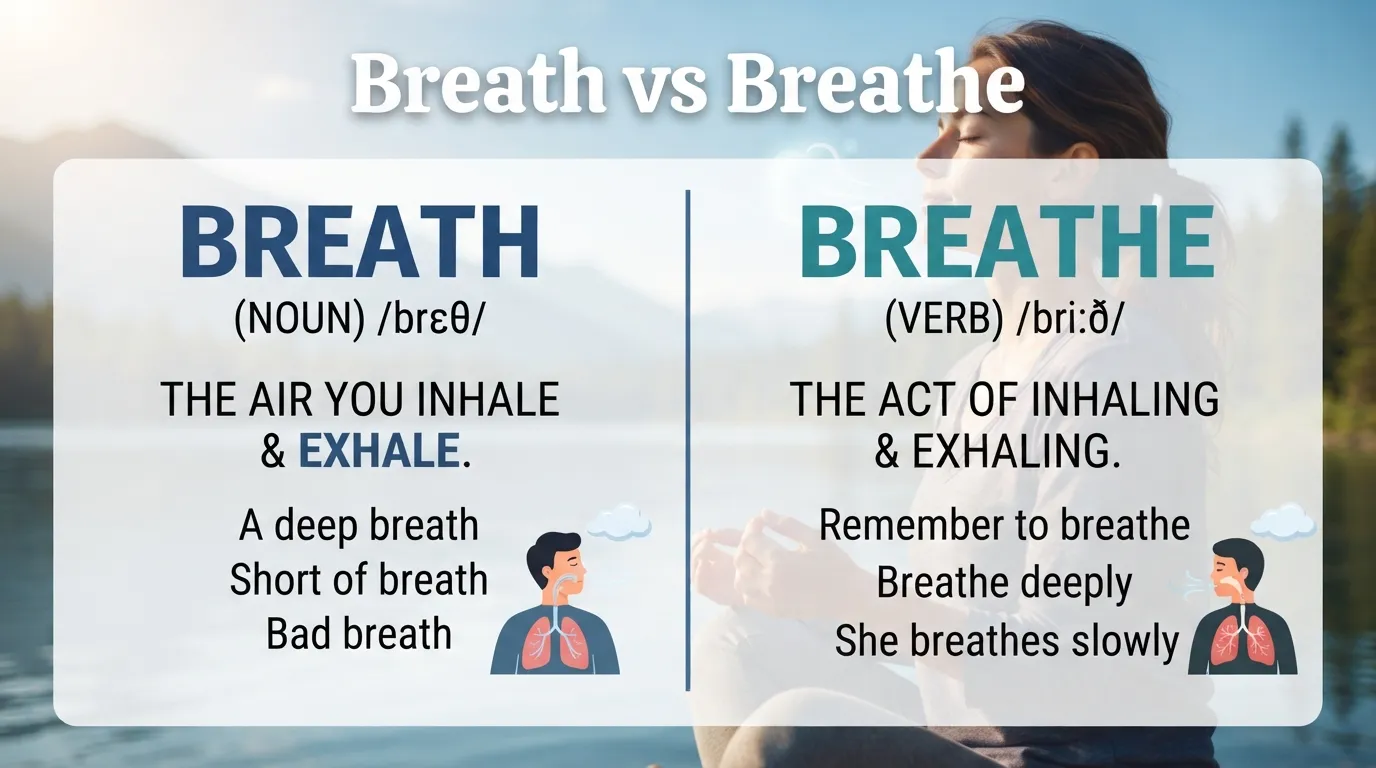
Breathe is a verb. It describes the physical action of taking air into your lungs and releasing it. “We need to breathe.” “She breathed deeply.” “He was having trouble breathing.” “The athlete stopped to breathe.” Because it is a verb, it changes form with tense: breathe, breathes, breathed, breathing. “She breathes slowly.” “He breathed a sigh of relief.” “They are breathing deeply.” The verb is the action, the process, the thing you do from birth to death without thinking about it — about twenty thousand times a day.
The pronunciation is “breeth” — one syllable, with a long ee sound and a soft th at the end, like the th in this or that (a voiced th, /ð/). The final e is silent, but it does two jobs. First, it marks the word as a verb — it is the letter that distinguishes breathe from breath. Second, it lengthens the vowel: the e at the end tells the reader that the ea in the middle is long. Without the e, the word would be breath, a different word with a different sound.
The verb also has a figurative life. You can breathe life into a project, breathe a sigh of relief, breathe down someone’s neck (to watch them closely, usually with pressure), breathe easy (to relax after worry). In all of these, the verb means something like “to live” or “to allow to live.” The metaphor is the body: a project that breathes is alive, a person who breathes easy is no longer holding their breath. The verb carries the idea of life itself.
Hold: The Noun
Breath is a noun. It refers to the air that enters or leaves your lungs, or to one act of inhaling or exhaling. “I took a deep breath.” “She held her breath.” “His breath was visible in the cold air.” “Take a slow breath before speaking.” Because it is a noun, it can follow a, the, your, my, deep, long, short, fresh, bad, cold. You can count it: one breath, two breaths, three breaths. You can describe it: a deep breath, a shallow breath, a ragged breath, a shaky breath. You can lose it: “I lost my breath.” You can catch it: “Let me catch my breath.”
The pronunciation is “breth” — one syllable, with a short e sound and a hard th at the end, like the th in think or thing (an unvoiced th, /θ/). The difference from breathe is twofold: the vowel is shorter, and the final th is harder. Say them aloud, one after the other: “breth — breeth.” The first is clipped. The second is drawn out. The spelling records the difference: breath has no final e, and its vowel is short. Breathe has a final e, and its vowel is long.
The noun also has a figurative life, and it is rich. Breath of fresh air means something new and refreshing. Waste of breath means an effort that will not be heard. Under your breath means muttered quietly. Take my breath away means to astonish or overwhelm. Hold your breath can mean to wait in suspense, not just to stop inhaling. Bad breath is a medical and social condition. Breath mint is a small candy with a large job. In all of these, the noun names a thing — air, a moment, a pause — that the verb describes doing.
The Final E: A Family Pattern
The breath/breathe pair belongs to a family of English noun-verb pairs where the verb adds a final e and the pronunciation changes. The pattern is one of the most consistent in English spelling, and learning it makes every member easier:
- Bath (noun) / bathe (verb) — “Take a bath” vs. “Bathe the baby.”
- Cloth (noun) / clothe (verb) — “A cloth” vs. “To clothe someone.”
- Sooth (noun, rare) / soothe (verb) — “Sooth” (truth) vs. “To soothe a worry.”
- Breath (noun) / breathe (verb) — “Take a breath” vs. “Breathe slowly.”
In each pair, the noun is shorter and the verb is longer by one letter. The final e is the verb marker. It tells the reader: this word is an action, not a thing. It also changes the pronunciation: the th at the end softens from the hard /θ/ of the noun to the soft /ð/ of the verb. The spelling and the sound work together. The e is not decoration. It is grammar, written down.
There is a second pattern worth noticing: the noun-verb pairs where the verb is formed by adding -e are part of a larger system in which English marks verbs with extra letters. Advice (noun) / advise (verb). Practice (noun, British) / practise (verb, British). Device (noun) / devise (verb). In each case, the verb is the longer form, and the extra letter is the signal. Breath/breathe follows the same logic with a different letter: the verb adds e instead of changing c to s.
Where the Confusion Lives
The most common error is writing breathe when you mean the noun: “Take a deep breathe.” It appears in emails, in social media posts, in student essays, in casual writing of every kind. The reverse error — writing breath when you mean the verb — is less common but still appears: “Try to breath slowly.” Both errors come from the same source: the two words look alike, sound alike, and describe the same biological process. The writer’s brain reaches for the wrong one, and the spellchecker does not catch it, because both words are correctly spelled English words. The error is grammatical, not orthographic, and spellcheckers do not check grammar.
The fix is a substitution test. If the word follows a, the, your, my, deep, or take, it is a noun, and the spelling is breath: “Take a deep breath.” “Hold your breath.” “A breath of fresh air.” If the word follows to, can, will, try to, or a subject pronoun, it is a verb, and the spelling is breathe: “Try to breathe slowly.” “She breathes deeply.” “We need to breathe.” The words around the blank tell you which word belongs in it. Grammar is the spellchecker that works.
There is also a pronunciation check, for writers who say the sentence aloud before writing it. If the final th sounds hard, like think, the word is breath. If it sounds soft, like this, the word is breathe. The ear can tell them apart, even when the eye cannot. Say the sentence, listen to the th, and the spelling follows.
Breath in Music and Sport
Musicians and athletes live by the breath/breathe distinction, and their vocabulary shows why the two words matter. A wind player’s breath control is the ability to manage airflow through an instrument — a noun phrase naming a skill. A singer is taught to breathe from the diaphragm — a verb phrase naming an action. A runner’s breathing rhythm is the pattern of inhales and exhales that sustains a pace. A swimmer’s breath is the gulp of air taken at the turn. In each case, the noun names the air or the capacity, and the verb names the doing. The two words work as a pair, and the pair is the whole technique.
Coaches use the distinction as a teaching tool. “Take a breath” is an instruction to pause, to reset, to gather yourself. “Breathe” is an instruction to keep going, to maintain the flow. The first stops the action. The second sustains it. A coach who confuses them confuses the athlete. The same is true for writers: a sentence that needs a pause needs breath, and a sentence that needs motion needs breathe. The grammar is the coaching.
Exhale: The Check That Stays
Here is the memory hook, and it grows directly out of the yoga class. Breathe is longer than breath — it has one extra letter, the final e — because breathing is the longer activity. A breath is a moment: one inhale, one exhale, done. Breathing is a lifetime: twenty thousand times a day, from birth to death, without stopping. The longer word names the longer action. The shorter word names the shorter thing. Breath: a moment. Breathe: a lifetime. The extra e is the extra time.
Another hook: the e in breathe stands for exhale — the action the verb describes. When you see the e at the end, think “exhale,” and you will know the word is the verb. When there is no e, think “air,” the thing, and you will know the word is the noun. Two hooks, one for each spelling, and the confusion is gone.
The instructor says, “Breathe in.” The class inhales. She says, “Hold your breath.” The class holds. She says, “Breathe out.” The class exhales. The verbs move the air. The noun names it. And now, on the page as in the room, you know which is which.










