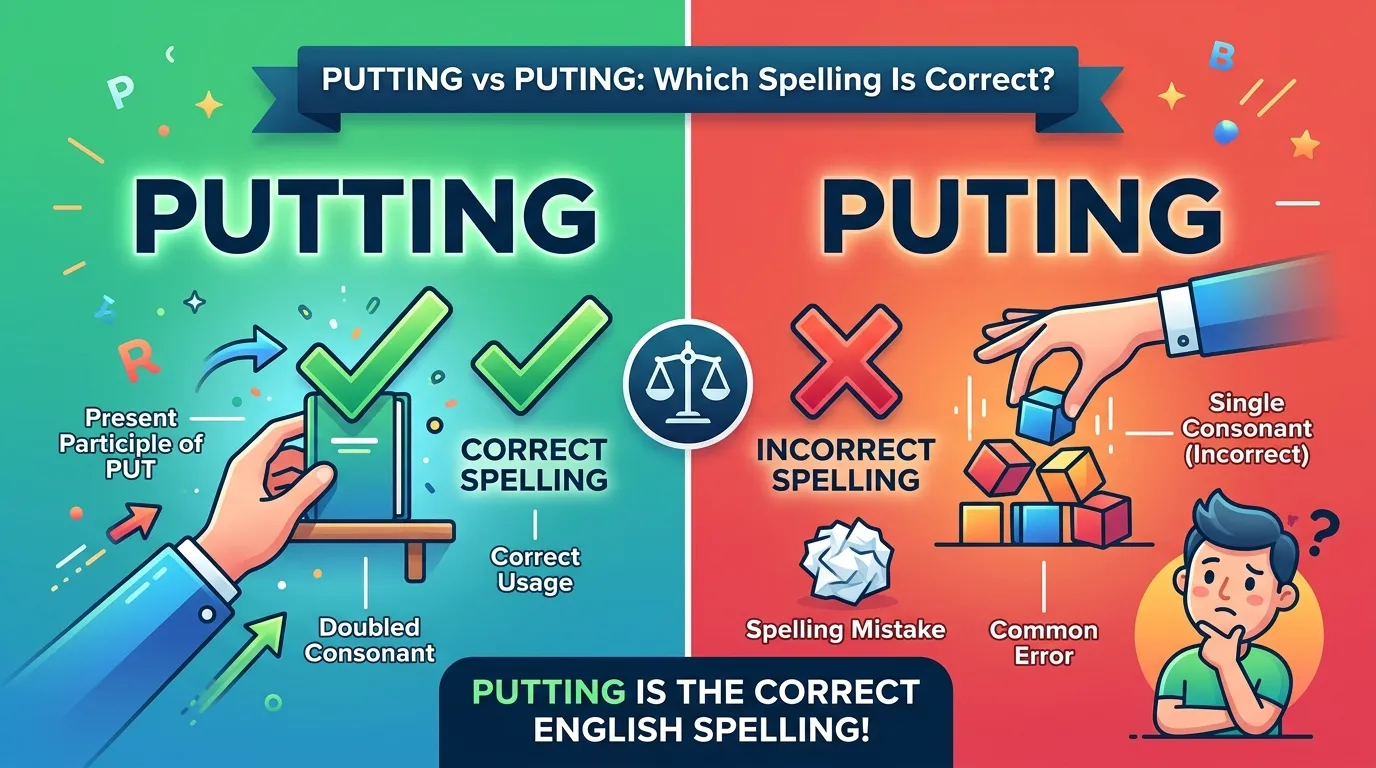
The spelling bee has reached its final round. The last two contestants stand at the microphones, and the judge announces the word: “Putting.” The first contestant asks for the definition, the sentence, the language of origin — all the lifelines the rules allow. Then she begins, letter by letter: “P-u-t-i-n-g.” A bell rings. She is out. The second contestant steps forward, takes a breath, and says: “P-u-t-t-i-n-g. Putting.” Silence. Then applause. The correct spelling is putting, with two ts. Puting, with one t, is a misspelling. And the reason the first contestant lost is the reason so many writers lose the same word: put looks like it should behave like other short verbs, and it doesn’t behave the way the eye expects.
The confusion is understandable. English has many verbs that add -ing without doubling their final consonant — wait → waiting, help → helping, look → looking — and a writer who applies that pattern to put gets puting. But put belongs to the family of verbs that double their final consonant, and the doubling is not optional. It is the spelling rule, and it is one of the most consistent rules in English.
The Spelling Bee
The judge’s sentence was: “She is putting the keys on the desk.” The word in the sentence is the present participle of the verb put — the -ing form. The base verb is put: three letters, one syllable, a short vowel u followed by a single consonant t. When a verb with that shape takes -ing, the final consonant doubles: put + ing = putting. The extra t is not decoration. It is the rule.
The first contestant’s mistake was a reasonable one. She heard “putting” and wrote what she heard: put + ing, one t. But English spelling is not a recording of sound. It is a system of patterns, and the pattern for put requires the double t. The second contestant knew the pattern, and the pattern won her the trophy.
The Doubling Rule, One Sentence
Here is the rule in its full form: when a verb has one syllable, ends in a single vowel followed by a single consonant, and takes a suffix beginning with a vowel (-ing, -ed), double the final consonant. Put fits every condition: one syllable, short vowel u, single consonant t, suffix -ing beginning with a vowel. So put → putting, put → putter (in the sense of someone who puts — rare, but regular).
The family is large, and recognizing it makes the rule feel like a pattern rather than an exception:
- run → running
- sit → sitting
- swim → swimming
- stop → stopping
- get → getting
- cut → cutting
- shut → shutting
- hit → hitting
- set → setting
- drop → dropping
Now compare the verbs that do not double. Wait → waiting, because the vowel is long (ai, two letters). Help → helping, because two consonants (lp) follow the vowel. Look → looking, because the vowel is a double letter (oo). The doubling rule only bites when a single short vowel is followed by a single consonant — which is exactly the shape of put.
There is a second form worth noting: the past tense of put is also put. “I put the book down.” “Yesterday I put the book down.” The verb does not change in the past tense at all — it is one of the verbs where present, past, and past participle are identical, like cut, hit, and set. The -ing form is the only form that changes the spelling, and it changes it by doubling the t.
Put: A Verb With a Hundred Jobs
Put is one of the most flexible verbs in English. Its basic meaning is to move, place, or cause something to be in a particular position, condition, or situation. “She is putting the keys on the desk.” “He is putting his clothes away.” “They are putting food in the refrigerator.” “I am putting my trust in you.” “She is putting pressure on the team.” The verb stretches from the physical (placing objects) to the abstract (placing trust, placing pressure) without changing its form.
The verb also appears in hundreds of common expressions, and putting carries all of them into the -ing form:
- Put up with — to tolerate. “She is putting up with the noise.”
- Put off — to postpone. “He keeps putting off the dentist.”
- Put down — to set down, or to belittle. “She is putting down her pen.” “Stop putting me down.”
- Put across — to communicate. “He is putting across his ideas clearly.”
- Put forward — to propose. “She is putting forward a new plan.”
- Put aside — to save or set apart. “They are putting aside money for the trip.”
- Put on — to wear, or to stage. “She is putting on her coat.” “The theater is putting on a new play.”
- Put out — to extinguish, or to publish. “He is putting out the fire.” “The band is putting out a new album.”
In every one of these, the spelling is putting, with two ts. The phrasal verbs inherit the spelling of the base verb, and the base verb doubles. A writer who misspells putting as puting in any of these expressions has made the same error — and the same fix applies.
Putting on the Green
Putting has a second life that has nothing to do with the verb put. In golf, putting is the act of hitting the ball gently along the green toward the hole, using a putter. The area where this happens is the putting green. The stroke itself is a putt. “She is putting for birdie.” “The putting green is fast today.”
The golf sense is a homograph — a word spelled the same as another word but with a different origin and meaning. Golf’s putting comes from the Scots word putt, meaning a gentle push or stroke, not from the verb put. The two words converged on the same spelling by coincidence, and they now share the double t. A writer describing golf writes putting with two ts, just as a writer describing moving boxes does. The spelling is the same; the meaning is different; the context tells you which one is meant.
The golf sense also produces its own family: putter (the club, and also the player who putts), putting green, putting stroke, putting average. And it produces one of the sport’s most quoted lines: that golf is a game of putting — that the short game, not the long drive, decides the score. Whether or not that is true, the spelling is settled: two ts, on the green and off it.
Phrasal Verbs: Put’s Extended Family
The phrasal verbs with put deserve a final note, because they are where the word’s flexibility is most visible — and where the spelling error spreads fastest, since phrasal verbs appear constantly in casual writing. Put up can mean to erect (“put up a tent”), to accommodate (“put me up for the night”), or to display (“put up a poster”). Put down can mean to set down, to record (“put down your name”), to euthanize an animal, or to belittle. Put off can mean to postpone or to disgust (“The smell put me off”). Put on can mean to wear, to stage, to fake (“putting on an accent”), or to add weight (“put on five pounds”).
Each of these meanings takes putting in the -ing form, and each one keeps the double t. The verb’s flexibility is a feature, not a flaw — it lets English say a hundred things with one short word — but it demands that the one short word be spelled correctly. A misspelling in any of these expressions is the same misspelling, and the fix is the same.
Putting It All Together: Practice Sentences
The rule is simple, but rules stick better with practice. Read these sentences and check the spelling in each one:
- “She is putting the groceries away.” — Two ts. Correct.
- “He keeps putting off the dentist.” — Two ts. Correct.
- “They are putting up a tent.” — Two ts. Correct.
- “She is putting for par.” — Two ts, golf sense. Correct.
- “We are puting the chairs in a circle.” — One t. Wrong. It should be putting.
Notice that the error in the last sentence is easy to miss at a glance. Puting looks plausible, especially in a long document where the eye skims. The defense is the same as the offense: slow down for half a second on words you know are trouble spots, and let the rule — one syllable, short vowel, single consonant, double it — do the work. Spelling checkers catch puting reliably, but a writer who knows the rule does not need the checker.
The Buzzer
The spelling bee ends with the second contestant holding the trophy and the first contestant learning the rule. The judge’s word was ordinary — putting, a word everyone in the room uses every day — and that is exactly why it was a good test word. Ordinary words are the ones we spell from habit, and habit is only as good as the rule behind it.
The rule fits on an index card: one syllable, short vowel, single consonant — double it. Put → putting. Cut → cutting. Run → running. The hand that knows the rule writes putting with two ts every time — on the moving box, on the golf green, in the phrasal verb, in the email, in the essay. And the bell stays silent.










