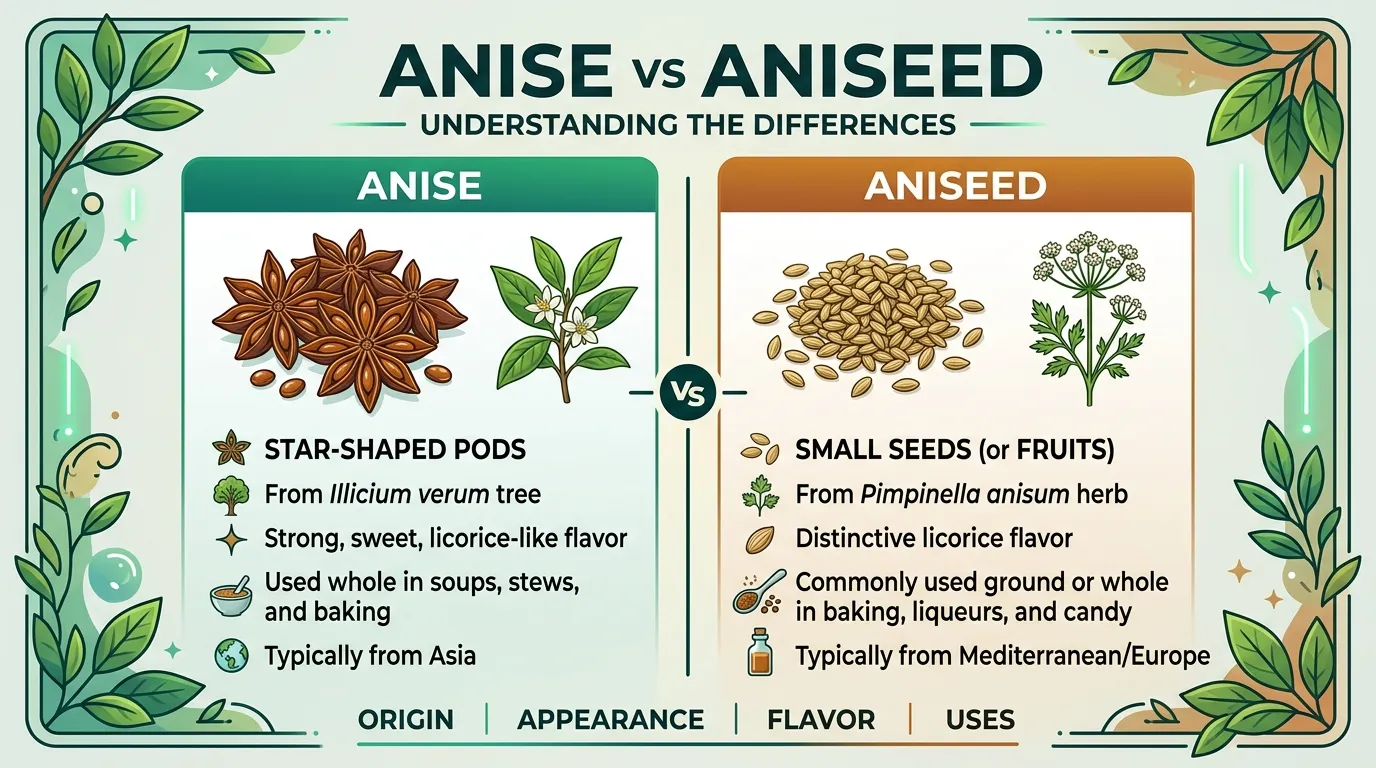
The spice stall at the market has two jars side by side. One is labeled anise. The other is labeled aniseed. A shopper picks up the second jar, frowns, and asks the vendor whether one of them is misspelled. The vendor shakes his head. Neither jar is wrong. Anise and aniseed are both correct words, and they refer to the same spice — but they are not quite the same word, and knowing which one to use depends on what you mean and where your reader lives. This is one of the rare pairs in this series where the answer is not “one is right and one is wrong.” The answer is “both are right, and each has its place.”
The confusion is natural. The two words differ by four letters — seed — and they point at the same flavor, the same plant, and often the same jar. A recipe that calls for anise and a recipe that calls for aniseed will send you to the same shelf. But the words carry different information, and using the precise one makes your writing clearer, especially in recipes, where precision is the point.
The Spice Stall
Start with the plant. Anise is an aromatic herb, Pimpinella anisum, a member of the parsley family, grown for its small, fragrant fruits — commonly called seeds — that taste sweet and warm, with a distinctive licorice-like flavor. The plant grows about two feet tall, with feathery leaves and clusters of tiny white flowers. The fruits are harvested, dried, and sold whole or ground.
The word anise can refer to three things: the plant itself (“She grows anise in the herb garden”), the dried fruits used as a spice (“Add a teaspoon of anise to the dough”), and the flavor (“The cookies have a strong anise flavor”). It is a flexible word, and its flexibility is why it is the more common term in American English — one word covers the plant, the spice, and the taste.
The word aniseed is narrower. It means specifically the seeds — the small dried fruits of the anise plant. “Add two teaspoons of aniseed to the mixture.” “She bought a packet of aniseed for baking.” The word is formed transparently: anise + seed. Its meaning is in its construction. When a British recipe says aniseed, it means the seeds, and only the seeds.
Plant or Seed? The Naming Question
The difference between the two words is a difference in focus. Anise is the whole picture: the plant, the spice, the flavor. Aniseed is a close-up: the seeds on the spoon. A writer who says “anise” might mean any of the three. A writer who says “aniseed” means the seeds, and the reader knows it.
This is why the two words are not fully interchangeable, even though they are often treated that way. “The bread is flavored with aniseed” is precise — the bread contains the seeds. “The bread is flavored with anise” is also correct, but slightly looser — the bread has the anise flavor, and the reader does not know whether the seeds, the ground spice, or an extract supplied it. In a recipe, the looser word is usually fine, because the cook understands the context. In a botanical description, the precise word matters more.
The regional split adds a second layer. In American English, anise is the dominant term for all uses — plant, spice, and flavor — and aniseed is recognized but less common. In British English, aniseed is very common when the seeds are meant, and anise is used for the plant and the flavor. So the rule is: American writing leans toward anise; British writing leans toward aniseed for the seeds. Neither choice is wrong in either variety, but each one sounds more natural to its home audience.
Three Cousins: Anise, Star Anise, Fennel
Anise has two famous look-alikes, and confusing them is the most common culinary mistake involving this word. The first is star anise, Illicium verum, a completely different plant — an evergreen tree from southern China whose fruits are star-shaped pods. Star anise tastes similar to anise because both contain the compound anethole, which produces the licorice-like flavor. But star anise is stronger, more pungent, and used differently — whole in braises and broths, ground in five-spice powder. It is not a substitute for anise in baking, and anise is not a substitute for star anise in a Chinese braise.
The second look-alike is fennel, Foeniculum vulgare, another member of the parsley family. Fennel seeds also taste of anethole, and fennel bulbs are used as a vegetable. Fennel is milder and fresher than anise, with a green, almost minty note. The three plants — anise, star anise, fennel — share a flavor compound but belong to different genera, grow in different places, and play different roles in the kitchen. Knowing which one a recipe means is part of cooking well.
Then there is licorice itself, Glycyrrhiza glabra, the plant that gives licorice candy its flavor. Licorice root contains glycyrrhizin, a different compound, and its flavor is deeper, darker, and more bitter than anise. People often say anise “tastes like licorice,” and the comparison is useful — but it runs in one direction. Anise tastes like licorice; licorice does not taste like anise. The distinction matters when a recipe calls for one and the cook reaches for the other.
Anise in the Kitchen
Anise appears in kitchens on every continent, and its uses show the word’s range. In baking, anise seeds flavor breads, cookies, and cakes — Italian biscotti, German Springerle, Greek koulourakia, and the anise cookies of Latin America all depend on it. The seeds are often left whole, so they crunch gently and release their flavor slowly. Ground anise distributes the flavor evenly but loses its punch faster, which is why whole seeds are preferred in most traditional recipes.
In sweets, anise flavors candies, cough drops, and liqueurs. Anisette is a sweet anise liqueur, popular in the Mediterranean. Sambuca is an Italian anise liqueur, served neat or with coffee beans. Ouzo is the Greek anise spirit, famous for turning milky white when water is added. Pastis is the French version, served diluted as an apéritif. Arak is the Middle Eastern anise spirit, served with water and ice. Each of these drinks depends on anethole, and each one is a different culture’s answer to the same flavor.
In savory cooking, anise flavors sausages, stews, and pickles. It appears in Indian curries, in Chinese five-spice powder (where star anise, not anise, is the usual ingredient — a frequent source of confusion), and in the spice mixtures of the Middle East. It pairs well with pork, with root vegetables, and with citrus. A pinch of anise in a carrot soup, a lamb stew, or a tomato sauce adds warmth without sweetness, and it is one of those spices that makes diners ask, “What is that flavor?” without being able to name it.
In drinks, anise flavors teas and infusions. Anise tea — hot water poured over crushed aniseeds — is a traditional remedy for indigestion and coughs, and it is served in many cultures as a digestif after meals. The tea’s flavor is gentle, sweet, and warming, and it is one of the most approachable ways to taste the spice.
Anise in Medicine and Folk Remedies
Beyond the kitchen, anise has a long history in traditional medicine. Anise tea — hot water poured over crushed aniseeds — has been used for centuries as a remedy for indigestion, bloating, and coughs. The tea’s active compounds relax the smooth muscle of the digestive tract and loosen mucus, which is why it appears in cough syrups and gripe water for infants in several traditions. Modern research supports the digestive use modestly: aniseed oil has measurable antispasmodic effects, though it is not a substitute for medical treatment.
Anise also appears in the history of pharmacy. Aniseed oil was once used to flavor medicines, masking the bitter taste of active ingredients. The flavor made the medicine easier to swallow, which is a small but real contribution to public health — a child who will take the medicine is a child who gets better. And in the perfume industry, anise provides a warm, sweet top note in soaps, lotions, and fragrances. The spice’s journey from the herb garden to the pharmacy to the perfume counter shows how one flavor can serve many purposes.
A Transatlantic Shopping List
The practical advice is short. If you are writing for an American audience, anise is the safer and more familiar choice for all uses — plant, spice, and flavor. If you are writing for a British audience, aniseed sounds more natural when you mean the seeds, and anise is the choice for the plant and the flavor. If you are writing a recipe, either word works, but aniseed is the more precise term for the seeds themselves, and precision is a virtue in recipes.
When shopping, read the label. A jar labeled aniseed contains the seeds. A jar labeled anise usually contains the same seeds, labeled with the broader word. A jar labeled star anise contains a different spice entirely. And a jar labeled anise extract contains a concentrated liquid flavoring, not the seeds at all. The label tells you what is inside; the word tells you how the seller thinks about it.
The Last Pinch
The memory hook is in the construction. Aniseed is anise + seed. The word says what it means: the seed of the anise plant. If you mean the seeds, say the seed — aniseed. If you mean the plant, the spice, or the flavor in general, anise will do. The vendor at the spice stall was right: neither jar is misspelled. They are two words for two ways of looking at the same spice — the whole plant, and the tiny seed that carries its flavor.










