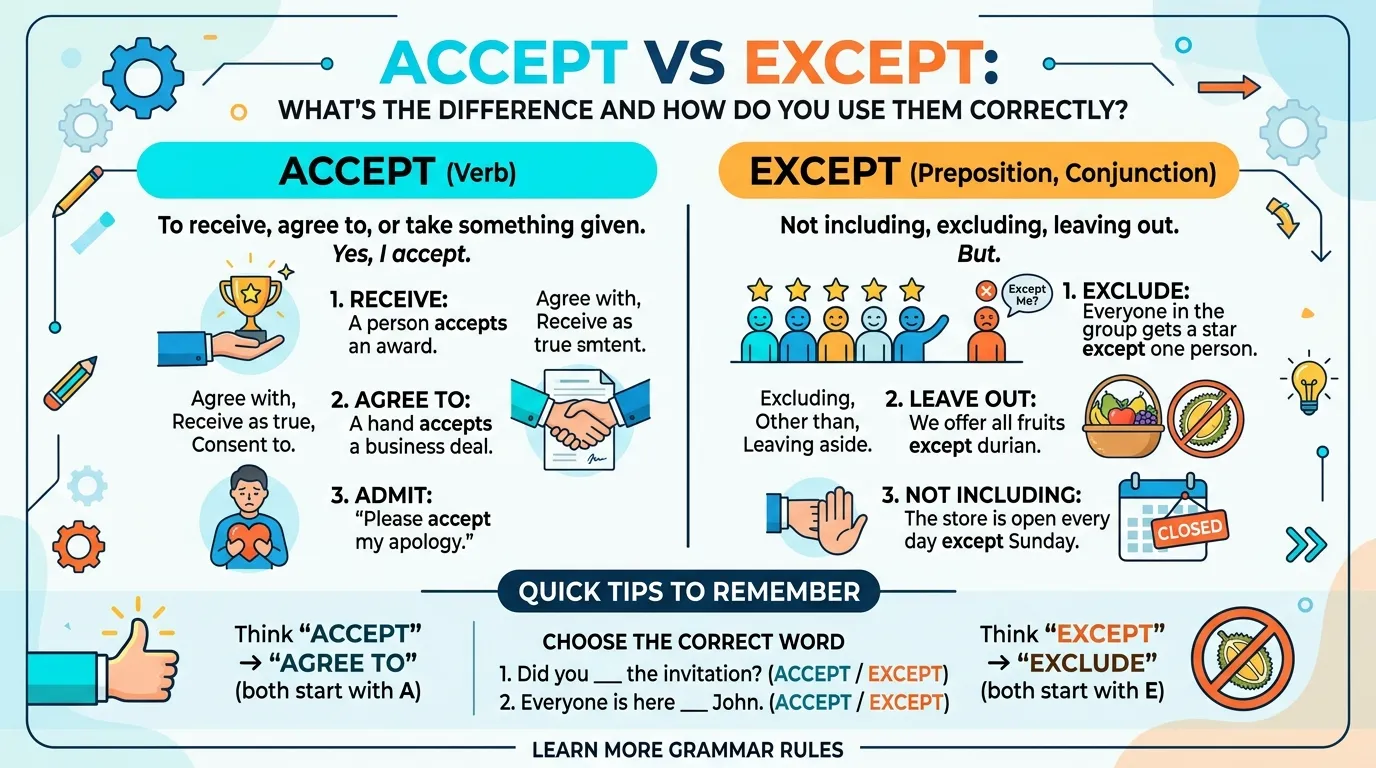
If you often pause when writing accept or except, you are not alone. These two words sound similar, but they have completely different meanings and grammatical functions.
The simplest distinction is this: accept usually means to receive, agree to, or approve something, while except usually means to leave something or someone out.
For example:
- I accept your apology. → I receive or acknowledge it.
- Everyone came except John. → John was left out.
Understanding accept vs except becomes much easier when you focus on their meanings rather than their similar sounds. This guide explains their definitions, pronunciation, grammar, history, common expressions, mistakes, formal and informal usage, and practical examples in everyday and professional English.
Quick Answer: Accept vs Except
Accept is a verb that generally means to receive something willingly, agree to something, approve something, or recognize something as true.
Except most often works as a preposition or conjunction meaning “excluding” or “with the exclusion of.” It can also be a verb in less common formal usage.
| Word | Main meaning | Common grammatical role | Example |
|---|---|---|---|
| Accept | Receive, agree to, approve | Verb | She accepted the invitation. |
| Except | Exclude, leave out | Preposition/conjunction | Everyone was invited except Mark. |
Easy memory trick
Think:
Accept = Agree/Allow/Receive
Except = Exclude
If you can replace the word with receive or agree, use accept.
If you can replace it with excluding or but, use except.
What Does Accept Mean?
Accept is primarily a verb. It describes the act of receiving, agreeing to, approving, or recognizing something.
Dictionary-style definition of accept
Accept (verb):
- To receive something willingly or without refusing it.
- To agree to something that has been offered.
- To approve or consent to something.
- To recognize something as valid, true, or reasonable.
- To tolerate or come to terms with a situation.
Examples of accept
- I accept your offer.
- She accepted the job.
- He accepted the award with gratitude.
- We accept credit cards.
- They finally accepted the decision.
- She accepted that the plan had failed.
Notice that accept always involves the idea of receiving, agreeing, approving, or acknowledging.
Accept as “receive”
The store does not accept checks.
Here, accept means “receive as a form of payment.”
Accept as “agree”
I accept your proposal.
This means the speaker agrees to the proposal.
Accept as “acknowledge”
He accepted that he had made a mistake.
Here, the word means he recognized the mistake as true.
What Does Except Mean?
Except generally means excluding someone or something.
It is commonly used to identify an exception to a general statement.
Dictionary-style definition of except
Except:
- Preposition: Excluding or leaving out.
- Conjunction: Used to introduce an exception or contrasting condition.
- Verb: To exclude or leave out, usually in formal or less common usage.
Examples of except
- Everyone attended except Sarah.
- I like all vegetables except broccoli.
- The office is open every day except Sunday.
- We can meet any time except Friday.
- All the students passed except two.
The basic idea is always exclusion.
Accept vs Except: The Key Difference
The biggest difference is simple:
Accept means to receive or agree. Except means to exclude or leave out.
Compare these sentences:
Accept:
Maria accepted the invitation.
Maria received the invitation and agreed to attend.
Except:
Everyone received an invitation except Maria.
Maria was excluded from the group receiving invitations.
The words are close in pronunciation, but their meanings move in opposite directions.
Accept brings something in.
Except leaves something out.
That is one of the most useful ways to remember the difference.
Why Do People Confuse Accept and Except?
The confusion mostly comes from pronunciation.
In many varieties of English, accept and except sound extremely similar, especially in fast speech.
Both commonly begin with an unstressed vowel sound:
- accept: /əkˈsɛpt/
- except: /ɪkˈsɛpt/
The final sound is the same: -sept.
The main difference is the initial vowel sound.
Because the words sound alike or nearly alike, people sometimes use the wrong spelling when writing.
This is especially common in:
- Text messages
- Social media posts
- Informal emails
- Fast typing
- English-language learning
- Dictation or speech-to-text
The solution is to focus on meaning and grammatical function, not just sound.
Accept vs Except Pronunciation
Although pronunciation varies slightly by accent, standard American English generally pronounces them approximately as follows:
Accept
uhk-SEPT
The stress falls on the second syllable.
I accept your apology.
Except
ik-SEPT
Again, the second syllable receives the main stress.
Everyone came except James.
Because the final syllable sounds almost identical, the beginning of the word matters.
A useful pronunciation clue
When speaking, don’t rely on pronunciation alone to distinguish these words. Context is usually the stronger clue.
For example:
I will ___ your invitation.
The meaning requires accept.
Everyone came ___ Tom.
The meaning requires except.
Accept and Except: Grammar Differences
Grammar provides another reliable way to distinguish the two words.
Accept is mainly a verb
Examples:
- I accept the terms.
- She accepted the position.
- They will accept your application.
It can take different verb forms:
| Tense/form | Example |
|---|---|
| Present | I accept the offer. |
| Third person | She accepts the offer. |
| Past | She accepted the offer. |
| Present participle | She is accepting the offer. |
| Past participle | She has accepted the offer. |
Except is usually a preposition or conjunction
As a preposition:
Everyone was there except David.
As a conjunction:
I would go, except I have work to do.
As a verb, except is much less common:
The rule excepts certain cases.
For everyday writing, you will usually encounter except as a preposition or conjunction.
Accept vs Except in a Sentence
The easiest way to understand the difference is through context.
Accept examples
- Please accept this gift.
- The company accepted my application.
- She accepted the challenge.
- Do you accept these terms?
- He accepted responsibility for the mistake.
- The restaurant accepts reservations online.
Except examples
- Everyone passed except Mike.
- I work every day except Saturday.
- All colors are available except black.
- The store sells everything except fresh meat.
- Nobody knew the answer except Anna.
- We can travel anywhere except during the holiday weekend.
Accept vs Except in Formal Writing
Both words are perfectly acceptable in formal English.
The important thing is using the correct word for the intended meaning.
Business writing
Accept:
We are pleased to accept your proposal.
Except:
All departments will participate except Accounting.
Academic writing
Accept:
The researchers accepted the hypothesis based on the available evidence.
Except:
The results were consistent across all groups except the control group.
Professional communication
Accept:
Please accept our revised terms.
Except:
The office is closed every day except Monday.
Neither word is inherently more formal than the other.
Accept vs Except in Casual Writing
The same rules apply in texting and casual communication.
For example:
I accept your apology.
and:
Everyone is coming except Jake.
are correct regardless of how informal the conversation is.
Casual writing may shorten other words, but there is no reason to interchange accept and except.
Common Collocations With Accept
A collocation is a group of words that commonly appear together.
Some frequent combinations with accept include:
- accept an offer
- accept an invitation
- accept a proposal
- accept responsibility
- accept payment
- accept a challenge
- accept a gift
- accept an apology
- accept the truth
- accept the consequences
- accept a decision
- accept a job
- accept a request
- accept the terms
- accept defeat
Examples
She decided to accept the job offer.
He refused to accept responsibility for the error.
The website does not accept payments by check.
Common Collocations With Except
Common expressions involving except include:
- everyone except
- all except
- nothing except
- anything except
- anything but (related expression)
- no one except
- every day except
- all day except
- except for
- except when
- except that
- except as
Examples
Everyone except Lisa agreed.
I eat almost everything except shellfish.
The plan is excellent except for one problem.
“Except” vs “Except For”
These expressions are closely related but can function differently depending on the sentence.
Except
Everyone came except John.
This directly excludes John.
Except for
The trip was perfect except for the weather.
This highlights an exception or negative detail.
Another example:
The report was complete except for a missing chart.
Except for is especially common when discussing a general situation that has one notable exception.
“Accept for” Is Usually Wrong
One of the most common mistakes is writing accept for when the intended phrase is except for.
Incorrect:
The project was successful accept for one delay.
Correct:
The project was successful except for one delay.
Remember:
Except for = with one thing left out
Accept = receive or agree
There is no standard everyday phrase accept for with this meaning.
Accept vs Except vs Expect
There is another word that frequently gets confused with these two: expect.
Accept
Means receive, agree to, or approve.
I accept your invitation.
Except
Means excluding.
Everyone came except John.
Expect
Means believe something will happen or anticipate something.
I expect John to arrive soon.
A simple comparison:
| Word | Meaning | Example |
|---|---|---|
| Accept | Receive or agree | I accept the offer. |
| Except | Exclude | Everyone came except Sam. |
| Expect | Anticipate | I expect Sam soon. |
These three words are worth learning together because their spellings and sounds can cause confusion.
Accept vs Except vs Excerpt
Another word worth distinguishing is excerpt.
An excerpt is a short section taken from a longer piece of writing, speech, film, or other work.
- Accept = receive or agree
- Except = exclude
- Excerpt = a short extracted passage
Examples:
She accepted the invitation.
Everyone came except James.
The magazine published an excerpt from the novel.
Accept: Literal and Figurative Meanings
Accept has both literal and abstract uses.
Literal use
The machine accepts coins.
This means the machine receives coins.
Social use
The group accepted him as a member.
This means the group welcomed or recognized him as belonging.
Emotional use
She learned to accept the changes in her life.
This means she came to terms with something.
Intellectual use
Scientists accept the evidence as reliable.
This means they recognize or regard it as valid.
The core idea remains receiving or recognizing something.
Except: Literal and Figurative Uses
Except usually identifies something outside a larger group or statement.
Literal exclusion
Every room was cleaned except the basement.
Abstract exclusion
I would agree except for one concern.
Conditional exception
I would join you, except I have another appointment.
In each case, except marks a limitation or exception.
Accept in Business and Professional English
Accept appears frequently in professional contexts.
Examples include:
- Accept an application
- Accept an offer
- Accept payment
- Accept responsibility
- Accept a contract
- Accept terms
- Accept a resignation
- Accept a request
- Accept a recommendation
Example
After reviewing the contract, the client decided to accept the terms.
This is natural and professional.
Except in Business and Professional English
Except is also common in workplace writing.
All employees must attend except those on approved leave.
The building is open every weekday except holidays.
All invoices have been processed except three.
In formal writing, except for may make some sentences clearer:
The report is complete except for the final financial section.
Accept vs Except in Academic Writing
Academic writers frequently use both words.
Accept
The committee accepted the revised research proposal.
Except
The pattern appeared in all samples except the final sample.
For academic writing, precision matters. Using accept when you mean except can change the meaning of an entire sentence.
Accept vs Except in Journalism
News writing often uses except when describing exceptions:
All schools will remain open except those in affected areas.
Accept appears in reports involving decisions, offers, agreements, and responses:
The union voted to accept the proposed agreement.
Both are standard choices.
Accept vs Except in Sports
Sports writing can use both words naturally.
Accept
The team accepted the challenge.
Except
Every player scored except the goalkeeper.
Another example
The coach accepted the referee’s decision.
All starters played except the injured forward.
Accept vs Except in Technical Writing
Technical and software documentation also uses both words.
Accept
The system accepts files in PDF format.
Except
The application supports all major browsers except Internet Explorer.
Technical writing benefits from being especially precise because a single word can affect instructions or specifications.
Accept vs Except in Blogging and Content Writing
Bloggers and content writers should follow the same basic rule.
Use accept when discussing:
- Agreements
- Offers
- Invitations
- Payments
- Responsibility
- Decisions
- Gifts
- Applications
Use except when discussing:
- Exceptions
- Exclusions
- Groups with something removed
- Limitations
- Special cases
Example
You can use almost any image format except one that is unsupported.
The platform may accept several file types.
Word History and Etymology of Accept
Accept comes from Latin roots associated with receiving or taking something willingly. It entered English through Old French and developed into the modern verb accept.
Over time, its meaning expanded beyond physically receiving something.
Today, accept can involve:
- Receiving
- Agreeing
- Approving
- Recognizing
- Tolerating
- Acknowledging
The idea of taking something in or recognizing it remains central to the word.
Word History and Etymology of Except
Except also traces back to Latin, from a root meaning essentially to take out or take away.
This history provides an excellent memory aid.
Think of the relationship this way:
Accept → take in
Except → take out
Although modern usage is more complicated than this simple distinction, the historical connection makes the difference easier to remember.
Synonyms for Accept
Depending on context, synonyms for accept include:
- Receive
- Approve
- Agree
- Admit
- Acknowledge
- Welcome
- Consent to
- Embrace
- Recognize
- Take
- Endorse
- Tolerate
Example
She accepted the offer.
Possible alternatives:
She agreed to the offer.
She approved the proposal.
She took the position.
The best synonym depends on context.
Synonyms for Except
Depending on the sentence, synonyms for except include:
- Excluding
- Leaving out
- Apart from
- Other than
- With the exception of
- But
- Save for
Example
Everyone attended except John.
Possible alternatives:
Everyone attended excluding John.
Everyone attended with the exception of John.
Everyone attended apart from John.
Some alternatives are more formal or less natural in everyday American English.
Antonyms of Accept
Possible opposites of accept include:
- Reject
- Refuse
- Decline
- Deny
- Disapprove
- Repudiate
For example:
She accepted the offer.
Opposite:
She rejected the offer.
Antonyms of Except
Because except expresses exclusion, possible conceptual opposites include:
- Include
- Incorporate
- Add
- Admit
- Contain
For example:
Everyone was included except David.
Here, include expresses the opposite idea of exclusion.
Common Mistakes With Accept and Except
Mistake 1: Using accept for exclusion
Incorrect:
Everyone came accept John.
Correct:
Everyone came except John.
Why? John is being excluded.
Mistake 2: Using except for agreement
Incorrect:
I except your apology.
Correct:
I accept your apology.
Why? The speaker is receiving or acknowledging the apology.
Mistake 3: Writing “accept for”
Incorrect:
The meal was excellent accept for the dessert.
Correct:
The meal was excellent except for the dessert.
Mistake 4: Confusing “accept” with “expect”
Incorrect:
I accept him to arrive at noon.
Correct:
I expect him to arrive at noon.
Expect means anticipate.
Mistake 5: Confusing “except” with “excerpt”
Incorrect:
I read an except from the article.
Correct:
I read an excerpt from the article.
An excerpt is a selected portion of a larger work.
Awkward vs Natural Examples
Example 1
Awkward/incorrect:
I except your invitation.
Natural:
I accept your invitation.
Example 2
Incorrect:
All employees attended accept Lisa.
Natural:
All employees attended except Lisa.
Example 3
Incorrect:
We accept everyone except for people who are not registered.
This sentence can be grammatical depending on intended meaning, but if the writer means the registration requirement is a condition, a clearer version may be:
We accept everyone who is registered.
Clear writing often avoids unnecessary exception structures.
How to Remember Accept vs Except
Here are several memory tricks.
Trick 1: Accept = Add
Both accept and add involve bringing something in.
Accept = Allow in
Trick 2: Except = Exclude
The first three letters of except are exc, which can remind you of exclude.
Except = Exclude
Trick 3: Think “in” vs “out”
Accept → in
Except → out
If something is being received or welcomed, choose accept.
If someone or something is being left out, choose except.
Trick 4: Use substitution
Ask:
Can I replace it with “receive” or “agree”?
If yes → accept.
Ask:
Can I replace it with “excluding” or “but”?
If yes → except.
A Simple Accept vs Except Test
Try filling in the blanks:
- I ___ your offer.
- Everyone came ___ David.
- The company will ___ applications until Friday.
- All the rooms were occupied ___ Room 12.
- She ___ responsibility for the mistake.
- I like every fruit ___ grapefruit.
Answers
- accept
- except
- accept
- except
- accept
- except
The pattern is straightforward:
Receive/agree → accept
Exclude → except
Accept vs Except: Comparison Table
| Feature | Accept | Except |
|---|---|---|
| Main meaning | Receive, agree, approve | Exclude |
| Primary grammatical role | Verb | Preposition/conjunction |
| Common idea | Bringing in | Leaving out |
| Example | I accept the offer. | Everyone came except Ben. |
| Pronunciation | uhk-SEPT | ik-SEPT |
| Common phrase | accept responsibility | except for |
| Opposite idea | Reject | Include |
| Common confusion | Except, expect | Accept, excerpt |
| Formal usage | Very common | Very common |
| American English | Standard | Standard |
| British English | Standard | Standard |
Are Accept and Except Different in British and American English?
Yes, both words are standard in American English and British English.
There is no major regional difference in their basic meanings.
For example, an American speaker may say:
I accept your offer.
A British speaker can say exactly the same thing.
Likewise:
Everyone was invited except Tom.
is standard in both varieties.
The main challenge is pronunciation, which can vary among regional accents. However, the spelling and core meanings remain the same.
Is Accept More Formal Than Except?
No.
Both are ordinary words used in casual, professional, academic, and formal English.
Compare:
I accept your apology.
Everyone came except Sarah.
Neither sentence is particularly formal or informal.
Their level of formality depends more on the surrounding language and situation than on the words themselves.
“Accept” in Common Expressions
Some common expressions include:
Accept responsibility
He accepted responsibility for the mistake.
Accept an apology
I accept your apology.
Accept an offer
She accepted the job offer.
Accept the consequences
We must accept the consequences of our decision.
Accept defeat
The team eventually accepted defeat.
Accept the truth
It took him time to accept the truth.
Accept the challenge
She accepted the challenge without hesitation.
“Except” in Common Expressions
Except for
Everything was ready except for the decorations.
Everyone except
Everyone except Maria agreed.
Nothing except
There was nothing except silence.
Anything except
The experience was anything except boring.
Except when
I usually walk except when it rains.
Except that
The plan is good except that it is expensive.
These expressions are common in both everyday and formal English.
When Should You Use Accept?
Use accept when someone:
- Receives something
- Agrees to something
- Approves something
- Welcomes someone
- Acknowledges something
- Recognizes something as true
- Takes responsibility
- Comes to terms with something
Quick examples
Accept the invitation.
Accept the payment.
Accept the apology.
Accept responsibility.
Accept the facts.
When Should You Use Except?
Use except when you:
- Exclude a person
- Exclude an object
- Identify an exception
- Describe a limitation
- Separate one item from a larger group
Quick examples
Everyone except John.
Every day except Sunday.
All colors except blue.
Everything except the final page.
Practical Recommendation for Writers
Before choosing between accept and except, stop and identify the relationship in your sentence.
If something is being received, approved, or agreed to, use accept.
If something is being excluded or treated as an exception, use except.
This method works across:
- American English
- British English
- Academic writing
- Business writing
- Journalism
- Technical documentation
- Sports writing
- Blogging
- Texting
- Everyday conversation
You do not need a complicated grammar rule. Meaning is the key.
Frequently Asked Questions About Accept vs Except
Is it accept or except?
It depends on the meaning. Use accept for receiving, agreeing to, approving, or acknowledging something. Use except when you mean excluding someone or something.
I accept your offer.
Everyone came except John.
What is the easiest way to remember accept vs except?
Remember:
Accept = receive or agree.
Except = exclude.
You can also remember except by connecting it with exclude.
Is “accept” a verb?
Yes. Accept is primarily a verb.
For example:
She accepted the invitation.
It can take forms such as accepts, accepted, accepting, and accepted.
Is “except” a verb?
Except can function as a verb, but this use is relatively uncommon in everyday English. It is much more commonly used as a preposition or conjunction.
For example:
Everyone attended except James.
What is the difference between accept and except in one sentence?
Accept means to receive or agree to something, while except means to exclude someone or something.
Is “except for” correct English?
Yes. Except for is a standard expression meaning that something is excluded or is an exception.
The room was perfect except for the noise.
Is “accept for” correct?
Usually not when you mean “with the exception of.” In that context, the correct expression is except for.
Correct: Everything was ready except for the chairs.
Are accept and except homophones?
They are often treated as near-homophones because their pronunciation is extremely similar, especially in some accents. However, their initial vowel sounds are technically different in standard pronunciations.
Their similar sounds are one major reason English speakers confuse them in writing.
What is the difference between accept, except, and expect?
Accept means receive or agree.
Except means exclude.
Expect means anticipate or believe something will happen.
I accept the invitation.
Everyone came except Paul.
I expect Paul to arrive soon.
Conclusion: Accept vs Except Made Simple
The difference between accept vs except becomes much easier when you focus on the basic meaning of each word.
Accept means to receive, agree to, approve, or acknowledge something.
She accepted the offer.
Except means to exclude, leave out, or identify an exception.
Everyone accepted the offer except John.
The best memory trick is:
Accept = bring in.
Except = leave out.
Remember that accept is primarily a verb, while except is most often a preposition or conjunction. Also watch for related words such as expect and excerpt, which create their own spelling and usage problems.
For American, British, academic, business, technical, journalistic, sports, and casual writing, the same core distinction applies. When you are unsure, replace the word mentally with receive/agree or exclude. If “receive” or “agree” works, choose accept. If “exclude” or “leaving out” works, choose except.
Once you connect each word with its central idea, this common English confusion becomes much easier to avoid.