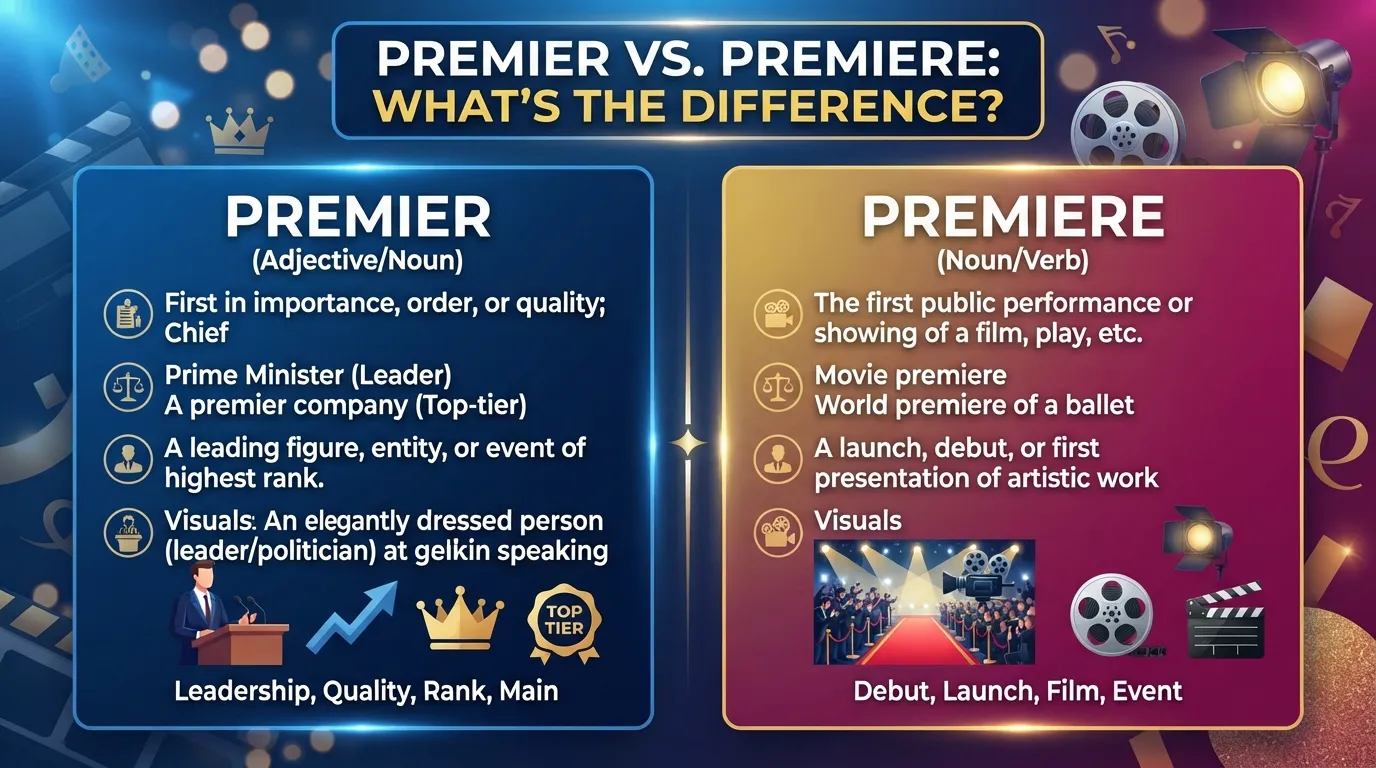
Two events are happening in the same city on the same Friday night. In a glass tower downtown, a company’s board is meeting its new premier — the head of a provincial government, in town to discuss a trade deal. Across town, a red carpet is rolled out in front of a cinema, where a film is having its premiere — its first public showing, with cameras, interviews, and a crowd. The two words sound nearly identical, differ by a single letter e, and belong to entirely different worlds: one is about rank, the other about first performances. Confusing them is easy. A “premier” of a movie is not a showing; a “premiere” university is not a first showing. One letter changes the building you are standing in.
Premier means first in importance, rank, or quality — the leading one. Premiere means the first public performance or showing of something. The distinction is one of the most reliably confused pairs in English, and it matters in journalism, business, and academic writing, where both words appear constantly. The good news is that the final e in premiere is a reliable signal: it marks the word that belongs to events.
The Corner Office: Premier as Rank
Start with the tower, because premier is the older and broader word. As an adjective, it means first, leading, foremost, or of the highest quality: a premier university, a premier destination, a premier surgeon, a premier wine. The word does not mean “first in time.” A premier university is not the first university ever founded; it is one of the leading ones. A premier destination is not the first place tourists visit; it is one of the best. The word ranks; it does not count.
This ranking sense makes premier a favorite of marketing and institutional writing, and also a word to handle with care. Because it claims top status, it invites the question “says who?” A hotel that calls itself “premier” is making a claim, not stating a fact, and careful writers attribute such claims: “the hotel describes itself as premier,” or “one of the city’s premier hotels, according to the guide.” Used sparingly, the word carries real weight. Used on every brochure and press release, it becomes wallpaper.
Premier also works as a noun, and this is where the tower meeting comes in. In Canada, Australia, and several other countries, a premier is the head of government of a province or state — the equivalent of a prime minister at the sub-national level. “The premier of Ontario announced a new transit plan.” “The Queensland premier resigned on Friday.” In France, the Premier ministre is the prime minister. In this political sense, the word is always a noun, always refers to a person, and always takes a capital letter when it is part of a title (“Premier Ford”) but not when it is a generic description (“the province’s premier”).
The Red Carpet: Premiere as Event
Now cross town to the cinema. A premiere is the first public performance, showing, or presentation of a creative work: a film premiere, a play’s premiere, a television season premiere, a ballet’s world premiere. The word names an event — a night, a showing, an occasion — not a rank. A film can have a lavish premiere and be a flop; a play can premiere in a church hall and run for decades. The premiere is about firstness in time, not about quality.
The word’s grammar follows its meaning. As a noun, it names the event: “The premiere is on Friday,” “We attended the world premiere.” As a verb, it describes the act of being shown first: “The film premieres in New York next month,” “The show premiered to strong ratings.” The verb is regular — premieres, premiered, premiering — and it applies to the work, not the audience: the film premieres; the audience attends the premiere. A common error is to write “we premiered the film” when the meaning is “we attended the premiere” — unless you are the distributor who actually staged the showing, premiere as a verb belongs to the work.
There are useful compounds. A world premiere is the first showing anywhere. A season premiere is the first episode of a new television season (and its mirror image, the season finale, is the last). A premiere date is the scheduled first showing. In the streaming era, the word has stretched: a series can “premiere” by dropping all episodes at once, and a “premiere” can be a digital event with no red carpet at all. The core meaning — first public presentation — holds through every change of venue.
One Letter, Two Histories
Both words come from French premier, meaning first, from Latin primarius (principal, from primus, first). English borrowed premier in the fifteenth century for the ranking sense — first in importance — and kept the French spelling. Premiere came later, in the nineteenth century, borrowed from the French feminine form première, short for première représentation (first performance). The extra e is the feminine ending of the French adjective, preserved in English as the mark of the event word.
That history gives the most reliable memory hook for the pair: the e at the end of premiere stands for event. Premier (no final e) = rank, status, leading. Premiere (final e) = event, showing, first performance. If the sentence is about an event with a date, a venue, and an audience, the word ends in e. If the sentence is about status — the best, the leading, the foremost — it does not.
Pronunciation adds a small wrinkle. In American English, both words are usually pronounced pruh-MEER, with the stress on the second syllable. In British English, premier is often PREM-ee-er or pruh-MEER, while premiere is PREM-ee-air. The variation means pronunciation is not a reliable guide to spelling — in most speech, the two words are indistinguishable. The writer must rely on meaning, and on the final-e test, not on sound.
The Errors That Embarrass
Three errors account for most of the confusion, and each has a clear fix. The first is calling a first showing a “premier”: “The movie’s premier is Friday.” Wrong — a showing is an event, so the word needs its final e: “The movie’s premiere is Friday.” The second is calling a top-ranked thing a “premiere”: “She attends a premiere university.” Wrong — a university’s rank needs the adjective without the e: “She attends a premier university.” The third is using premiere as an adjective for rank in marketing copy — “our premiere service” — which is so common that some dictionaries now list it as a variant, but which careful editors still correct to “our premier service.”
There is also a subtler error: using premier when the meaning is genuinely about firstness in time. “The premier episode of the series” is wrong if the meaning is “the first episode” — the correct word is “the premiere episode” (the episode that premiered) or simply “the first episode.” Premier never means “first in time”; it always means “first in importance.” Keeping that distinction sharp prevents the most persistent misuse of the pair.
A fourth error belongs to headlines, where space pressure breeds confusion. A headline like “Premier to Premiere New Policy” is actually correct — a head of government (premier) is about to unveil (premiere) a policy — but it looks like a typo to readers who do not know the pair. Headline writers sometimes dodge the collision by rephrasing: “Premier to Unveil New Policy.” In body copy, though, there is no need to dodge. The two words can sit in the same sentence as long as each is doing its own job, and a sentence that uses both correctly is a quiet demonstration that the writer knows the difference.
A note on the political noun: when premier means a head of government, it can never be spelled premiere. “The premiere of Ontario” is not a person; it is a first showing that happens to be in Ontario. Newsrooms catch this error quickly, because it changes a politician into an event. The same discipline applies in reverse: “the film’s premier” is not a showing; it is a rank the film does not have.
Choosing in One Second
Here is the decision, compressed. Ask what the sentence is about. If it is about an event — a showing, a performance, a first presentation with a date and an audience — write premiere, with the final e for event. If it is about rank — the leading, the best, the foremost — or about a head of government, write premier, without the final e. If the sentence is about a first episode, a first screening, or a first performance, the event word applies. If it is about a top university, a top surgeon, or a top destination, the rank word applies.
The two Friday-night events — the premier in the tower and the premiere at the cinema — will both be reported in Monday’s papers, and the reporters who cover them will get the spelling right by thinking about what each word means, not how it sounds. The words sound the same. They mean different things. And the single letter e, sitting quietly at the end of premiere, is all that separates a head of government from a night at the movies.










