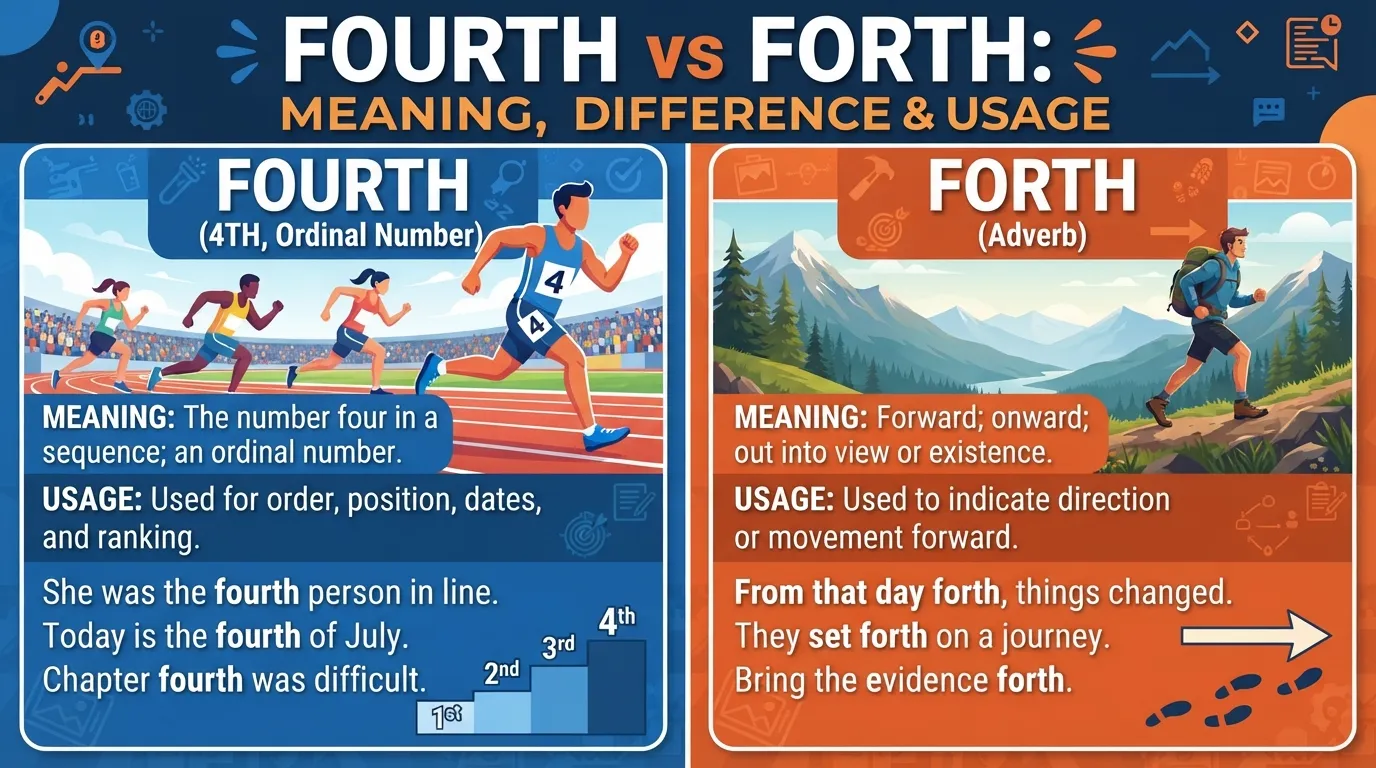
The race was decided by a fraction of a second. Three runners crossed the line in a blur, and the crowd waited for the photo finish. When the result came up, Maya had finished fourth — one place off the podium, one place from a medal. She walked off the track, found her coach, and said something that surprised him: “I went forth and gave it everything.” Her coach smiled, because in that one sentence she had used both words correctly without thinking about it. Fourth was her position. Forth was her direction — forward, onward, into the race.
Fourth and forth sound almost identical in most varieties of English, and they share three of their letters. But they have nothing to do with each other. Fourth belongs to the number four. Forth means forward, onward, or outward. Confusing them is easy in speech — the ear cannot tell them apart — but in writing, the wrong choice changes the meaning entirely. “She finished forth” is not a ranking; it is a direction.
The Photo Finish: Fourth as a Number
Fourth is an ordinal number: the form of four that marks position in a sequence. First, second, third, fourth. It answers the question “which one in order?” — the fourth runner, the fourth chapter, the fourth floor, the fourth attempt. Like other ordinals, it can act as an adjective (“the fourth page”), a noun (“she finished in fourth”), or part of a fraction (“a fourth of the cake” — though quarter is more common for fractions in everyday speech).
The spelling follows a rule that works for the whole ordinal family: take the cardinal number and add -th. Four becomes four-th. Six becomes sixth, seven becomes seventh, ten becomes tenth. The exceptions — first, second, third, fifth (which changes ve to f), twelfth — are few, and fourth is not one of them. If you can spell four, you can spell fourth: it is four plus th, with nothing dropped and nothing added.
Fourth also appears in dates and titles. July 4th is the Fourth of July in the United States. A “fourth” can be a musical interval — the distance from C to F is a perfect fourth. In law, the Fourth Amendment protects against unreasonable searches. In all these uses, the word points back to the number four. If the sentence is about counting, ordering, or ranking, fourth is the word.
The Expedition: Forth as a Direction
Forth is a different creature entirely. It is an adverb meaning forward, onward, outward, or away from a starting point. Explorers go forth. Ideas come forth. Witnesses step forth. The word has an old, slightly formal flavor — it belongs to speeches, scripture, and literature more than to everyday conversation, where forward, out, or on usually do the job. “They went forth” sounds like a line from a novel or a sermon; “They went forward” sounds like a news report.
The history explains the flavor. Forth comes from Old English forþ, related to fore and before — the family of words about what lies ahead. It is a cousin of forward (forth + ward, “toward the forth direction”) and of forthcoming (coming forth, approaching). In older English, forth was an everyday word: Shakespeare’s characters go forth, come forth, and set forth constantly. Over centuries, forward and out took over most of its jobs, and forth retreated into fixed phrases and formal registers. What remains is a word with a deliberate, almost ceremonial sound.
That ceremonial quality is why forth survives in phrases where a plainer word would feel flat. A graduation speaker says “go forth and make a difference” because forth carries a blessing that “go forward” does not. A judge asks a witness to “step forth” because the old word lends gravity to the moment. The word’s formality is not a flaw; it is its function.
Phrases That Keep Forth Alive
Most modern encounters with forth happen inside fixed expressions, and learning those expressions is the fastest way to master the word. Back and forth is the most common: repeated movement between two places, positions, or ideas — “the ball went back and forth,” “we went back and forth on the price for weeks.” Note that the phrase pairs forth with back: the two directions of travel. And so forth means “and other similar things” — “pens, notebooks, folders, and so forth” — and is the formal cousin of etc.
Go forth means to set out, especially on a mission or a new chapter: “The graduates went forth into the world.” Come forth means to emerge or appear: “New evidence came forth during the trial.” Bring forth means to produce or give rise to: “The policy brought forth fierce debate.” Set forth means to present or explain, especially in writing: “The report sets forth the committee’s findings.” Call forth means to summon or evoke: “The speech called forth a standing ovation.” Put forth means to propose: “She put forth a new plan.”
Each of these phrases uses forth in its directional sense — outward, forward, into the open. None of them has anything to do with the number four. And none of them can swap in fourth: “back and fourth” is a common misspelling, and it is wrong. The test is simple: if the phrase is about movement or emergence, the word is forth, spelled f-o-r-t-h, with no u.
Two more phrases deserve a mention because they appear in older texts and still surface in formal writing. Forthwith means immediately, at once — “the payment is due forthwith” — and it is forth plus with, the sense being “forward with it, without delay.” Henceforth means from this time onward — “henceforth, all meetings will be recorded” — and it is hence (from here) plus forth (forward). Both words preserve the directional core of forth, and neither has any connection to the number four. If you meet them in a contract or a proclamation, read them as time words built from a direction word: forthwith looks forward to immediate action, henceforth looks forward from this moment.
The Sound Trap: Why the Ear Can’t Help
In most accents, fourth and forth are pronounced almost identically — FORTH — with the only difference being the u sound that some careful speakers preserve in fourth (FOURTH). In rapid speech, even that difference vanishes. The result is a classic homophone trap: the ear gives no reliable signal, and the writer must rely on meaning alone.
The misspellings follow a predictable pattern. Writers who mean fourth but think of forth write “she came in forth place” — wrong, because a place in a ranking needs the ordinal. Writers who mean forth but think of fourth write “they went fourth into the world” — wrong, because a journey needs the directional adverb. Both errors sound right and look nearly right, which is why they survive proofreading. The eye, like the ear, slides over the difference.
The defense is a meaning check, not a spelling rule. Ask: does the sentence involve the number four, a ranking, or an order? If yes, write fourth — the one with four in it. Does the sentence involve moving forward, outward, or onward? If yes, write forth — the one without u, because it has nothing to do with “four” and needs no u to prove it. The mnemonic writes itself: fourth contains four; forth contains fort, as in a fort you march forth from — or, more simply, forth is fourth minus the u, because direction needs no number.
It also helps to practice the pair in writing rather than only in reading. Dictation exercises, where a teacher reads sentences aloud and students must choose the spelling from meaning alone, are a classic classroom tool for exactly this reason: they force the ear to hand the decision to the mind. Try it on yourself with five sentences of your own — two about rankings, three about movement — and check your answers against the meaning test. After a few rounds, the choice stops feeling like a guess and starts feeling like recognition. The words will still sound identical. You will simply stop listening to the sound and start listening to the sense.
Two Sentences, Two Words, One Finish Line
Return to Maya and her race, because her sentence holds the whole lesson. “I finished fourth” — the ordinal, the ranking, the number four. “I went forth” — the direction, the onward movement, the courage to start. The two words sat side by side in one sentence and never collided, because each was doing its own job. That is the goal for any writer: not to memorize a rule, but to feel the two jobs so clearly that the right spelling follows the meaning without a second thought.
Try it on a few more sentences. “This is the ___ time I’ve asked” — counting, so fourth. “The committee put ___ a proposal” — proposing, bringing outward, so forth. “Read the ___ paragraph” — ordering, so fourth. “The discussion went back and ___ for hours” — movement between positions, so forth. Each time, the meaning test settles it in a second. The words may sound the same, but they never mean the same — and once the meanings are separate in your mind, the spellings will stay separate on the page.










