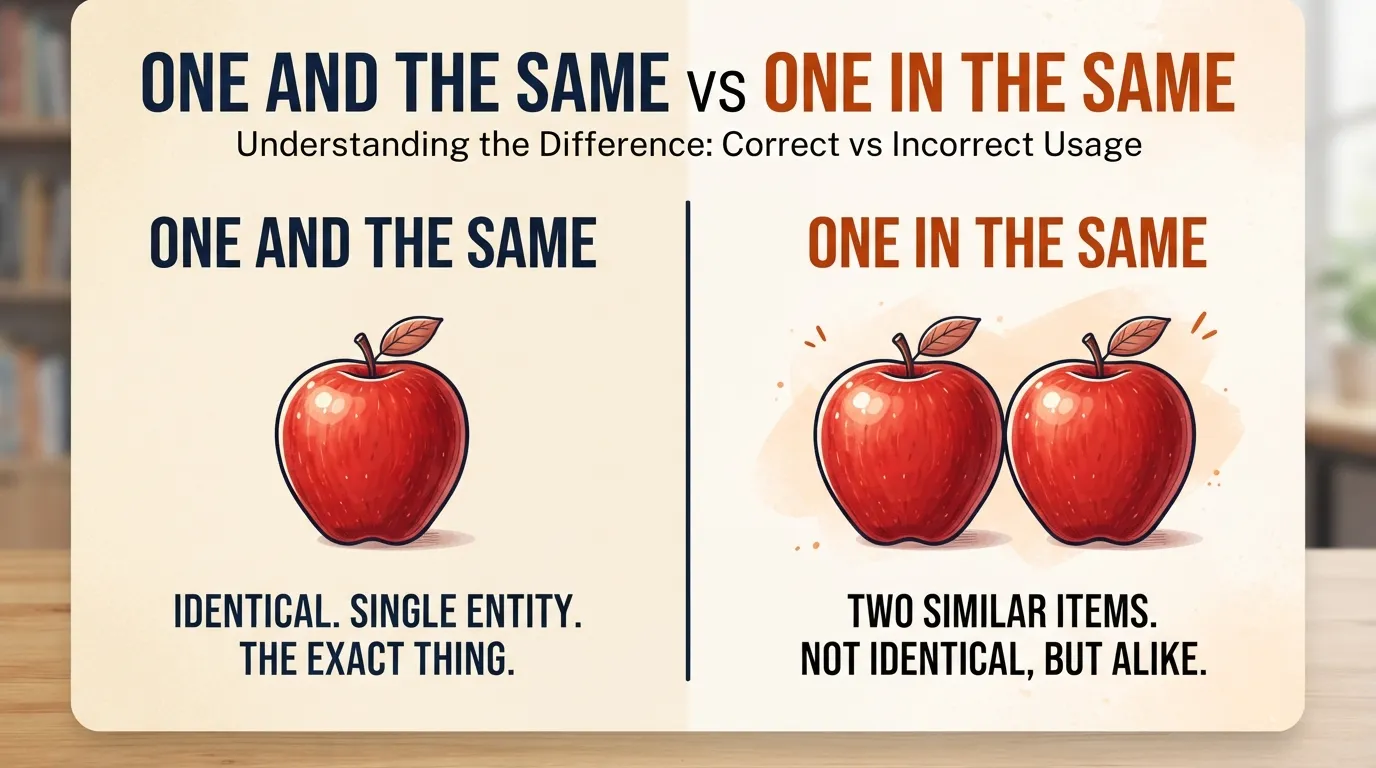
The courtroom was quiet when the prosecutor stood up. “The man who called the station on Tuesday,” she said, “and the man who sent the email on Wednesday — they are one and the same.” A murmur ran through the gallery. Two names, two messages, two days — and one person behind them all. The prosecutor’s phrase did the work of a whole paragraph: it collapsed two apparent identities into one. It also contained a trap that catches thousands of writers every year, because the correct phrase is one and the same, and the version most people write — one in the same — is a mistake.
The two phrases sound nearly identical in rapid speech. And, unstressed, shrinks to a murmur — “one ‘n’ the same” — and the ear, trying to make sense of it, hears in. The result is one of English’s most common eggcorns: a mishearing that produces a plausible but wrong phrase. The error is so widespread that it appears in published books, news articles, and legal documents. It is still an error. If you mean “exactly the same person or thing,” the phrase is one and the same, with and.
The Case of the Two Names
Return to the courtroom, because the idiom’s job is easiest to see there. One and the same is used when two descriptions, names, or roles appear to refer to different things, and the speaker wants to say they refer to one. “The author and the speaker are one and the same.” “The manager and the owner are one and the same.” “The company that bought the factory and the company that closed it are one and the same.” In each case, the sentence first presents a pair — two names, two roles, two descriptions — and then collapses them. The phrase is the collapse.
The idiom works because it is emphatic. Saying “they are the same” is flat. Saying “they are one and the same” insists: not merely similar, not merely related, but identical — one entity, not two. That emphasis is why the phrase appears in arguments, revelations, and denials. A detective says it when the suspect’s alibi crumbles. A journalist says it when two shell companies turn out to share an owner. A friend says it when the online stranger turns out to be the neighbor. The phrase carries the weight of a discovery.
Grammatically, the phrase functions as a predicate — it completes a linking verb: “They are one and the same.” It can also modify a noun with a hyphen: “the one-and-the-same person.” It does not take a plural, and it does not change form for tense. The structure is fixed: one + and + the same. Every word matters, and the and is the load-bearing one.
Anatomy of an Idiom: Why And, Not In
Why and? Because the phrase is built from two claims joined together. One claims singularity: there is one entity, not two. The same claims identity: that entity is the same one already mentioned. The and joins the two claims: the two descriptions are one entity and the same entity. Remove the and and the structure falls apart — which is exactly what one in the same does. In is a preposition of place or membership; it cannot join two claims. “One in the same” is not a collapsed version of the idiom; it is a different, ungrammatical construction wearing the idiom’s clothes.
The phrase has a long history. Versions of it appear in English from the sixteenth century onward, in Shakespeare, in the King James Bible’s phrasing, and in legal writing, where precision about identity is the whole job. The legal use is worth noting: when a contract or indictment says two names are “one and the same,” it is making a claim with consequences — that the person who signed as “J. Smith” and the person charged as “John Smith” are the same individual. The phrase’s weight in law is part of why getting it right matters beyond style. A legal document that says “one in the same” has introduced an ambiguity into the one place ambiguity is least welcome.
There is also a rhetorical cousin worth distinguishing: one and the same thing — the full form, with thing at the end — is common and correct: “Profit and purpose are one and the same thing.” The shorter form, without thing, is equally correct and more common in speech. Both use and. Neither uses in.
Eggcorns: When the Ear Rewrites the Language
One in the same belongs to a family of errors called eggcorns — mishearings that replace a word or phrase with a similar-sounding one that seems to make sense. The term itself comes from a mishearing: someone heard acorn as eggcorn — and an acorn is, after all, vaguely egg-shaped and corn-like, so the error feels reasonable. Other famous eggcorns include for all intensive purposes (for for all intents and purposes), on tender hooks (for on tenterhooks), a doggy-dog world (for a dog-eat-dog world), and beckon call (for beck and call).
What makes eggcorns stubborn is that they are not random typos. They are reinterpretations: the listener hears something unclear and rebuilds it from familiar parts. One in the same feels plausible because in the same is a perfectly good English phrase on its own — “in the same group,” “in the same boat,” “in the same room.” The listener’s brain takes a familiar chunk (in the same) and slots it into an unfamiliar idiom (one and the same), producing a sentence that sounds right and means nothing. The error survives because it is almost right, and “almost right” is the hardest kind of wrong to notice.
The defense against eggcorns is not better hearing but better reading. Idioms are learned by eye as much as by ear, and the written form — one and the same — is unambiguous in a way the spoken form is not. If you have ever written one in the same, you are in large company, and the fix is one word: swap in for and. The sentence will sound the same. It will mean what you meant.
When One in the Same Is Actually Correct
There is a genuine exception, and it is important, because it explains why the error feels so plausible. The word combination one in the same can be correct when in has its own grammatical job — when it genuinely means membership or location. “She is one in the same group as her sister” is correct: one counts her, in the same group says where she belongs. “He is one in the same class of investors” is correct for the same reason. “There was only one in the same box” is correct: one item, located in the same box.
The difference is structural. In the correct uses, one is a number or pronoun, and in the same… is a prepositional phrase that follows it, with a noun after same: one in the same group / class / box / room. In the error, there is no noun after same, and one is not counting anything — the phrase is trying to say “identical,” and in cannot do that job. The test is simple: if you can add a noun after same — one in the same group — the in is legitimate. If you cannot — “they are one in the same” with nothing after same — the word should be and.
This exception also explains a usage note for careful writers: when you do mean membership, consider rephrasing anyway. “She is one in the same group” is correct but slightly awkward; “She is in the same group” or “She is one of the same group” is cleaner. The rephrasing avoids the shadow of the eggcorn entirely. Good writing is not only about being right; it is about not looking wrong.
Using the Idiom Well
One and the same is a strong phrase, and strong phrases wear out if overused. In ordinary writing, it earns its place when identity is genuinely surprising or contested — the two names that turn out to be one person, the two companies that turn out to be one organization, the two problems that turn out to have one cause. When identity is obvious, the phrase is overkill: “The car and the vehicle are one and the same” is a tautology, not a revelation. Save the idiom for moments when the collapse of two into one is news.
The phrase also has a formal register. It appears in academic writing (“the observer and the observed are one and the same in this method”), in journalism (“the donor and the lobbyist are one and the same”), and in law, where it is close to a term of art. In casual conversation, people often prefer simpler phrasing — “it’s the same person,” “same guy” — and the idiom can sound stiff. Matching the phrase to the register is part of using it well: in a courtroom or a report, one and the same is exactly right; in a text message, it may be more than the moment needs.
And a final note on the courtroom where we started. The prosecutor’s sentence worked because it was precise: two descriptions, one person, joined by and. Had she said “one in the same,” the jury would have understood her — the error is that common — but the transcript would have carried a mistake into the record. The difference between and and in is two letters. The difference between a correct idiom and an eggcorn is the difference between saying what you mean and almost saying it. In language, as in a courtroom, almost is not enough.










