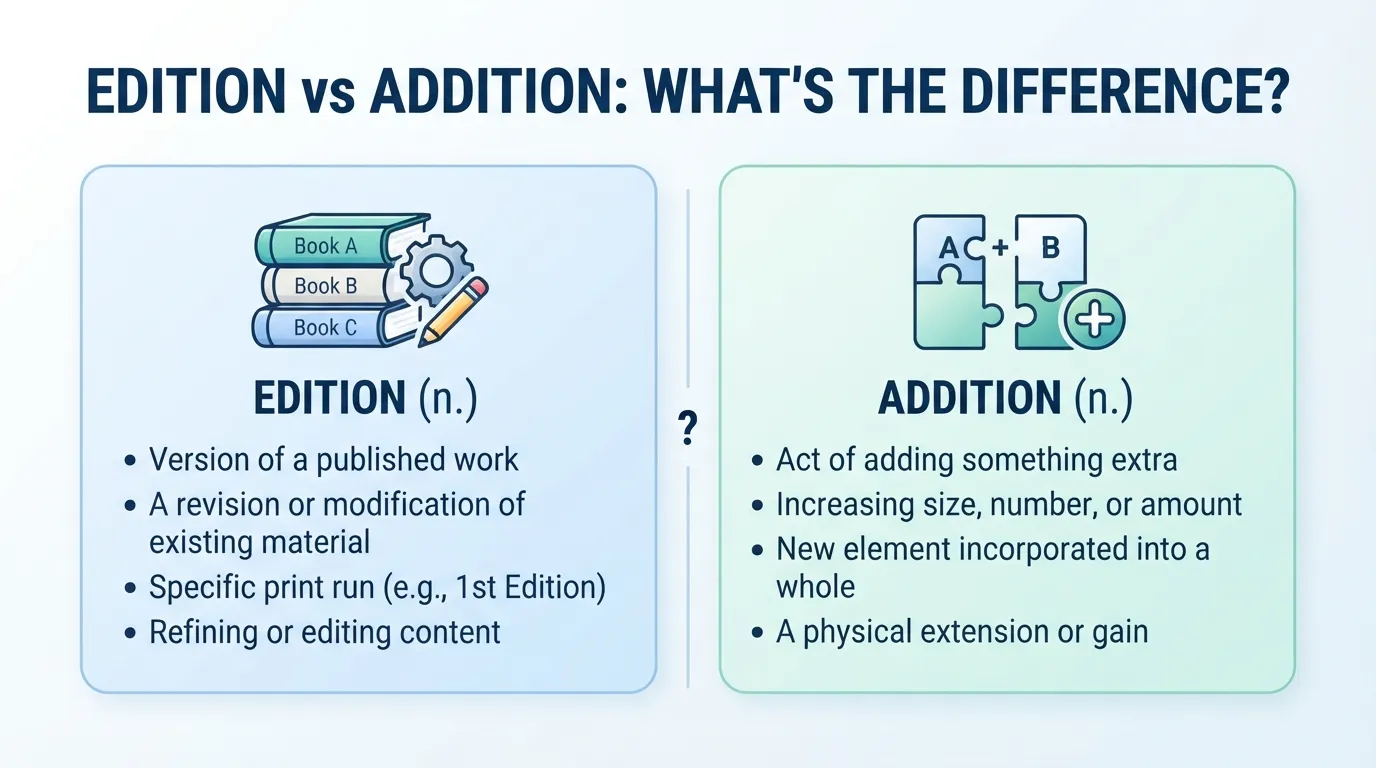
On a quiet morning, two professionals start their work. In a library downtown, a librarian slides a new book onto a shelf and labels it the third edition — a new version of a familiar title, revised and updated. Across town, a contractor watches a crew frame a new room onto the back of a house — an addition, something added to what was already there. Both people are working with the ending -ition. Both words sound alike. But the librarian and the builder are doing opposite things: one is releasing a version, the other is adding a piece.
Edition and addition are two of the most commonly confused words in English, and the confusion is easy to understand. They look alike, they sound alike, and they both belong to the world of making and publishing things. But they are not interchangeable, and swapping them changes the meaning of a sentence completely. A new edition of a book is not a new addition to a book — unless it is, and that is exactly where the trouble starts.
The Librarian’s Word: Edition
Edition means a particular version or form of something that is published, produced, or released. The word lives in the world of versions. A first edition is the first printing of a book. A revised edition is a version with corrections and updates. A limited edition is a version produced in a small, numbered quantity. A Sunday edition is the version of a newspaper published on Sunday.
The key idea is that an edition is a whole thing in a particular form. When you buy the latest edition of a textbook, you are not buying something added to the textbook. You are buying the textbook itself, in its newest version. The old edition still exists; the new edition replaces it on the shelf. That is why we say “the latest edition” — the word tracks versions across time.
The word has spread far beyond books. Software has editions: a standard edition and a professional edition. Games have editions: a deluxe edition with extra content. Magazines have international editions. Products have special editions. In every case, the meaning holds: a distinct version of a thing, released as a whole.
There is also a quieter, technical use. In publishing, an edition can mean all the copies of a work printed at one time from the same plates. “The entire edition sold out.” Here the word means a batch, a print run. The version sense and the batch sense are related: one printing produces one version, in one quantity.

The Builder’s Word: Addition
Addition comes from the verb add, and it means something that has been added, or the act of adding. The word lives in the world of accumulation. A home addition is a room built onto an existing house. A new addition to the team is a person who has joined the group. An addition to the report is a section that was not there before. In mathematics, addition is the operation of combining numbers.
The key idea is the opposite of an edition’s. An addition does not replace anything. It joins something that already exists. The house is still there; the new room is attached to it. The team is still there; the new member is part of it. The report is still there; the new section is inside it. That is why we say “an addition to” — the word points at a relationship between the new piece and the old whole.
The mathematical sense is the oldest and the most precise. Addition is one of the four basic operations, alongside subtraction, multiplication, and division. “She checked her work using addition.” In this sense, the word has nothing to do with versions at all. It is pure combining: two quantities becoming one sum.
The word also carries a warm, human sense. “A new addition to the family” almost always means a baby. “A welcome addition” means something or someone whose arrival improved the group. In these phrases, the word is doing emotional work — marking an arrival, a gain, a growth.
Why They Get Mixed Up
The confusion has three sources. The first is the ending. Both words end in -ition, a Latin suffix that turns verbs into nouns. Edition comes from the Latin edere, to bring forth or publish. Addition comes from addere, to add. The shared ending is a coincidence of Latin grammar, not a sign that the words are related in meaning.
The second is the sound. In fast speech, edition and addition blur together. The difference is in the first syllable — eh versus ah — and in some accents that difference is small. A listener can easily mishear one for the other, especially in a noisy room or a mumbled sentence.
The third is the overlap in the world of books. A book can have both an edition and an addition, and the same sentence can contain both ideas. “The new edition includes an addition to chapter three.” That sentence is perfectly correct — a new version that contains a new section — and it shows exactly why the words get tangled. They live in the same neighborhood. They just do different jobs.

Edition and Addition in the Same Sentence
The best way to keep the two words straight is to see them working side by side. Read each pair and notice which word fits which job:
- “I bought the latest edition of the magazine.” — a version of the magazine.
- “I made an addition to the article.” — something newly included in the article.
- “The publisher released a special edition for students.” — a version, released as a whole.
- “The new chapter is a useful addition to the book.” — a piece added to the book.
- “Did you read today’s edition of the newspaper?” — today’s version.
- “We made an addition to the guest list.” — a name added to the list.
The test is simple. Ask: am I talking about a version of the whole thing, or a piece added to it? Version → edition. Piece added → addition. The test works in every context: books, software, buildings, teams, families, mathematics.
There is one sentence where the test gets interesting: “The deluxe edition includes bonus content.” Is the bonus content an edition or an addition? Both. The deluxe edition is a version of the game. The bonus content is an addition to it. The two words are doing their two jobs in the same sentence, and the sentence is correct because each word is in its proper place.
Edition in Software, Games, and Collecting
The word edition has found a second career in software and games, and it is worth a closer look because it stretches the version idea in interesting ways. A software standard edition and a professional edition are not sequential versions — they are parallel versions, sold at the same time, with different features. The professional edition is not newer. It is bigger. The version idea has become a tier idea: same product, different levels.
Games took it further. A deluxe edition includes bonus content — extra levels, artwork, soundtracks. A collector’s edition includes physical objects — figurines, maps, art books. A game of the year edition bundles the original game with all its expansions. In each case, the word still means a version, but the version is defined by what it contains, not by when it was released. The librarian’s shelf has become a shop window.
Collecting adds one more twist. A first edition book is valuable precisely because it is the earliest version — the one closest to the author’s original text, printed before corrections and revisions. Collectors pay premiums for first editions of famous books, and the value depends on the edition being genuinely first, not a later reprint dressed up as one. Here the version idea meets money: the edition is not just a version, it is a provenance, a piece of history you can hold.
A Quick Shelf Check
When the words blur, run this check. First, try replacing the word with version. If the sentence still makes sense, you want edition: “the latest version of the book” works, so “the latest edition of the book” is right. Second, try replacing it with something added. If that fits, you want addition: “a useful something-added to the book” is clumsy but clear, so “a useful addition to the book” is right.
And remember the librarian and the builder. The librarian deals in versions — editions on a shelf, each one replacing the last. The builder deals in pieces — additions attached to what already stands. Two professionals, two words, two jobs. Keep the librarian and the builder in their proper places, and the words will stay in theirs too.


That is the whole difference, and it is worth holding onto. Edition is a version. Addition is something added. They share an ending, a sound, and a neighborhood — and nothing else. The next time the two words blur, ask the librarian-or-builder question, and the right word will step forward.










