The headline on the copy desk read: “Mayor Pled Guilty in Tax Case.” The senior editor stared at it for ten seconds, picked up a red pencil, and changed one word: “Mayor Pleaded Guilty in Tax Case.” The junior reporter who had written the headline protested. “But pled is right,” she said. “Everyone says pled.” The editor nodded. “Everyone says it,” she said. “And in this newspaper, we print pleaded.” The argument that followed — about pleaded versus pled — is one of the longest-running disputes in American newsrooms, and it has a clear answer that satisfies almost nobody: both forms are correct, but they are not equal, and the choice depends on where you are writing, how formal you are being, and whose stylebook sits on your desk.
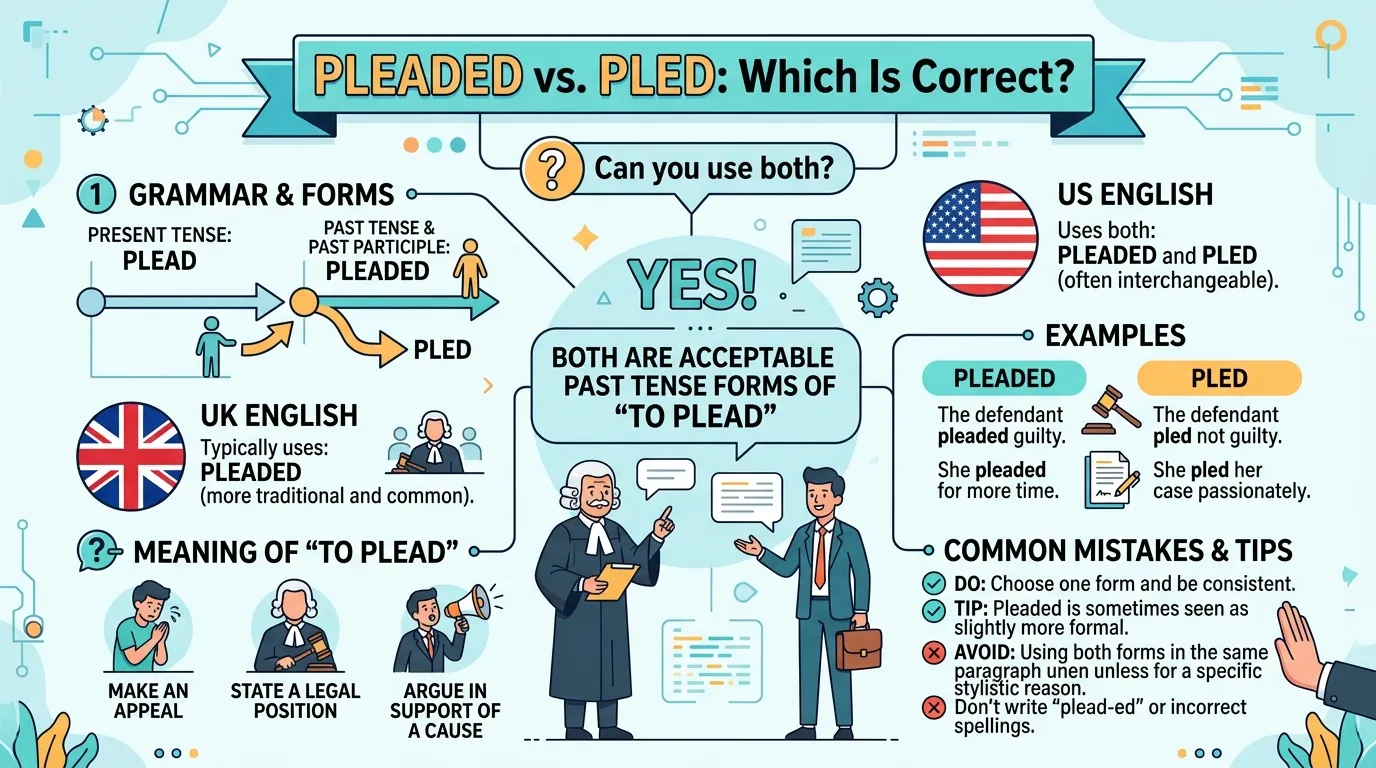
The facts first. Pleaded is the standard past tense and past participle of plead everywhere in the English-speaking world. It is the only form used in British English, and it is the preferred form in American formal writing. Pled is also correct, but it is largely an American form, common in legal writing, in speech, and in headlines, and rare or unheard in British English. If you want one form that works everywhere, in every register, it is pleaded. If you want the form that fits an American courtroom or a tight headline, pled is available — but it is the exception, not the rule.
The Headline on the Desk
Headlines are where pled lives most visibly, and the reason is space. “Mayor Pled Guilty” is two characters shorter than “Mayor Pleaded Guilty.” In a headline, where every character counts and the type is large, two characters matter. Headline writers have used pled for a century because it is shorter, punchier, and — to the American ear — perfectly natural. The Associated Press, the wire service whose style governs most American newspapers, has long listed pleaded as the preferred form in body copy while tolerating pled in headlines. The result is a split that readers notice: the headline says pled, the article below it says pleaded, and the reader wonders which one is right. Both are. The newspaper is using two registers in two places, the way a person might say “gonna” in conversation and “going to” in a letter.
The senior editor’s correction was not about correctness. It was about the newspaper’s house style. Every publication chooses a stylebook — AP, Chicago, New York Times, Guardian — and the stylebook’s choice becomes the publication’s law. The AP Stylebook says: use pleaded. The Chicago Manual of Style says the same. The Guardian’s style guide says pleaded, and British papers have no pled at all. The junior reporter’s instinct — “everyone says pled” — was about speech. The editor’s correction was about print. Both were right about their own domain. The headline was wrong only because it violated the paper’s chosen style.
Pleaded: The Safe Choice
Pleaded is the regular form: plead plus -ed, the way walk becomes walked and talk becomes talked. It is the form listed first in every major dictionary. It is the form used in British English without exception. It is the form used in American academic writing, in legal briefs, in formal correspondence, and in international English. “He pleaded guilty.” “She pleaded with the committee.” “They pleaded for more time.” “The defendant pleaded not guilty.” In every one of these sentences, pleaded is correct, unremarkable, and safe.
The safety of pleaded is its chief virtue. A writer who uses pleaded will never be corrected by a British reader, never be flagged by a style guide, and never sound informal in a formal document. The form is transparent: it follows the regular rule, and the reader’s eye passes over it without stopping. In writing, invisibility is often the goal. The verb should carry the meaning without drawing attention to its own spelling. Pleaded does that. It is the form that disappears into the sentence, and that is exactly what a writer wants from a verb.
Pled: The American Short Form
Pled is the irregular form, and its history is worth knowing because it explains why it feels so natural to American ears. English has a family of verbs that form their past tense by changing the vowel rather than adding -ed: feed/fed, speed/sped, bleed/bled, lead/led, read/read, plead/pled. Pled follows this pattern — the ea shortens to e, the way bleed becomes bled and feed becomes fed. The form is not a corruption. It is an old pattern, applied to a verb that also has a regular form. English has several verbs with two past tenses — dreamed/dreamt, learned/learnt, burned/burnt, spelled/spelt — and pleaded/pled is one of them.
Where does pled live? In American courtrooms, first. Lawyers say “my client pled guilty” and “he pled not guilty” as a matter of professional habit, and court transcripts are full of it. In American speech, second: “She pled with him to stay” sounds natural to most American ears, and many Americans would not recognize it as a choice at all. In American headlines, third, for the space reasons discussed above. In British English, almost nowhere: a British reader encountering pled will usually read it as an Americanism, and a British editor will change it to pleaded without a second thought.
There is one more place pled appears that deserves a note: fixed legal phrases. “Pled guilty” and “pled not guilty” are the phrases most often seen with pled, and they are so common in American legal writing that some American dictionaries list them as standard. But even in American legal writing, pleaded guilty is equally common and equally correct, and it is the form the AP Stylebook recommends even for legal stories. The legal profession’s attachment to pled is a matter of habit, not of rule.
The Courtroom vs the Newsroom
The courtroom and the newsroom use the verb differently, and the difference is about more than spelling. In court, plead has a technical meaning: to make a formal statement of guilt or innocence in response to a charge. “How do you plead?” “Not guilty, Your Honor.” “The defendant pleaded guilty to one count.” The plea is a legal act, and the verb that describes it is doing legal work. In everyday speech, plead has a broader meaning: to beg, to ask earnestly, to make an emotional appeal. “She pleaded with him to stay.” “He pleaded for a second chance.” “They pleaded for mercy.” The verb in these sentences is doing emotional work.
The spelling split maps loosely onto this difference. Pled clusters around the legal meaning — “pled guilty,” “pled not guilty,” “pled no contest” — while pleaded covers both meanings comfortably. A writer who uses pleaded for both is never wrong. A writer who uses pled for the emotional meaning — “She pled with him to stay” — is using an American colloquial form that a British reader will find odd and a formal reader will find informal. The safe rule, again, is pleaded for everything. The exception, if you want it, is pled for American legal contexts.
“Plead the Fifth”
One fixed phrase deserves its own section, because it is the most famous use of the verb in American culture. “To plead the Fifth” means to invoke the Fifth Amendment to the U.S. Constitution — the right against self-incrimination — and refuse to answer a question. “The witness pleaded the Fifth.” “He pled the Fifth.” Both appear, and the same rule applies: pleaded is safe everywhere, pled is American and informal. The phrase itself is American — there is no British equivalent, because there is no British Fifth Amendment — so the American form is less out of place here than elsewhere. But the style guides still prefer pleaded, even for this phrase, and the AP Stylebook’s entry on the subject is explicit.
The phrase also illustrates something about plead that the spelling debate obscures: the verb is doing cultural work. “Pleading the Fifth” is not just a legal act. It is a dramatic one, performed on television, in films, in congressional hearings, and the phrase carries the weight of all those performances. The spelling of its past tense is a small matter beside the phrase’s cultural power. But small matters are what copy desks are for, and the copy desk’s answer is the same as it is for every other use: pleaded.
The One-Word Verdict
Back to the headline. The senior editor’s correction stood. The newspaper printed “Mayor Pleaded Guilty in Tax Case,” and the junior reporter learned a lesson that every writer learns eventually: correctness and style are not the same thing. Pled is correct. Pleaded is correct. The newspaper chose pleaded, because the newspaper’s stylebook chose pleaded, because pleaded works in every register, in every country, in every kind of writing. The one-word verdict is this: write pleaded. It is the form that never needs an explanation, never draws a red pencil, and never makes a British reader pause. Pled is available for the American courtroom and the tight headline. Everywhere else, pleaded is the word.