The plaque on the war memorial listed the names of the fallen under a single heading: “Roll of Honour.” A visiting American student read it, frowned, and whispered to her teacher, “Shouldn’t that be Honor?” The teacher shook her head. “Not here,” she said. “This is a Commonwealth memorial. Here it is Honour.” The student looked at the plaque again — the names, the dates, the single word at the top — and understood something that no spelling list had ever taught her: the difference between honor and honour is not about correctness. It is about place. The word is the same. The spelling is a passport.
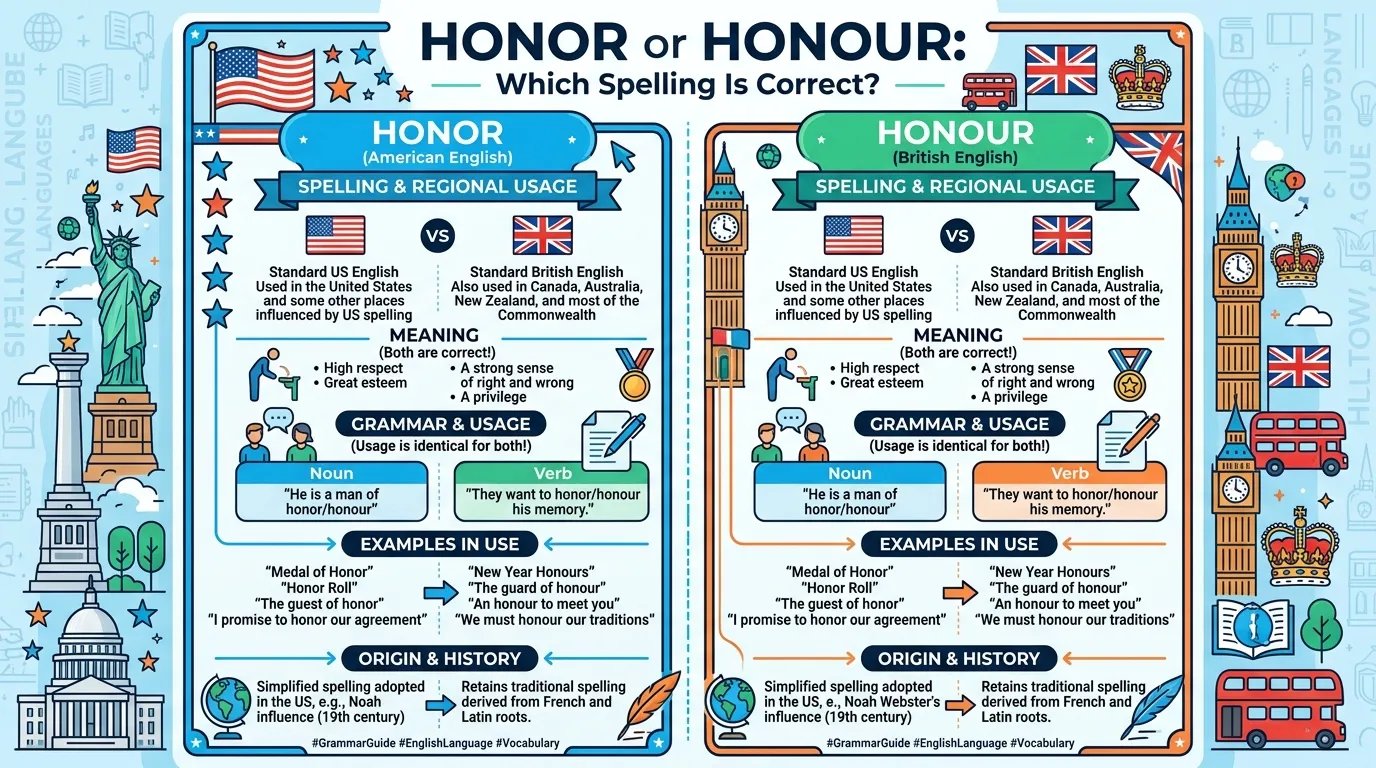
The facts are simple. Honor is the American spelling. Honour is the British spelling, used also in Canada, Australia, New Zealand, and most Commonwealth countries. Both are correct. Neither is a misspelling. The meaning is identical in every respect: respect, high regard, integrity, good reputation, a privilege or special recognition. The choice between them depends entirely on which variety of English you are writing — and on staying consistent once you have chosen.
The Plaque
War memorials are the purest place to see the split, because they are permanent. A plaque cannot be updated with a find-and-replace. The “Roll of Honour” on a British, Canadian, or Australian memorial was carved with a u because the carver wrote British English, and the u belongs to that system the way the spelling of “colour” and “favour” does. An American memorial says “Roll of Honor” or “Honor Roll” without the u, because American English dropped it. Both plaques honor the same thing. Both spellings honor the same word. The u is not a decoration. It is a marker of the system that produced the plaque.
The school’s “Honor Roll” is the American cousin of the memorial’s “Roll of Honour.” In the United States, the Honor Roll is the list of students with high grades — a term every American schoolchild knows. In Britain, the equivalent list is rarely called that; the phrase “roll of honour” belongs to memorials, not to schools. The two phrases are not just spelled differently. They live in different institutions. The American Honor Roll is about achievement. The Commonwealth Roll of Honour is about remembrance. The spelling split and the institutional split go together, and a writer who moves between the two systems needs to know both.
The memorial plaque also teaches something about permanence. A spelling choice carved in stone cannot be corrected with a software update, and the carvers of these plaques knew it: they chose the spelling of their own system with care, because the plaque would outlive them. That care is a model for everyday writing. A spelling choice in a document may not be carved in stone, but it is read by people who will judge the writer by it — a hiring manager reading a résumé, a professor reading an essay, a client reading a proposal. The u in honour is small, but the judgment it invites is not.
The Man Who Dropped the U
The u in honour was not always there to be dropped. The word came into English from Old French honor — itself from Latin honor — and for centuries English spelled it honor, without the u. The u arrived in the seventeenth and eighteenth centuries, when English writers, influenced by French spelling, began adding u to words of French and Latin origin: colour, favour, labour, neighbour, honour. The u was a fashion, a mark of French elegance, and it spread through British English until it became the standard.
Then came Noah Webster. The American lexicographer, compiling his dictionaries in the early nineteenth century, saw the u as an unnecessary French import and removed it — along with the u in colour, favour, and labour, and the -re in centre and theatre, and the double l in travelling and labelling. Webster’s reforms were deliberate, systematic, and nationalistic: he wanted an American spelling that was simpler, more phonetic, and visibly distinct from British spelling. The American public adopted his reforms, and the u vanished from American honor within a generation. The British kept it. The split was not an accident. It was a decision, made by one man with a dictionary and a conviction that spelling should serve the republic.
Honor the Noun
As a noun, honor/honour covers a wide range of meanings, and all of them cross the Atlantic intact. It means respect: “It was an honor to meet her.” It means high regard: “He defended his family’s honour.” It means integrity: “A person of honor keeps promises.” It means good reputation: “The scandal damaged his honour.” It means a privilege or special recognition: “It is an honour to be invited.” “She received the honor of a state dinner.” In every sentence, the meaning is the same in both spellings, and the only choice is the u.
The noun also appears in fixed phrases that carry the same spelling choice. In honor of (US) / in honour of (UK): “A concert in honor of the composer.” On one’s honor (US) / on one’s honour (UK): “On my honour, I will tell the truth.” Honor system (US) / honour system (UK): a system based on trust, without supervision. Maid of honor (US) / maid of honour (UK): the chief bridesmaid. Matron of honor (US) / matron of honour (UK): the married equivalent. Guest of honor (US) / guest of honour (UK): the person being celebrated. In every phrase, the u follows the system, and mixing systems — “in honour of” in an American wedding program, “maid of honor” in a British one — reads as an error even though both spellings are correct in their own systems.
Honor the Verb
As a verb, honor/honour means to show respect, to fulfill an obligation, or to keep a promise. “We honor our veterans every year.” “The university will honour its best students.” “She honored the agreement.” “They honoured the fallen.” The verb follows the same spelling rule as the noun, and its forms follow the same pattern: honors/honours, honored/honoured, honoring/honouring. The u stays or goes in every form, consistently.
The verb has a special use in finance and law that is worth knowing: to honor a check or a contract is to accept it as valid and pay it. “The bank honored the check.” “The company honored its debts.” In this sense, the verb is doing institutional work — it is about validity, not respect — and it appears in contracts, banking documents, and legal writing, where the spelling system of the document governs. A contract written in British English says “honoured.” A contract written in American English says “honored.” The meaning is identical. The u is the only difference, and it is the difference that tells the reader which legal system drafted the document.
Phrases That Never Change Their U
There is one phrase in the honor family that breaks the pattern, and it is the most formal phrase of all. “Your Honor” — the form of address for a judge in an American courtroom — is spelled without the u, always, because it is American. Its British equivalent is “Your Honour” — with the u, always, because it is British. The two phrases are not variants of one phrase. They are two phrases, one per system, and each is fixed in its own system. An American lawyer who writes “Your Honour” has made a spelling error in American English. A British barrister who writes “Your Honor” has made a spelling error in British English. The phrase does not travel. It belongs to its courtroom.
Similarly, the phrase “on my honour” in British English and “on my honor” in American English are fixed within their systems, and the same is true of “word of honour” (UK) and “word of honor” (US). These phrases are worth memorizing as units, not as words, because they appear in oaths, in pledges, in fiction, and in film, and the u is part of the phrase’s identity. A British character in a novel says “on my honour.” An American character says “on my honor.” The novelist who swaps them has given the character the wrong accent — in spelling, if not in speech.
The Consistency Rule
The only real error with honor and honour is inconsistency. A document that writes “honor” in paragraph one and “honour” in paragraph three has not made a spelling error. It has made a consistency error, and consistency errors are the ones readers notice, because they signal that the writer does not know which system they are in. The rule is simple: pick a system — American or British — and stay in it for the whole document. Honor, color, favor, labor, center, traveled go together. Honour, colour, favour, labour, centre, travelled go together. The systems are packages, and the u is one item in the package.
Back to the plaque. The American student learned that the memorial’s spelling was not a mistake, and the teacher learned that the student had asked the right question. The plaque says “Roll of Honour” because it was carved in a country that spells the word with a u. The student’s school says “Honor Roll” because it stands in a country that spells it without one. Both are correct. Both honor the same thing. The u is small — one letter, silent, invisible in speech — and it carries the whole history of two countries’ spelling: a French fashion, an American reform, and a plaque that will outlast them both.