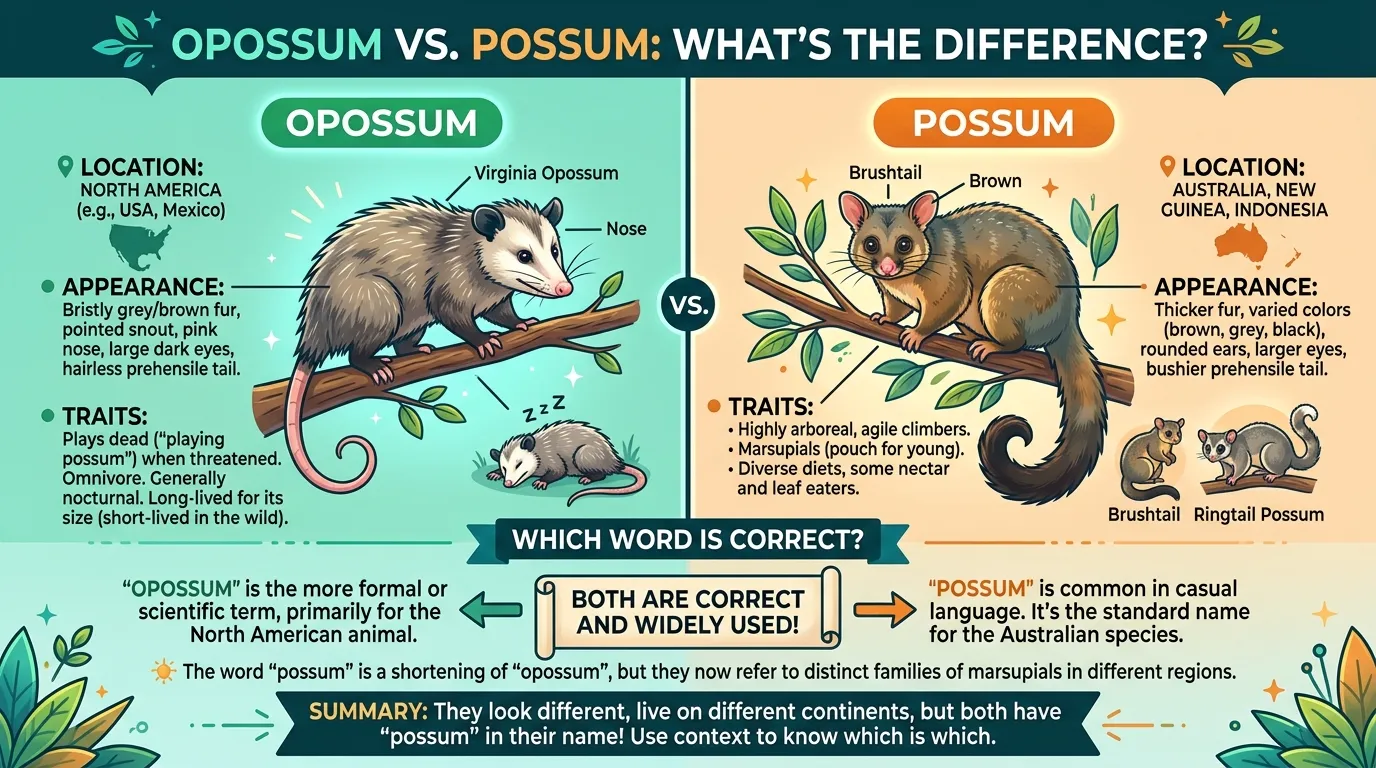
The wildlife rehabilitation center had two intake forms on the same clipboard, and they looked like they described the same animal. The first, from Ohio, said “Virginia opossum, found in a garage.” The second, from a partner center in Sydney, said “Common brushtail possum, found in a roof.” Same clipboard. Two animals. Two words. Opossum and possum are not interchangeable — they name different animals on different continents. The Virginia opossum is a North American marsupial. The possums of Australia and New Zealand are a separate family of marsupials. Americans shorten opossum to possum in casual speech, which is where the confusion begins. Australians never shorten their possums to opossums, because their animals were never opossums at all.
Intake Form One: The Virginia Opossum
The Virginia opossum (Didelphis virginiana) is the only marsupial native to North America. It is a cat-sized animal with gray-white fur, a pointed snout, a hairless prehensile tail, and opposable thumbs on its hind feet. It is famous for “playing possum” — collapsing into a death-like state, complete with a foul smell and a lolling tongue, when threatened. The display is involuntary, a stress response, not a performance. The animal is not pretending. It is overwhelmed.
The word opossum comes from the Powhatan word aposoum, meaning “white animal,” recorded by English colonists in Virginia in the early 1600s. The initial o is part of the word’s origin, and it is pronounced in formal speech — “uh-POS-um” — though many Americans drop it in casual conversation, saying “possum.” That dropping is the source of the confusion: the American animal’s casual name sounds identical to the Australian animal’s real name.
Intake Form Two: The Australian Possum
The Australian possums are a different family entirely — the Phalangeridae, which includes the common brushtail possum, the ringtail possum, and the sugar glider. They are tree-dwelling marsupials with bushy tails, big eyes, and soft fur, and they are among the most common wild animals in Australian cities, where they raid roofs and gardens at night. They do not play dead. They do not have the opossum’s pointed snout or bare tail. They are not closely related to the Virginia opossum at all — the two families diverged tens of millions of years ago, when the continents were still connected through Antarctica.
The name possum was given to the Australian animals by Captain James Cook’s naturalist Joseph Banks, who thought they resembled the American opossum. The resemblance was superficial, but the name stuck, and it has caused confusion ever since. In Australia and New Zealand, possum is the only correct name. Writing opossum for an Australian animal is wrong — it is like calling a wallaby a kangaroo. Close, but not the same animal.
The Silent O: Why Americans Drop It
Why do Americans say “possum” for an opossum? The reason is sound. The first syllable of opossum is unstressed, and unstressed first syllables tend to disappear in fast speech — the same process that turned esquire into squire in some dialects. Over generations, the casual form possum became so common in American speech that many Americans do not know the full form exists. Dictionaries list possum as an informal variant of opossum in American English, and it is acceptable in casual writing. In formal, scientific, and educational writing, opossum is the standard.
The Australian word has no o to drop. Possum is the full, correct name, and it has been since Banks coined it. There is no longer form hiding behind it. That asymmetry is the key to the pair: the American word can lose its o in speech; the Australian word never had one.
Playing Possum: The Idiom That Crossed Over
The idiom “playing possum” comes from the Virginia opossum’s death-feigning behavior, and it means pretending to be asleep, dead, or unaware to avoid trouble. “He played possum until the meeting ended.” “The company played possum during the investigation.” The idiom uses the short form possum, even in formal writing, because the idiom froze in the casual form. Writing “playing opossum” would be technically more precise and stylistically wrong — the idiom is playing possum, and idioms keep their own spellings.
The idiom is also used in Australia, where it refers to the same behavior — but Australian possums do not play dead. The phrase traveled with the name, not with the animal. An Australian who says “playing possum” is borrowing an American idiom about an American animal, applied to a situation that has nothing to do with either possum. Language is full of such borrowings, and this one is among the most confusing, because it makes the two animals seem like one.
The Opossum’s Superpowers: Immunity, Memory, and the Prehensile Tail
The Virginia opossum has a set of abilities that sound invented. It is almost immune to snake venom — it can survive bites from rattlesnakes and copperheads that would kill a dog — because its blood contains a protein that neutralizes venom. It is highly resistant to rabies, because its body temperature is too low for the virus to thrive. It has an excellent memory: in one study, opossums remembered the location of food after a year without practice, outperforming rats, rabbits, cats, and dogs. And its tail is prehensile, able to grip branches and carry nesting material, though the old story that opossums sleep hanging by their tails is a myth — adults are too heavy, and only juveniles dangle briefly.
The opossum is also a champion tick-eater. A single opossum can eat thousands of ticks in a season, grooming them off its fur and swallowing them, which makes the animal an unlikely ally in the fight against Lyme disease. Wildlife centers use this fact to persuade homeowners not to trap or kill opossums found in garages: the animal in the garage is eating the ticks in the yard. The opossum’s reputation as a pest is undeserved. It is a shy, nocturnal, mostly harmless animal with a remarkable immune system and a better memory than the dog that barks at it.
Possums in New Zealand: The Invasive Cousin
The Australian possum’s story takes a darker turn in New Zealand, where the common brushtail possum is an invasive species. Introduced in the 1830s for the fur trade, possums now number in the tens of millions in New Zealand, where they have no natural predators and where they eat native birds’ eggs, strip native forests, and spread bovine tuberculosis. New Zealand spends hundreds of millions of dollars a year on possum control, and the animal is one of the country’s most hated pests. The same animal that is a beloved, protected native in Australia is a declared enemy in New Zealand.
The contrast is a lesson in how much geography matters to a name. In Australia, the brushtail possum is a native animal, protected by law, and a familiar sight in city gardens. In New Zealand, it is an ecological disaster. In North America, the word possum means something else entirely. Three continents, two animals, one word — and the only way to keep them straight is to ask where the animal lives, and to spell the American animal’s full name with its o.
Opossums in the City: Garages, Roofs, and Backyard Encounters
Most people meet an opossum in a garage, a shed, or a backyard at night. The animal is nocturnal, shy, and slow-moving, and it enters human spaces looking for food — fallen fruit, pet food left outside, compost, insects. The correct response is to leave it alone. The opossum will usually leave on its own within a night or two, and it will take thousands of ticks with it. If it does not leave, a wildlife rehabilitator can remove it humanely. What you should not do is approach it, corner it, or try to pick it up. A frightened opossum may hiss, bare its fifty teeth — more teeth than any other North American land mammal — and, if the stress is severe enough, collapse into its death-feigning state. The display is alarming and harmless. The animal is not attacking. It is overwhelmed.
The Australian possum’s city life is louder. Brushtail possums are a familiar, noisy presence in Australian suburbs, where they live in roofs, screech at night, and raid fruit trees. Australians have a complicated relationship with them: the animals are protected natives, but they are also roof-dwelling pests, and residents are advised to block entry points and provide nest boxes rather than trap them. The contrast with the American opossum is instructive. The American animal is a shy visitor who leaves. The Australian animal is a permanent neighbor who stays. The names sound the same, but the animals’ relationships with people could not be more different.
Two Continents, Two Animals: A Field Guide
Here is the practical guide. If the animal is in North or South America, it is an opossum — the Virginia opossum in the north, various other opossum species further south. In formal writing, use opossum. In casual writing, possum is acceptable for the American animal. If the animal is in Australia, New Zealand, or nearby islands, it is a possum — brushtail, ringtail, pygmy, or sugar glider. Never write opossum for an Australian animal. If you are writing about the idiom, write playing possum, with the short form, in every variety.
The test is geography. North America: opossum. Australia: possum. The clipboard at the rehab center had it right — two forms, two animals, two continents — and the only error would have been treating them as one.