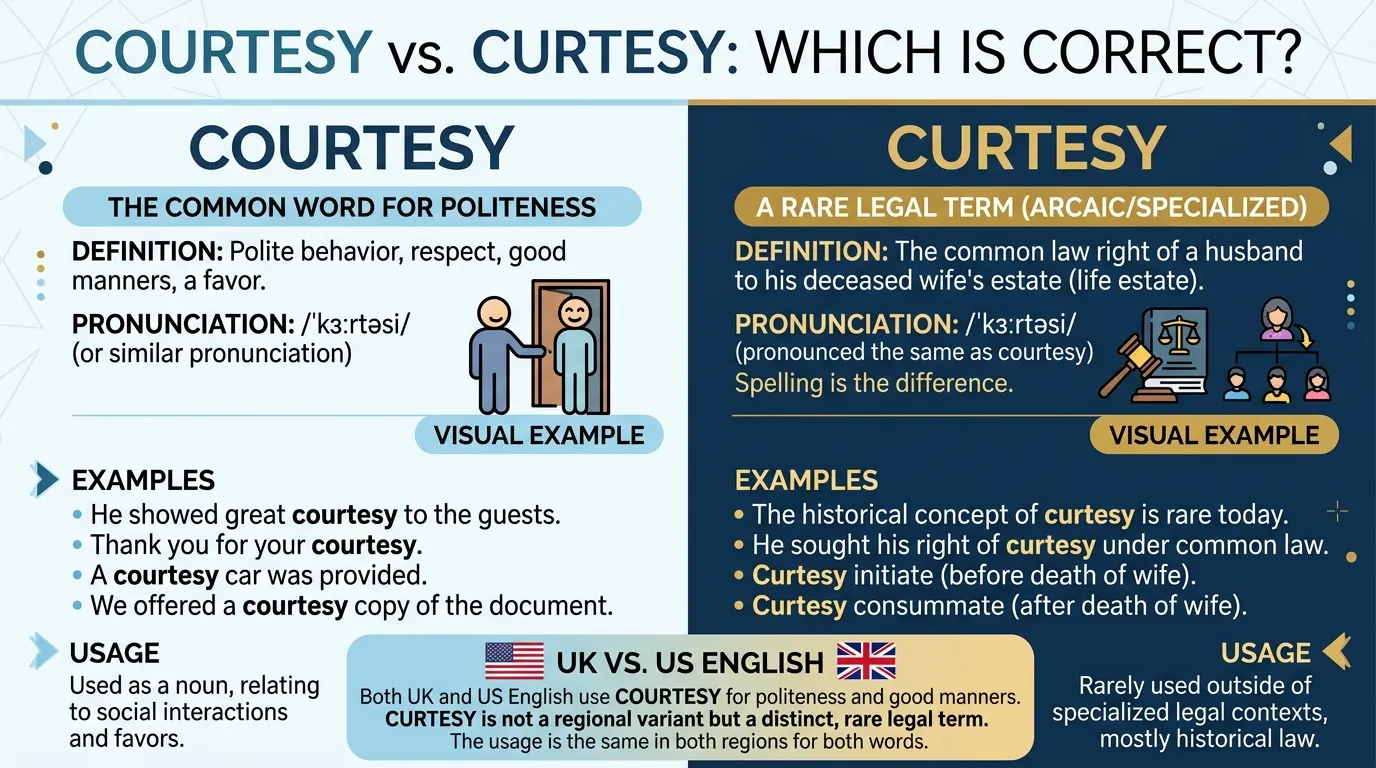
The ballroom dance instructor had a rule for the first lesson: “Courtesy is the first step.” She meant politeness — the bow, the offer of a hand, the thank-you after the dance. A student in the back row raised a hand and asked about a word he had seen in an old law book: curtesy. Same sound, different spelling, and a meaning that has nothing to do with dancing. Courtesy is the standard word for politeness, respect, or something given for free. Curtesy is an old legal term with a completely different meaning — a widower’s life interest in his dead wife’s land. The two words sound nearly identical, and they are not interchangeable. One belongs in everyday life. The other belongs in a medieval law archive.
First Position: Courtesy as Politeness
Courtesy means polite behavior, respect, or consideration for others. “She showed great courtesy to the guests.” “Common courtesy costs nothing.” “He held the door as a courtesy.” The word comes from the Old French cortoisie, meaning courtly behavior — the manners of a royal court — and it carries that sense of graciousness into modern English. It is the word for the small behaviors that make social life work: greetings, thanks, apologies, patience, deference.
The word also has a second meaning, equally common: something given for free, as a favor. A courtesy car is a free loan car. A courtesy call is a free or complimentary visit. A courtesy shuttle is a free bus. A courtesy copy is a copy sent as a favor. In all of these, courtesy means “given without charge, as a kindness.” The two meanings are related — a free service is a polite gesture — and they share the same spelling. The adjective form is courteous: “a courteous host.” The adverb is courteously: “She replied courteously.” There is no such word as courtesyly.
The Archive: Curtesy as Law
Curtesy is a different word with a different history. In English feudal law, curtesy — also called tenancy by the curtesy — was a husband’s right to a life interest in his dead wife’s land, provided they had had a child born alive who could inherit. The word comes from the same root as courtesy — the Old French courtoisie — but it took a separate legal path, and by the Middle Ages it was a term of art with a narrow, technical meaning.
The legal rule was a mirror image of dower, the widow’s right to a life interest in her dead husband’s land. Curtesy protected the widower; dower protected the widow. Both were feudal institutions, and both were largely abolished in the modern era — in England by the Administration of Estates Act 1925, and in most American states by modern probate law. Today, curtesy survives only in legal history, in old cases, and in the occasional law-school exam. If you meet the word outside a law book, it is almost certainly a misspelling of courtesy.
Two Words, One Sound: Why the Ear Fails
Courtesy and curtesy are pronounced nearly identically — “KUR-tuh-see” — with the difference being the vowel in the first syllable: cour- versus cur-. In fast speech, the difference vanishes. A writer spelling by ear can easily produce curtesy when they mean courtesy, and spellcheckers often fail to catch it, because curtesy is a real word. The error survives because it is almost right, and almost right is the hardest kind of wrong to notice.
The spelling difference has a logic. Courtesy keeps the ou of its French root — the same ou as in court, course, and courteous. Curtesy dropped the o in its legal specialization, becoming a distinct spelling for a distinct meaning. The o is the marker: if the sentence is about politeness or free service, the word needs its o. If the sentence is about feudal land law, it does not.
Courtesy in the Wild: Calls, Cars, and Copies
The word’s busiest contexts are worth collecting, because they are where the misspelling is most visible. Courtesy call — a visit or phone call made as a politeness, or a free service call. Courtesy car — a free loan vehicle. Courtesy shuttle — a free bus between a hotel and an airport. Courtesy copy — a copy sent for information, often abbreviated cc in emails. Courtesy title — a title used as a politeness, such as Ms. or Dr. Courtesy of — provided by, as in “Photos courtesy of the archive.” Out of courtesy — done to be polite: “Out of courtesy, she waited.”
In all of these, the spelling is courtesy, with the o. The word’s family follows the same spelling: courteous, courteously, discourtesy, discourteous. The legal word has no family — it stands alone, a fossil of feudal law, with its own spelling and its own narrow meaning. Learning the root spelling fixes the whole family at once.
Courtesy vs Kindness: Close Neighbors
Courtesy and kindness are neighbors, not twins. Courtesy is behavior governed by social convention — the bow, the greeting, the held door. Kindness is behavior governed by genuine feeling — the gift, the comfort, the sacrifice. Courtesy can be performed without feeling. Kindness cannot. A courteous stranger holds the door because it is done. A kind stranger holds the door because they care. The distinction matters in writing: “a courtesy” is a formal act, while “a kindness” is a personal one. A hotel offers courtesies. A friend offers kindnesses. The ballroom instructor’s rule — “courtesy is the first step” — was about convention, not feeling. The feeling comes later, after the steps are learned.
Courtesy in Business: The Cc Line and the Courtesy Visit
The word does quiet, exact work in business writing. The cc line of an email stands for courtesy copy — a copy sent for information, not for action. The recipient of a courtesy copy is expected to read, not to reply. A courtesy visit is a formal call made out of politeness rather than necessity: a new manager visiting a partner office, a diplomat calling on a counterpart. A courtesy meeting is a meeting held to maintain a relationship, not to decide anything. In all of these, courtesy signals that the action is governed by convention, not by need.
The business uses have their own traps. A courtesy discount is a free or reduced-price service offered as goodwill. A courtesy deadline is a soft deadline, extended as a favor. A courtesy hold on a hotel room is a reservation held without a deposit, as a favor. In each case, the word marks the action as a favor, and the favor can be withdrawn. The spelling, as always, is courtesy, with the o. A business email that writes curtesy copy has turned a politeness into a feudal land right, and the reader who notices will quietly doubt the writer’s attention to detail.
Discourtesy: The Opposite That Keeps the O
Every courtesy has its opposite, and the opposite keeps the same spelling. Discourtesy is rude behavior, the absence of politeness: “His discourtesy to the staff was noted.” Discourteous is the adjective: “a discourteous reply.” Discourteously is the adverb: “She answered discourteously.” The dis- prefix negates the word without changing its spelling, and the o survives in every form. The legal word curtesy has no opposite — there is no discourtesy in feudal law, because the legal term was never about politeness in the first place. The two words share a root and nothing else, and their families diverged centuries ago: one grew into a whole vocabulary of manners, the other stayed a single fossil in the law books.
Courtesy in the Ballroom: Etiquette as a Language
The dance studio’s rule — “courtesy is the first step” — was literal as well as figurative. In ballroom dancing, courtesy is choreography: the bow before the dance, the offer of a hand, the escort back to the seat, the thank-you after the music stops. Each gesture has a form, and the form is the politeness. A dancer who skips the bow has not just been rude. They have missed a step. The studio taught courtesy the way it taught the waltz: as a sequence, practiced until it became automatic.
The same logic applies to courtesy in everyday life. The held door, the offered seat, the patient wait, the thanked cashier — these are the choreography of social life, and they work because they are conventional. Everyone knows the steps. The word courtesy names both the steps and the attitude behind them, and the spelling carries the o of court, the place where the manners were born. The law book’s curtesy has no dance, no bow, and no o. It has only the archive, and the archive is where it belongs.
The Dance Floor Verdict
The instructor’s student closed the law book. The class went back to the dance. The rule, written on the studio wall, read: “Courtesy is the first step.” The o was there, and it belonged there, because the sentence was about politeness, not about feudal land law. The legal word stayed in the archive, where it belongs. The everyday word stayed on the wall, where it belongs. One letter o, two words, two worlds — and the spelling picks the world.