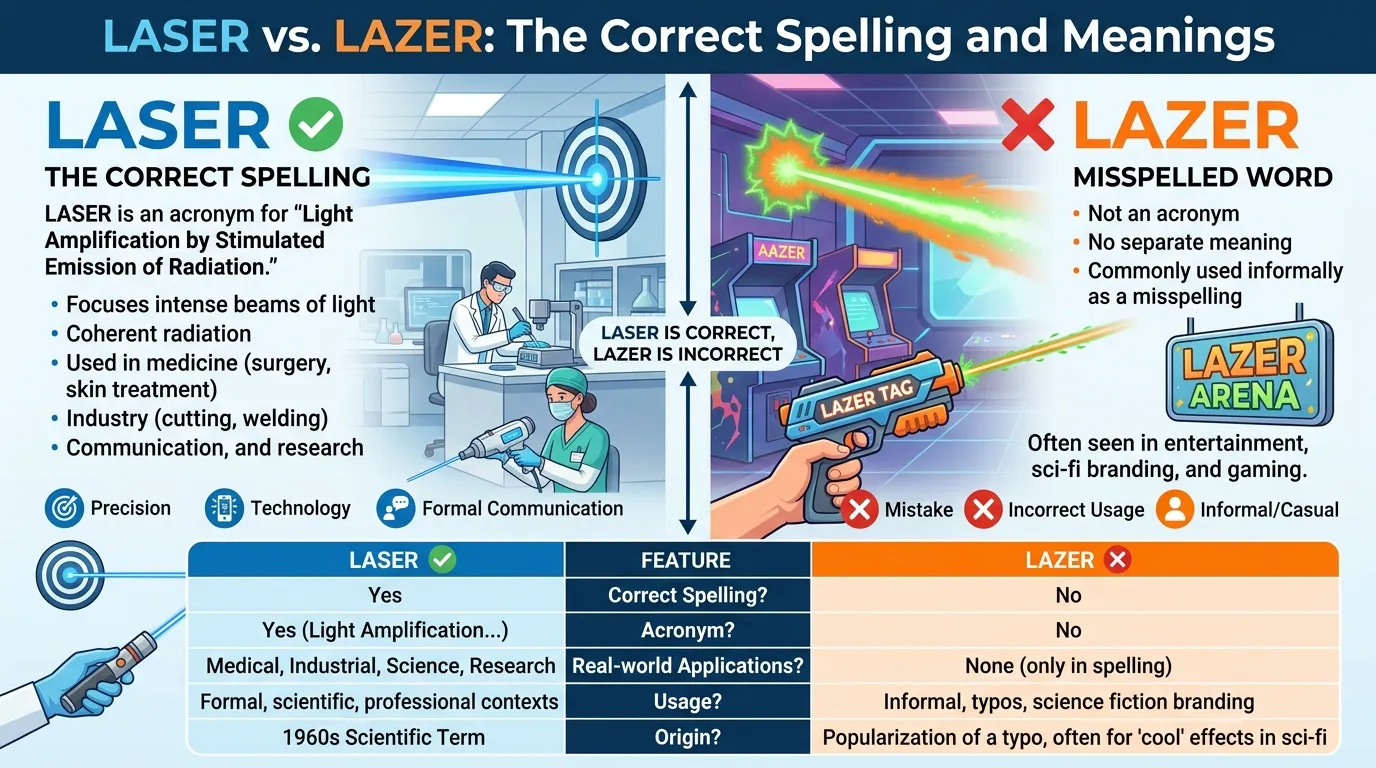
At the science-fiction convention, a cosplayer carried a prop gun with a label taped to the side: “LAZER BLASTER.” A few halls over, a physics professor gave a talk about the history of the laser — spelled with an s. The cosplayer’s spelling looked cool. The professor’s spelling was correct. Laser is the standard spelling in every variety of English. Lazer, with a z, is a misspelling in standard writing, though it appears constantly in brand names, video games, and internet slang. The reason the z version feels plausible is that it follows the sound — and the story of why the s version won is a story about acronyms, physics, and marketing.
The Prop Table: What a Laser Actually Is
A laser is a device that produces a narrow, intense beam of light through a process called stimulated emission of radiation. The word is an acronym: Light Amplification by Stimulated Emission of Radiation. The s in laser comes from stimulated — the second word of the acronym. That is the whole reason for the s. The spelling preserves the acronym’s letters, and changing the s to a z breaks the acronym’s logic.
The first working laser was built in 1960 by Theodore Maiman at Hughes Research Laboratories, using a ruby crystal. Within years, lasers were cutting, measuring, reading, and healing: laser eye surgery, laser printers, barcode scanners, laser cutting tools, fiber-optic communications. The word moved from the laboratory into everyday life so fast that most people never learned it was an acronym at all. It became an ordinary noun, lowercased, pluralized — lasers — and used as a verb: “to laser-cut,” “laser-focused.” But the spelling kept its acronym bones.
Why the Z Feels Right — and Isn’t
Three forces push writers toward lazer. The first is sound. In English, the s between two vowels often sounds like z — think of laser itself, pronounced “LAY-zer.” A writer spelling by ear hears a z and writes a z. The second force is branding. Companies love the z because it looks energetic and modern: laser tag arenas, gaming gear, and toy guns frequently brand themselves with z. The third force is the general American habit of using z where British spelling uses s — organize, realize, customize — which makes lazer feel like just another American spelling. It is not. The z in organize comes from a Greek root. The s in laser comes from an acronym. Different histories, different spellings.
Dictionaries are unanimous: laser is the standard spelling in American and British English alike. Lazer is listed, if at all, as a nonstandard variant or a brand spelling. Style guides agree. In formal, academic, technical, and professional writing, lazer reads as an error. In a brand name — “Lazer Tag,” “Lazer Blaster” — it is a deliberate stylistic choice, and it belongs to the brand, not to the language.
The Acronym Family: Radar, Scuba, and Sonar
Laser belongs to a family of words that started as acronyms and became ordinary nouns. Radar is Radio Detection and Ranging. Sonar is Sound Navigation and Ranging. Scuba is Self-Contained Underwater Breathing Apparatus. Maser is Microwave Amplification by Stimulated Emission of Radiation — the microwave cousin of the laser, and the word from which laser was coined by swapping microwave for light.
All of these words kept their acronym spellings when they became ordinary nouns. Nobody writes radar as radarr, or scuba as skuba, even though the spellings are irregular. The same loyalty applies to laser. The word’s spelling is a fossil of its origin, and the fossil is the standard. When a writer changes the s to a z, the fossil cracks.
Laser in the Wild: Medicine, Industry, and Pop Culture
The word’s range shows why the spelling matters. In medicine, laser surgery corrects vision, removes tissue, and treats skin conditions — and a medical paper that writes lazer loses credibility instantly. In industry, laser cutting and laser measurement are precision processes, and the technical documentation uses the standard spelling. In everyday life, laser printers, laser pointers, and laser shows are ordinary objects, and the packaging uses the standard spelling.
In pop culture, the z thrives. Science-fiction weapons are lazer guns in games, comics, and toy packaging, because the z looks futuristic. The convention cosplayer’s “LAZER BLASTER” was not wrong for a costume — it was branding, and branding plays by different rules. But the physics professor’s talk, the medical paper, the technical manual, and the school essay all need laser. The setting decides the spelling, and the standard setting is s.
Laser-Focused: The Figurative Life
The word has a rich figurative life. To be laser-focused is to concentrate intensely on one thing. Laser-like precision is exactness. A laser eye for detail is sharp observation. In all of these, the spelling is laser, and the metaphor works because a real laser beam is narrow, intense, and exact. The figurative uses are where the word appears most often in business and self-help writing — “laser focus,” “laser-sharp” — and they are also where the z misspelling appears most often, because the writers are typing fast and thinking about the metaphor, not the acronym. The acronym is still there, though, holding the s in place.
Laser Safety: Classes, Labels, and the Pointer Problem
Lasers are classified by hazard level, and the classification system is a good reason to spell the word correctly: a safety label that reads “LAZER” looks counterfeit. Class 1 lasers are safe under normal conditions — the lasers in printers and disc drives. Class 2 lasers are low-power visible lasers, such as presentation pointers, safe because the blink reflex limits exposure. Class 3R and 3B lasers are more powerful, used in surveying and entertainment, and require caution. Class 4 lasers are high-power devices used in surgery, cutting, and research, and they can burn skin and blind eyes instantly.
The pointer problem is the most common safety issue. Cheap, mislabeled laser pointers sold online are often far more powerful than their labels claim, and shining one at an aircraft is a federal crime in many countries, because a beam that looks harmless on the ground can dazzle a pilot thousands of feet up. Safety warnings, regulations, and prosecutions all use the standard spelling, laser, and a warning label with lazer on it would undermine its own authority. The spelling is part of the safety.
The Laser in Language: New Verbs and Compounds
Laser has grown a family of verbs and compounds that show how fully it has entered the language. To laser something is to cut or treat it with a laser: “laser-cut steel,” “laser-printed,” “laser-etched glass.” Laser-focused is the most common compound adjective, and it has spawned a whole shelf of imitations: laser-sharp, laser-like, laser-guided. A laser in slang can be a precise remark: “a laser of a sentence.” The word’s journey from acronym to noun to verb to metaphor is one of the fastest in English — sixty years from laboratory to everyday speech — and the spelling held steady through the whole trip. The s survived every reinvention, because the acronym never let go.
Laser vs Maser vs Phaser: The Family Tree
Laser has relatives, and they explain the spelling. The maser came first: Microwave Amplification by Stimulated Emission of Radiation, built in 1953 by Charles Townes. The laser was the maser with light instead of microwaves, and its name was coined by swapping the first word. Townes and his colleagues later proposed the graser — gamma-ray amplification — which has never been built. Science fiction added the phaser, a fictional weapon from Star Trek, whose name was invented to sound scientific. The family shows the pattern: each word is an acronym, each keeps its acronym spelling, and none of them tolerates a z in place of the s that comes from stimulated.
There is also the word lase, the back-formed verb meaning “to emit laser light” or “to treat with a laser”: “The device lases at 632 nanometers.” Lasing is the process. The verb is rare outside technical writing, but it follows the same spelling as its parent, with the s intact. And the adjective laser in “laser printer” and “laser pointer” is a noun used as a modifier, not a true adjective — the printer is not laser-like, it uses a laser. The grammar is as precise as the beam, and the spelling is as steady as the acronym.
The Convention Verdict
The cosplayer kept the “LAZER BLASTER” label, because it was a costume, and costumes get to play. The professor kept laser, because it was a lecture, and lectures get the standard spelling. The rule is simple: in standard English, the word is laser, with an s from stimulated. The z belongs to brands, games, and props. On the page, in your own voice, write laser — and let the acronym do its quiet work.