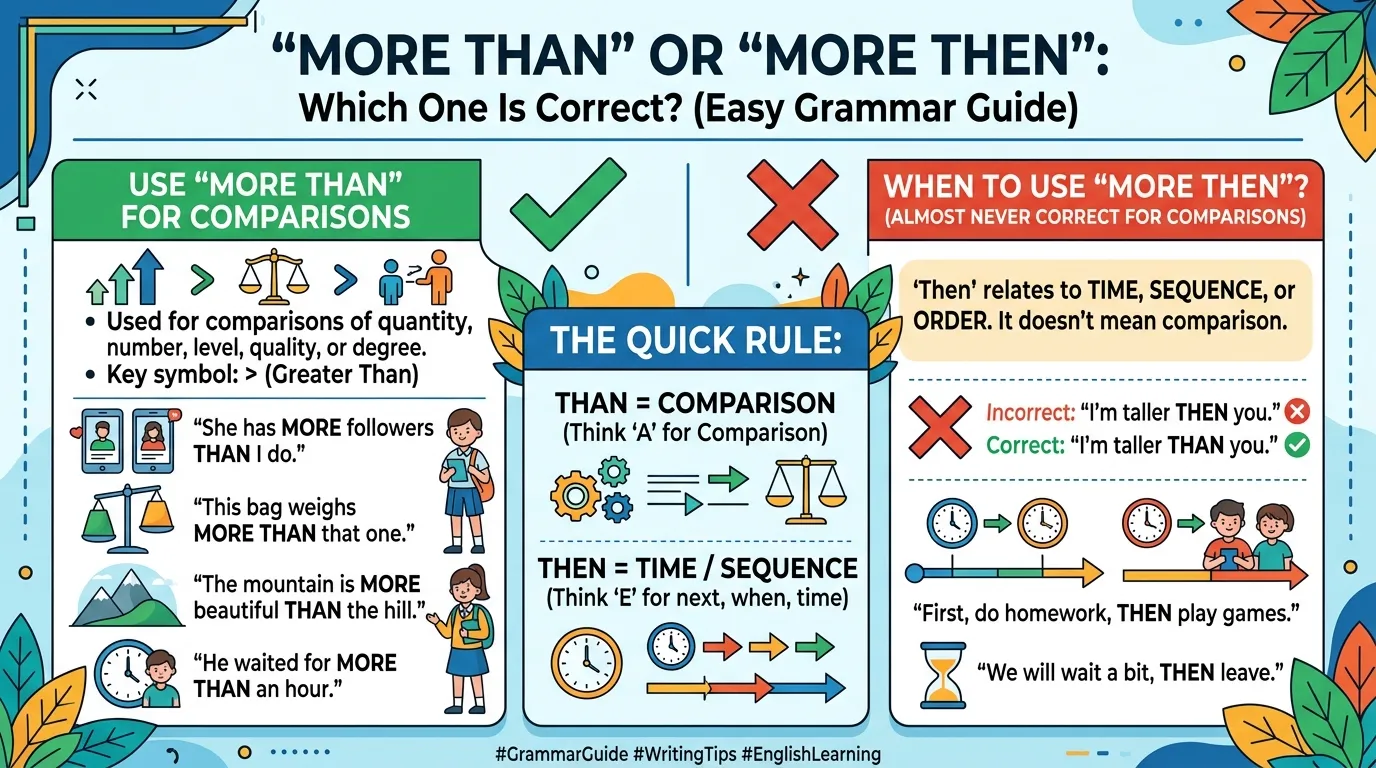
The grocery receipt said something odd. Under the total, in the store’s loyalty-program summary, it read: “You saved more then $12 this month.” The shopper stared at it. Twelve dollars was real money, but the sentence was wrong — and the error was a single letter. More than is the phrase for comparisons and amounts. More then is almost always a mistake. The two words than and then differ by one letter, sound nearly identical in fast speech, and do completely different jobs. Than compares. Then sequences. Mix them up and the sentence quietly stops making sense.
The Checkout Test: Comparing vs Sequencing
Start with the two jobs. Than is the comparison word. It appears after comparative adjectives and adverbs — more, less, bigger, faster, better, earlier, rather — and introduces the thing being compared against. “This bag costs more than that one.” “She runs faster than her brother.” “I would rather walk than drive.” “There were more than fifty people in line.” In every case, than sets up a comparison between two things, and removing it breaks the comparison.
Then is the sequence word. It means “at that time,” “next,” or “in that case.” “We shopped, then we went home.” “If it rains, then we stay inside.” “Back then, milk cost a dollar.” “First the price, then the tax.” In every case, then orders events in time or steps in a sequence. It never compares. If your sentence is about which of two things is bigger, better, or more numerous, the word is than. If it is about what happened next, the word is then.
More Than: The Comparison Engine
More than is one of the most common phrases in English, and it does three distinct jobs. First, it compares amounts: “more than ten dollars,” “more than half the class,” “more than enough.” Second, it compares qualities: “more than happy to help,” “more than a little surprised,” “more than just a hobby.” Third, it works with other and else to signal something beyond the expected: “nothing more than a rumor,” “more than meets the eye.”
The phrase also appears in a set of fixed constructions worth knowing. More than one takes a singular verb in formal writing: “More than one shopper has noticed the error.” More than can introduce a surprising contrast: “He is more than a clerk; he runs the place.” And in the phrase more than ever, it marks a peak: “Customers care about prices more than ever.” In all of these, than is the comparison word, and then cannot substitute for it.
A common error to watch for is more then in comparative sentences, especially in informal writing and social media. “This costs more then that one” is wrong. “She is taller then me” is wrong. “I like this more then that” is wrong. In each case the writer meant a comparison, and the comparison word is than. Spellcheckers often miss the error, because then is a real word — it is just the wrong real word.
Then: The Sequence Engine
Then does its own three jobs. First, it orders events: “We paid, then we left.” “She finished the report, then sent it.” Second, it marks a point in time: “Back then,” “until then,” “from then on.” Third, it introduces a consequence: “If the price drops, then I’ll buy it.” “If not now, then when?” The word is a workhorse of narrative and logic alike, and it appears in nearly every story, instruction, and argument.
Then also appears in fixed phrases. Now and then means occasionally. Every now and then is the longer form. Then and there means immediately, on the spot. And then continues a sequence. But then introduces a qualification: “The price is high, but then, so is the quality.” In none of these can than substitute. “Now and than” is nonsense, and “but than” is a different construction entirely.
Why the Ear Confuses Them
The confusion has a simple cause: in unstressed speech, than and then sound almost identical. Both reduce to a quick “th’n” in fast conversation. A listener hearing “more th’n ten dollars” cannot tell from sound alone which word was spoken, and a writer typing quickly often picks the wrong one. The error is especially common after more, because more then looks plausible on the page — the two words sit together naturally, and the eye slides over the difference.
Typing adds a second cause. Than and then differ by one letter in the middle — a versus e — and on a keyboard the two letters are close enough that a fast typist can hit the wrong one without noticing. Autocorrect rarely catches it, because both words are valid. The only reliable defense is the meaning test: comparison or sequence? If you are comparing, type than. If you are sequencing, type then. The test takes one second and catches the error every time.
The Receipt, Corrected: A Field Guide to Both Words
Return to the grocery receipt. “You saved more then $12 this month” is a comparison: the savings are being measured against $12. The correct word is than: “You saved more than $12 this month.” The store’s signwriter meant well and typed fast, and the error survived because it looks so ordinary. Most readers would not notice. But a reader who does notice will quietly doubt the store’s attention to detail — and in business writing, that doubt is expensive.
Here is a quick field guide for the two words in everyday writing. Comparison sentences — prices, sizes, speeds, amounts, preferences — take than: “better than,” “less than,” “rather than,” “other than,” “more than,” “fewer than.” Sequence sentences — instructions, stories, schedules, consequences — take then: “first this, then that,” “if so, then,” “back then,” “until then.” When a sentence contains both, each word does its own job: “If the new price is lower than the old one, then I’ll switch.” One sentence, two words, two jobs, no confusion.
More Than in Numbers: Percentages, Money, and Measurements
The comparison word does its heaviest work in numbers. “More than 50 percent off.” “More than a million customers.” “More than three feet tall.” In each case, more than sets a threshold, and the number that follows is the thing being exceeded. Two usage notes matter here. First, in formal writing, more than is preferred with numbers, while over is the casual alternative: “more than fifty people” is the careful form, “over fifty people” is the everyday form, and both are widely accepted today. Second, more than one takes a singular verb in formal style — “More than one shopper has complained” — because the phrase is treated as a single quantity, not a plural.
Money brings its own idioms. “More than your money’s worth” means better value than the price suggests. “More than you bargained for” means an unexpected extra, usually unwelcome. “More than meets the eye” means hidden depth. Each phrase uses more than to signal that the obvious measurement understates the reality. The grocery receipt’s “more than $12” belonged in this family: a measurement, a threshold, a comparison. The then on the receipt broke the family rule, and the sentence quietly stopped being a measurement at all.
Than in Comparisons of Time: Earlier, Later, and Rather
Than also governs comparisons of time, and these are where the than/then confusion is most dangerous, because both words can appear in the same sentence. “The sale ends sooner than we expected, then the prices go back up.” The first word compares the timing; the second sequences the events. “She arrived earlier than planned, and then she waited.” “Rather than wait, we left, and then we called.” In each sentence, the two words sit side by side, doing different jobs, and swapping them would garble both halves.
Rather than deserves a note of its own, because it is the comparison phrase most often mistyped as “rather then.” “Rather than drive, we walked.” “Rather than complain, she fixed it.” The phrase means “instead of,” and it is a comparison of choices. “Rather then” is always wrong. The same applies to other than — “other than the price, it was perfect” — and less than — “less than an hour.” In every comparative phrase, the word is than, and the test is the same: comparison means than, sequence means then.
Than and Then in Editing: The Proofreader’s Checklist
Editors catch the than/then error with a simple habit: whenever they see more, less, better, rather, or any comparative, they check the next word. If the sentence compares, the next word must be than. If it sequences, it must be then. The habit catches the error because the error is always local — it lives in the word right after the comparative, and the comparative is easy to spot. A second habit helps: reading the sentence aloud. The ear hears the comparison or the sequence more clearly than the eye sees the spelling, and a sentence that says “more then” aloud will sound wrong to a careful listener, even though it looks plausible on the page.
The error is also worth checking in the other direction. A sentence that says “and than we left” is wrong — the sequence word is then. A sentence that says “better then ever” is wrong — the comparison word is than. The two errors are mirror images, and the same meaning test catches both. Comparison or sequence? The answer is the spelling. The proofreader who asks the question every time will never let the error through, and the writer who asks it while typing will never make it in the first place.
The One-Second Test
Before you send the email, the report, or the sign, run one test. Ask: am I comparing or sequencing? Comparing — bigger, smaller, more, less, better, worse, rather — means than. Sequencing — next, after that, at that time, in that case — means then. The grocery receipt needed than. The story of the shopping trip needs then. The two words sound the same, but they never mean the same, and the meaning test settles the choice every time.