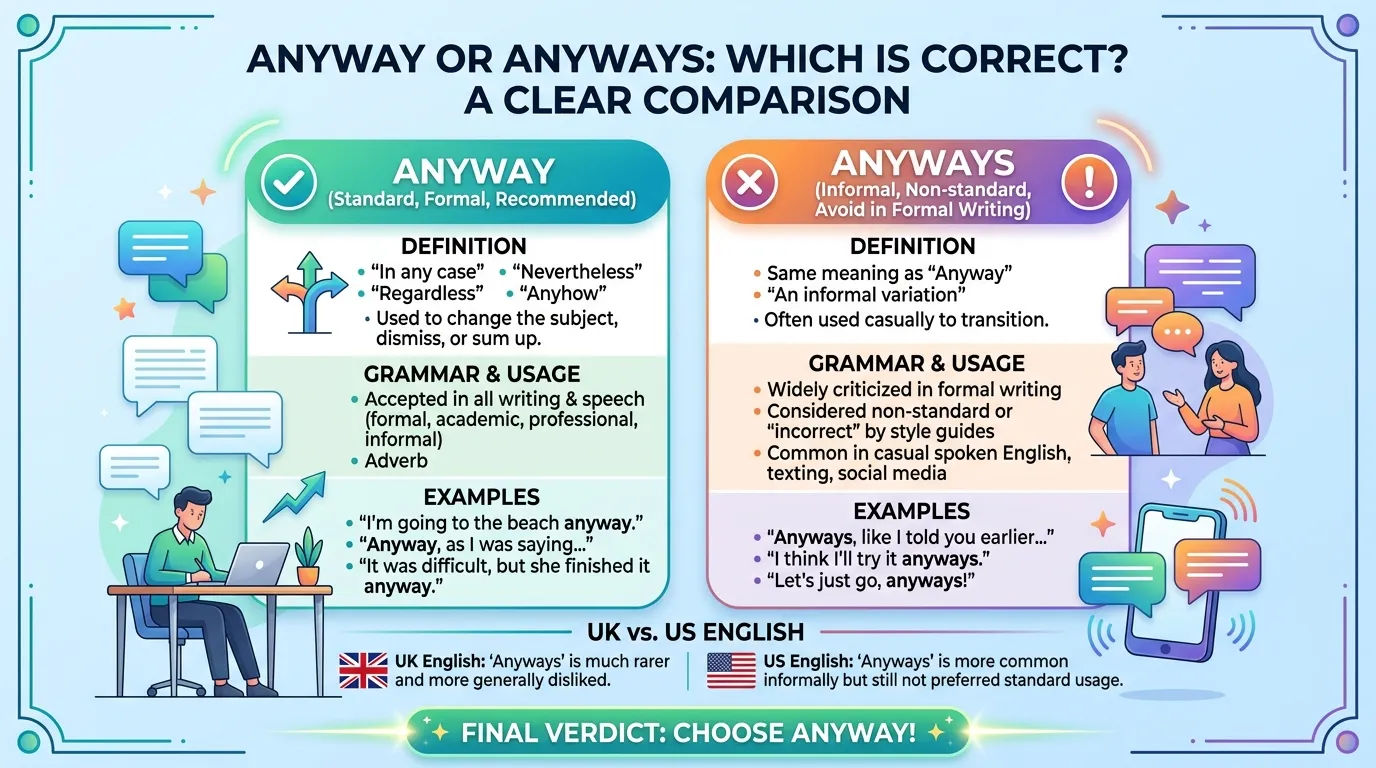
The radio host took a call from a listener who had a long story about a lost wallet, a helpful stranger, and a bus ride across town. Halfway through, the caller said, “Anyways, the wallet turned up.” The host smiled, because the caller’s anyways had done exactly what the word always does: it steered the conversation back on course. The standard form is anyway. Anyways is a real word, but it is informal, chiefly American, and out of place in formal writing. The extra s does not change the meaning. It changes the register — the social level of the sentence — and knowing when that matters is the whole lesson of this pair.
The Switchboard: What Anyway Actually Does
Anyway is a discourse marker: a word whose job is to manage the conversation rather than to add information. It does three jobs. First, it returns to the main point after a digression: “The wallet, the bus, the stranger — anyway, it turned up.” Second, it concedes a point and moves on: “It was expensive. Anyway, we bought it.” Third, it dismisses an objection: “Anyway, it doesn’t matter now.” In each case, anyway works like a hand on the steering wheel, turning the conversation back toward the road.
Anyway also works as an ordinary adverb meaning “in any case” or “regardless”: “Anyway, I was going home.” “The rain didn’t matter; we went anyway.” “Anyway you look at it, it’s a good deal.” In these uses, the word is neutral and standard in every register, from text messages to legal briefs. It is one of the most common words in spoken English, and it appears constantly in writing that imitates speech.
The Extra S: Where Anyways Comes From
Anyways is anyway with an extra s, and the s has a history. English has a small family of words that add a final s in informal speech: towards, afterwards, anyways, anywheres (the last one is now considered nonstandard). The s is an old adverbial ending — the same s that survives in besides, towards, and always — and it lingered in dialect speech long after standard English dropped it from most words. Anyways survived in American colloquial speech, in Southern and Midland dialects, and in the speech of people who learned the word by ear rather than by book.
That history explains the word’s social signal. Anyways sounds folksy, warm, and unpretentious. It is the word a storyteller uses at a kitchen table, a friend uses in a voice message, a comedian uses on stage. It is not the word a lawyer uses in a brief, a manager uses in a report, or an applicant uses in a cover letter. The meaning is identical to anyway. The impression is different, and the impression is the point.
Anyways on the Air: The Register Ladder
Registers — levels of formality — decide which form fits. At the bottom of the ladder, in casual conversation, texts, and social media, anyways is common and unremarkable: “Anyways, what were we saying?” In the middle, in everyday workplace speech and informal emails, anyway is the safer choice, though anyways will pass without comment in most offices. At the top, in formal writing — reports, academic papers, business proposals, published articles — anyway is the only choice, and anyways reads as an error.
The regional pattern adds a layer. Anyways is chiefly American. British English rarely uses it, and British style guides treat it as a nonstandard Americanism. An American writer who uses anyways in a novel is making a character choice. A British writer who uses it is usually quoting an American. International writers should default to anyway, which is standard everywhere, and reserve anyways for dialogue and deliberate informality.
Anyway vs Any Way: The Space That Changes Everything
A separate confusion deserves attention, because it catches even careful writers. Anyway (one word) is the discourse marker described above. Any way (two words) is a noun phrase meaning “any manner” or “any route”: “Is there any way to fix this?” “Any way you slice it, the numbers work.” The two-word form is about method or manner. The one-word form is about moving the conversation along. “Any way, let’s go” is wrong. “Is there anyway to fix this?” is also wrong — the sentence needs the two-word form, because it is asking about a method.
The test is simple: if you can replace the word with “in any case” or “regardless,” the one-word form anyway is right. If you can replace it with “any manner” or “any route,” the two-word form any way is right. “Anyway, let’s go” passes the first test. “Is there any way to fix this?” passes the second. The space between the words carries the whole meaning, and dropping it changes the sentence.
Anyway in Fiction: Dialogue That Sounds Real
Novelists love anyway, and for good reason: it is one of the most natural-sounding words in English dialogue. Real people use it constantly — to change the subject, to concede a point, to wrap up a story. “Anyway, I should go.” “Anyway, that’s not the point.” “Anyway, she said yes.” A novel without anyway in its dialogue sounds stiff, because real conversation is full of steering words, and anyway is the most common steering word there is.
Anyways is the novelist’s character tool. A character who says anyways signals something about themselves: informal, warm, possibly rural or working-class, possibly American, possibly young. The choice is deliberate, the way an accent or a catchphrase is deliberate. A writer who gives a London barrister the word anyways has made a characterization error. A writer who gives it to a Texas truck driver has made a characterization choice. The word is a costume, and costumes must fit the character.
The same principle applies to memoirs, podcasts, and first-person essays. A writer telling their own story in their own voice may use anyways to sound like themselves — and the reader will accept it, because authenticity is part of the contract. A writer telling someone else’s story in a neutral voice should use anyway, because neutrality is part of that contract. The word is small, but it carries the whole voice of the piece.
Anyway vs Anyhow vs Anyways: The -S Family
Anyway has two relatives worth knowing. Anyhow means “in any case” or “in any manner”: “Anyhow, we managed.” “He did it anyhow.” It overlaps with anyway in the “in any case” sense, but it also carries a careless flavor — “anyhow” can suggest “in a slapdash way” — that anyway does not have. Anyways is the informal s-form of anyway, discussed above. And the -s family extends further: towards (standard in British English, informal in American), afterwards (standard everywhere), besides (standard everywhere), anywheres (nonstandard everywhere). The s is an old adverbial ending that standard English kept in some words and dropped in others, and the survivors are a mixed bag — some standard, some informal, some wrong. Anyways sits in the middle: real, informal, and out of place in formal writing.
Anyway in the Office: Meetings, Emails, and the Art of Moving On
The office is where anyway does its most delicate work. In a meeting that has drifted off course, someone says, “Anyway, back to the budget,” and the room resets. The word is a polite steering wheel — it acknowledges the digression without blaming anyone for it, and it returns the group to the agenda without a confrontation. A manager who uses anyway well runs shorter meetings. A manager who never uses it watches meetings drift.
In emails, anyway serves the same function in writing. “Anyway, the deadline stands.” “Anyway, let me know what you decide.” The word sits at the start of a sentence or a paragraph and signals a shift: from background to action, from discussion to decision. It is the written equivalent of a hand on the table. And in emails, the register rule is strict: anyway is the only choice. An email that opens a paragraph with anyways will read as careless to most professional readers, even if the rest of the email is flawless. The word is small, but the impression it makes is not.
There is also the phrase “anyway, anyhow” — a doublet that means “in any case, no matter how” — and the British phrase “anyway up,” meaning “in any case.” Both are informal, and both use the standard form. The s never appears in the fixed phrases. The office, the email, and the meeting all belong to anyway, and the kitchen table and the phone call belong to either.
The Caller’s Lesson: Choosing in Real Life
Back at the radio station, the caller used anyways perfectly — for a phone call. The word fit the setting: informal, spoken, warm, human. If the same caller had written a letter to the station’s management, the same word would have been a small mistake, the kind that makes a reader pause and reassess the writer. That is the real lesson of this pair. The words mean the same thing. The settings do not.
So here is the practical rule. In speech, use either, and let the setting decide. In writing, use anyway unless you are deliberately writing dialogue or informal prose. In formal writing, never use anyways. And when you see any way written as two words, check whether the sentence is about manner or about moving on — because the space, not the s, is the change that matters most.