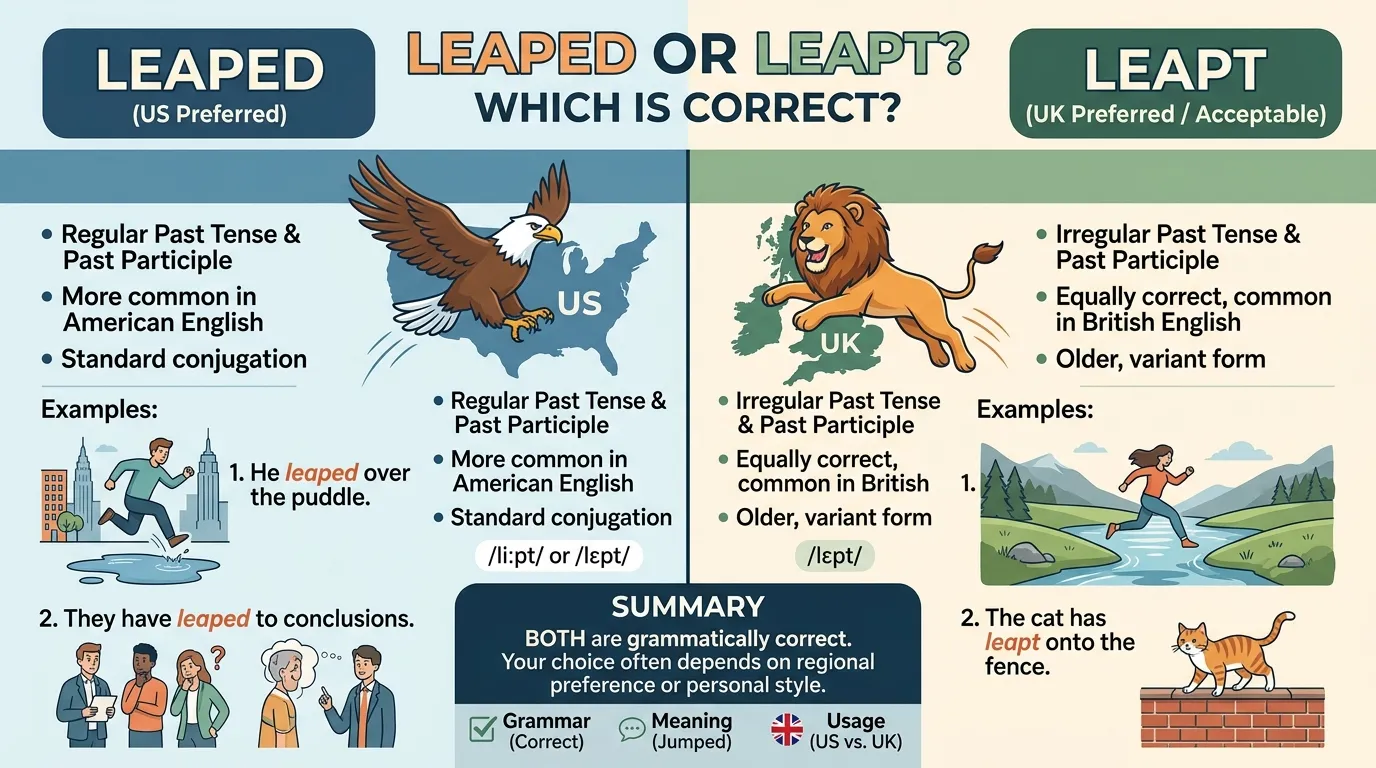
The long jumper hit the board at full speed, rose, hung in the air for what felt like a long time, and landed in the sand. The stadium announcer’s voice rolled over the crowd: “She leaped seven meters!” On the television broadcast, the British commentator said something slightly different: “She leapt seven metres!” Two announcers, one jump, two spellings of the same past tense. Both were right. Leaped and leapt are both correct past-tense forms of the verb leap, and the choice between them is mostly a matter of where you live and what register you are writing in. The American ear expects leaped. The British ear is comfortable with either, but leans toward leapt in storytelling. Neither spelling is a mistake, and neither is more “correct” in any absolute sense.
The Sand Pit: What Leap Actually Means
Before the spelling, the verb itself. Leap means to jump with force, to spring from one place to another, or to move suddenly from one state to another. “She leaped over the puddle.” “The cat leapt onto the windowsill.” “Sales leaped by 40 percent.” “He leapt to his feet.” The verb covers physical jumping and figurative jumping alike, and it carries a feeling of energy and suddenness that plain jumped does not quite match. A child jumps. An athlete leaps. A stock price leaps. A heart leaps.
The verb is irregular in an unusual way: it has two accepted past forms. Most English verbs pick one path — regular -ed or irregular vowel change. Leap kept both. The regular form leaped follows the standard rule: add -ed to the base. The irregular form leapt follows an older pattern in which the past tense ends in -t: dreamt, learnt, spelt, burnt, dealt, kept. Both forms mean exactly the same thing, and they are interchangeable in most sentences. The difference is flavor, not grammar.
The -T Family: Leapt’s Older Relatives
Leapt belongs to a family of verbs that form the past tense with -t instead of -ed. The family includes dream/dreamt, learn/learnt, spell/spelt, burn/burnt, dwell/dwelt, smell/smelt, spill/spilt, spoil/spoilt. In British English, both forms of each pair are usually acceptable, with the -t form often sounding slightly more literary or old-fashioned. In American English, the -ed forms dominate, and the -t forms can sound quaint or British — an American who writes “he dreamt” is usually doing it deliberately, for effect.
The -t forms are survivals from an older layer of English, when verb endings were less regular than they are now. Over centuries, most verbs drifted toward the regular -ed pattern, and American English drifted faster and further than British English. That is why leaped feels normal to American ears and leapt feels normal to British ones. The two varieties of English simply kept different amounts of the old pattern. Neither is wrong; they are just different stopping points on the same road.
Pronunciation adds a wrinkle. Leaped is pronounced “leept” — one syllable, with the -ed reduced to a t sound. Leapt is also pronounced “lept.” In speech, the two forms are identical. The difference exists only on the page. That is why the confusion is a writing problem, not a speaking problem, and why no one in the stadium noticed that the two announcers had used different words.
Two Broadcast Booths: The Atlantic Split
The regional pattern is the most useful thing to know about this pair. In American English, leaped is the standard past tense in nearly all contexts — news, fiction, academic writing, conversation. Leapt appears occasionally, usually in literary or deliberately old-fashioned writing, and most American style guides treat it as a British variant. In British English, both forms are standard, with leapt more common in narrative and literary writing and leaped more common in straightforward reporting. Australian and Canadian English sit between the two, with leapt somewhat more common than in the United States but leaped fully acceptable.
The practical advice follows from the pattern. If you write for an American audience, use leaped and you will never be wrong. If you write for a British audience, either form works, but leapt will sound more at home in a novel and leaped will sound more at home in a news report. If you write for an international audience, leaped is the safer default, because it is the form every English speaker recognizes as standard, while leapt may look like a typo to an American reader who has never seen it. Consistency matters more than the choice itself: do not write leaped in one paragraph and leapt in the next without a reason.
Leap the Noun: The Jump Becomes a Thing
Leap is also a noun, and the noun has no spelling question at all. A leap is a jump: “a leap across the stream,” “a leap of faith,” “a quantum leap.” The noun is the same in every variety of English. The phrases built on it are worth knowing, because they are where the verb appears most often in figurative writing. A leap of faith is a decision made without complete evidence — the phrase comes from philosophy and theology, where it describes trusting something beyond proof. A quantum leap is a sudden, dramatic advance — the phrase comes from physics, where a quantum jump is actually tiny, but popular usage turned it into a synonym for a huge step forward. A leap year is a year with an extra day, February 29, added to keep the calendar aligned with the seasons.
The noun also appears in fixed combinations: leapfrog (the children’s game, and the verb for overtaking), leap second (an extra second added to clocks to match Earth’s rotation), leap of logic (an unjustified conclusion). In all of these, the spelling is leap, plain and unchanging. The past-tense question only arises when the word is a verb in the past.
Leaped in the Wild: Sports Pages, Markets, and Novels
Where does each form actually show up? On American sports pages, leaped rules: “The running back leaped over the defender.” In British match reports, leapt is at least as common: “The striker leapt above the defence.” In financial writing, both varieties use leaped more often than leapt, because business prose prefers the regular form: “Profits leaped in the third quarter.” In fiction, the choice becomes a style decision. A British novelist might write “he leapt from the train” for the slightly older, more literary feel. An American novelist would write “he leaped from the train” without thinking twice.
There is one context where leapt has a special home: poetry and song. The -t form is one syllable, like leaped, but it looks older on the page, and poets and lyricists sometimes choose it for that antique flavor. Hymns, carols, and folk songs preserve leapt in lines written generations ago, and modern writers who echo those forms borrow the spelling along with the sound. If you meet leapt in a poem, it is almost certainly a deliberate choice, not an error.
Leap in Idiom and Sport: The Long Jump, the High Jump, and the Leap of Faith
The long jump is the sport where leap lives most literally. The athlete sprints down the runway, hits the takeoff board, and leaps into the sand. The high jump is its vertical cousin: the Fosbury Flop, the straddle, the scissors — all ways of leaping over a bar. The triple jump is three leaps chained together: hop, step, jump. In each event, the verb is leap, and the past tense in the American broadcast is leaped, in the British broadcast leapt. The commentators’ choice is a regional fingerprint, audible to anyone who listens for it.
But the verb’s figurative life is larger than its sporting life. A leap of faith is the best known of its idioms, and it comes from the philosopher Søren Kierkegaard, who used the image of a leap to describe the act of believing without proof. The phrase has traveled far from philosophy: into business (“a leap of faith on a new product”), into relationships (“taking a leap of faith”), into everyday speech (“it was a leap of faith, but it worked”). A quantum leap is the other great idiom, and it is a scientific misunderstanding that became standard English. In physics, a quantum leap is the smallest possible change in an electron’s energy level. In popular speech, it means a huge advance. The misunderstanding is now so established that correcting it is pedantry — the idiom means what people use it to mean.
There is also the phrase to leap to conclusions — to judge too quickly, to jump ahead of the evidence — and its cousin to leap at the chance, to seize an opportunity eagerly. Both use leap for suddenness, not for distance. And in the phrase look before you leap, the verb carries a warning: check before you commit. The proverb is old, the advice is timeless, and the spelling of the past tense in the story that follows it — “he looked before he leaped” or “he looked before he leapt” — depends, as always, on where the storyteller lives.
The One Rule That Settles It
If you remember one thing, remember this: leaped is always safe, everywhere. Leapt is also correct, but it carries a British and literary flavor that may not suit every context. When in doubt, write leaped. When writing for a British audience in a narrative or literary register, leapt is a fine choice. The long jumper in the stadium did not care which spelling the announcers used. The jump was the same. So is the past tense — two spellings, one leap, and no wrong answer as long as you pick the one that fits your audience.