The wedding planner stared at the seating chart. The bride’s mother was to sit beside the groom’s father. The chart also had a note at the bottom: “Besides the seating, we need to confirm the flowers.” One letter s separated the two words on the page, and that single letter changed everything. Beside means next to, at the side of. Besides means in addition to, or apart from. They share a root, look almost identical, and do completely different jobs. Choosing the wrong one does not just misspell a word — it changes the meaning of the sentence.
The Seating Chart: Beside Means Next To
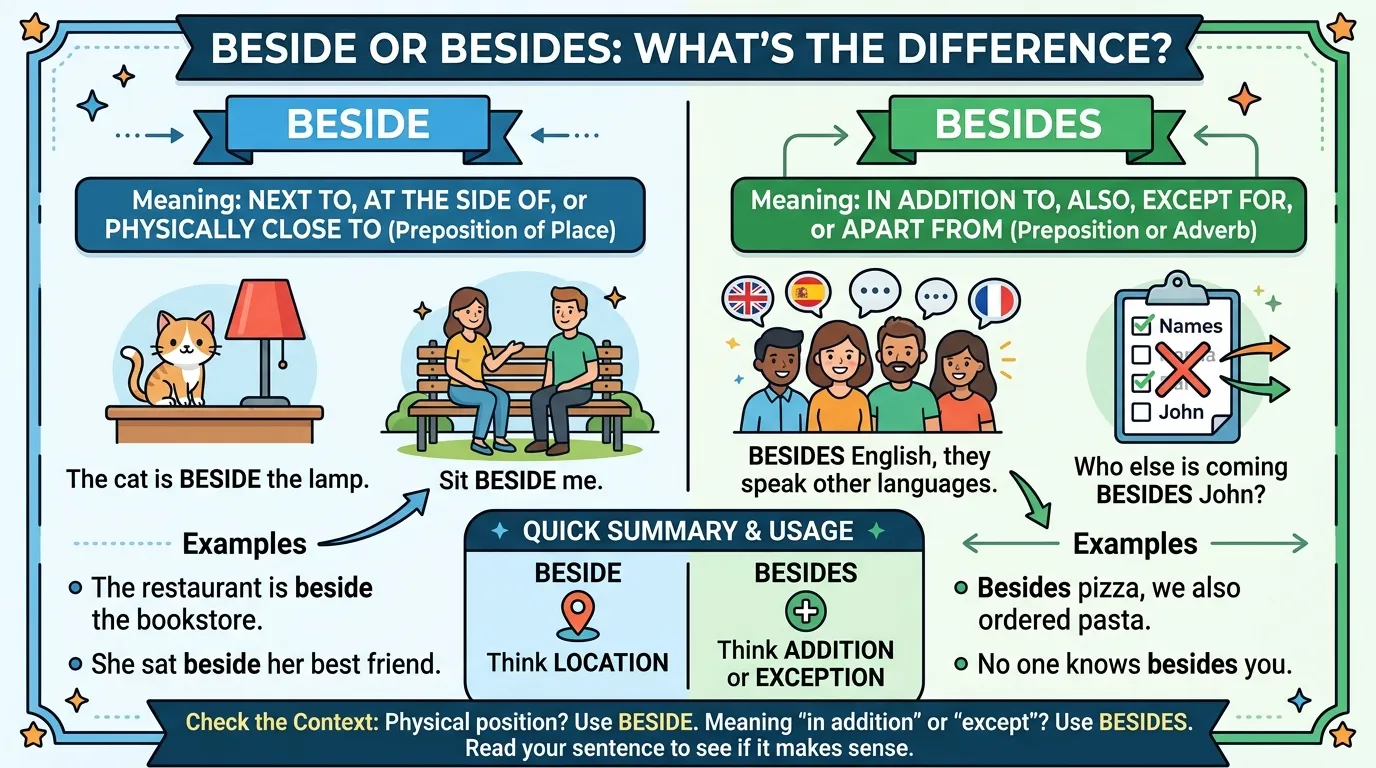
Beside is a preposition of place. It means next to, at the side of, or alongside. “She sat beside her sister.” “The vase stands beside the window.” “He parked beside the entrance.” The word answers the question “where?” — and the answer is always “next to something.” It is the word for chairs, benches, hospital beds, and wedding tables: two things side by side, sharing a space.
Beside also appears in a handful of fixed phrases. Beside oneself means overcome with emotion: “She was beside herself with joy.” Beside the point means irrelevant: “The color of the napkins is beside the point.” To stand beside someone means to support them: “I will stand beside you.” In each phrase, the spatial sense — being next to something — carries into the figurative meaning. The word never means “in addition to.” That job belongs to its longer cousin.
The Footnote: Besides Means In Addition To
Besides is a different word with two main jobs. As a preposition, it means “in addition to” or “apart from”: “Besides the flowers, we need to confirm the music.” “Who else is coming, besides your parents?” “Besides being a planner, she is a florist.” As an adverb, it means “moreover” or “also”: “The venue is beautiful. Besides, it is affordable.” “I don’t want to go. Besides, it is raining.” In both jobs, the word adds something — an extra item, an extra reason, an extra thought.
The adverb use is the one that trips writers most often, because it sits at the start of a sentence and sounds like a conversational aside. “Besides, the cake is already ordered.” “Besides, we have no time.” The word functions as a pivot: it acknowledges what came before and adds a new consideration. It is the word for footnotes, afterthoughts, and final arguments — everything that comes after the main point.
One S, Two Histories
The two words share a root. Beside comes from Old English be sidan, meaning “by the side.” Besides is beside plus the old adverbial -s ending — the same s that survives in towards, afterwards, and always. Over centuries, the two forms drifted apart in meaning. Beside kept the spatial sense. Besides took the additive sense. The s is not decoration. It is the mark of the word that adds.
That history gives the most reliable memory hook for the pair: the s in besides stands for supplement — something extra. If the sentence is about being next to something, the word has no s. If the sentence is about adding something, the word has the s. The test takes one second: next to, or in addition to? The answer picks the spelling.
The Toast: Besides in Speech
In speech, besides does a job that beside never does: it introduces the clincher. The best man’s toast might end with “Besides, they were clearly made for each other.” The word signals that the speaker is adding the strongest reason last. It is a rhetorical move — save the best argument for the word that means “in addition” — and it works because the audience hears the addition coming.
Beside rarely appears in toasts, because toasts are about adding praise, not about seating. But it appears constantly in descriptions of the room: “The bride stood beside her father.” “The candles sat beside the flowers.” In a wedding, both words are everywhere, doing their separate jobs, separated by one letter and a whole meaning. The planner who confuses them will seat the flowers and add the chairs — and the chart will quietly stop making sense.
The Classic Error: “Beside” for “Besides”
The most common error is using beside where besides belongs: “Beside the flowers, we need music.” The sentence means the flowers are sitting next to something, which is not what the writer meant. The writer meant “in addition to the flowers.” The fix is one letter: add the s. The reverse error is rarer but real: “She sat besides her sister” is wrong, because sitting is spatial, and the spatial word is beside. The fix is the same letter, removed.
There is also a subtler error: using besides as a preposition of place in the phrase “besides oneself,” which should be beside oneself. “She was besides herself with joy” is wrong — the idiom uses the spatial word, because the image is of standing next to oneself, outside one’s own body, overcome with feeling. Idioms preserve old spellings, and this one preserves beside.
Beside in Literature: The Poet’s Favorite Preposition
Beside has a literary life that besides never had. Wordsworth’s most famous poem opens “I wandered lonely as a cloud” and continues “beside” the lakes and daffodils — the poet beside the flowers, the reader beside the poet. The preposition is the word for companionship, for standing next to something and sharing its space. Poets reach for it when they want nearness without possession: “beside the river,” “beside the window,” “beside herself.” The word is quiet, precise, and physical.
Besides has no such poetic life, because addition is not a poetic act. A poet who writes “besides the river” has made an error, not a metaphor. The distinction is a useful test for any writer: if the sentence is trying to paint a picture of two things side by side, the word is beside. If the sentence is trying to add a reason, an item, or an argument, the word is besides. The picture and the addition are different jobs, and the spelling marks the difference.
Besides as a Noun? The Plural Trap
A rare but real confusion comes from the noun besides in the phrase “besides” as used in old legal writing, where it could mean “other things” — but in modern English, besides is never a noun, and it never takes a plural. The trap is the opposite: writers sometimes treat beside as if it were a verb or a noun, producing sentences like “she besided the chair” or “the besides of the table.” Both are wrong. Beside is a preposition only. Besides is a preposition or an adverb only. Neither word changes form, takes a plural, or becomes a verb. They are fixed in their jobs, and the only choice the writer makes is which one fits the sentence.
There is one more fixed phrase worth knowing: beside the point is the standard idiom for “irrelevant,” and it uses beside, not besides. “The cost is beside the point.” The image is of standing next to the point, not on it — near the argument, but not addressing it. The idiom preserves the spatial word, because the image is spatial. Besides the point is a common error, and it is wrong for the same reason “beside the flowers” is wrong when the writer means “in addition to the flowers”: the spatial word cannot do the additive job.
Beside vs Next To vs Alongside: Three Words for Nearness
Beside has two close neighbors, and choosing among the three is a matter of shade. Next to is the plainest: “She sat next to her sister.” It is the everyday phrase, the one a child would use. Beside is slightly more formal and slightly more literary: “She sat beside her sister.” It carries a hint of companionship, of standing together. Alongside suggests parallel movement or partnership: “They worked alongside each other.” “The boat sailed alongside the shore.” The three words overlap heavily, and in most sentences any of them would work. The choice is one of tone: plain, literary, or cooperative.
Besides stands apart from all three, because it does not describe nearness at all. It describes addition. A writer who confuses beside with besides has not chosen the wrong shade of nearness — they have chosen the wrong job entirely. The seating chart needs beside. The footnote needs besides. The distinction is not subtle, and once the two jobs are clear, the spelling follows: the spatial word has no s, the additive word has one.
The Chart, Corrected
The planner fixed the chart. The mother sat beside the father. Besides the seating, the flowers were confirmed. One letter, two jobs, no confusion. The rule is simple enough to carry in your pocket: next to means beside, no s. In addition to means besides, with the s for supplement. The wedding went ahead, the seating held, and the footnote said exactly what it meant.