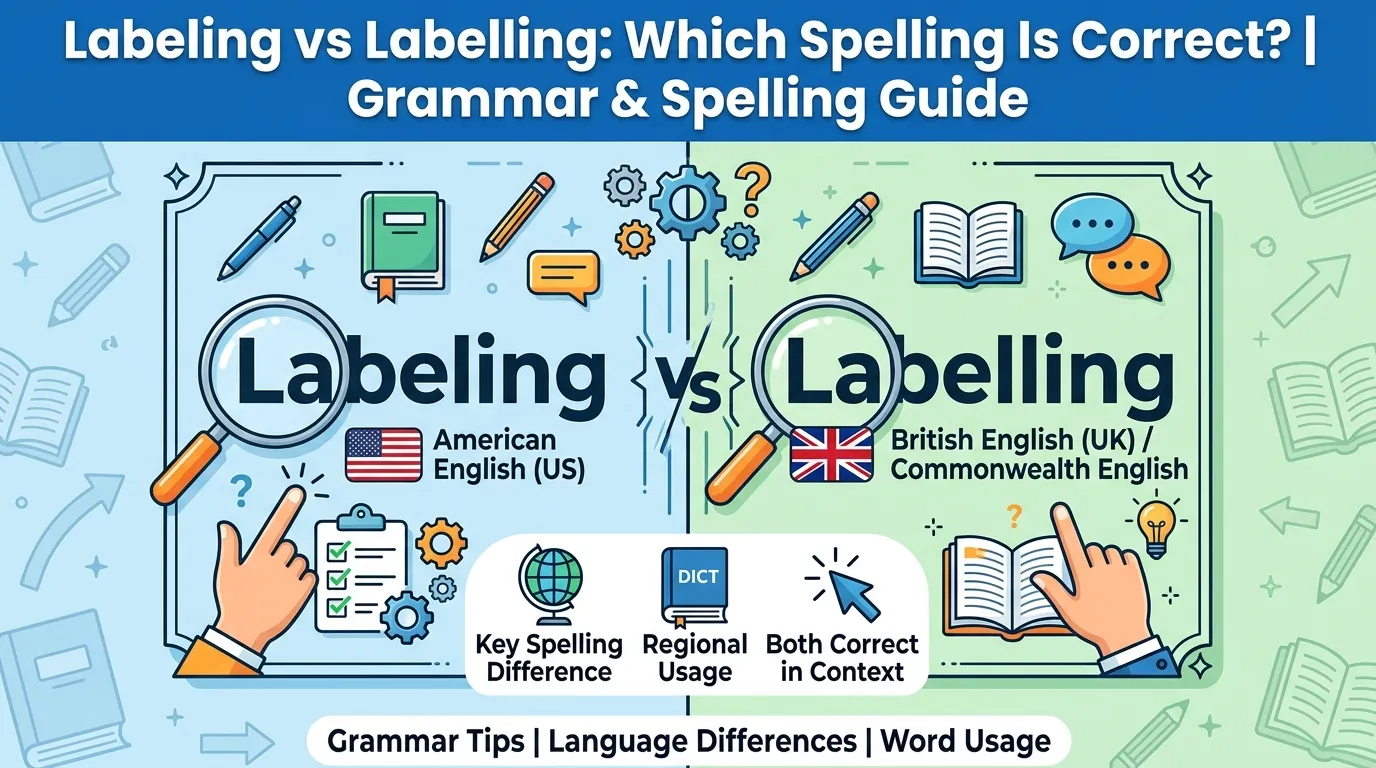
The loading dock is loud and fast. A worker with a handheld label gun is tagging boxes as they come off the truck — destination, contents, handling instructions, one sticker per box, fifty boxes an hour. On the shipping manifest, the process is described in two words: “labeling in progress.” The shipment is bound for London, where the same process on the receiving manifest is described as “labelling in progress.” Same worker, same gun, same stickers — one extra l. The correct spelling depends on which side of the Atlantic the paperwork is filed. Labeling is the American spelling. Labelling is the British spelling. Both are correct, both mean the same thing, and the difference is a single letter with a two-hundred-year history.
The confusion is not about meaning. Nobody misunderstands either spelling. The confusion is about which one to use, when, and why the same verb produces two forms at all. The answer lies in a spelling rule that America and Britain interpret differently — a rule about what happens when you add a vowel suffix to a word that ends in a single consonant.
The Loading Dock
Start with what the verb means. To label something is to attach a name, a description, a category, or an identifying mark to it. The worker on the dock labels boxes. A museum labels its exhibits. A food company labels its products with ingredients and nutrition information. “The warehouse is labeling the new shipment.” “The laboratory labels every sample with a date and a code.”
The verb also has a figurative life, and it is the one that generates the most argument. To label a person is to assign them a category, often a reductive one: “Don’t label him just because he’s quiet.” “She was labeled a troublemaker in school.” In this sense, labeling is an act of judgment, and the word carries a warning — labels stick, and they often flatten the thing they describe. Sociologists have a name for this: labeling theory, the idea that the labels applied to people shape how they are treated and how they see themselves. The theory began in criminology, where researchers observed that calling someone a criminal could push them toward criminal behavior, and it has since spread to education, medicine, and everyday conversation.
The noun form, labeling or labelling, names the process itself: “Accurate food labeling helps consumers.” “The labelling of the exhibits took all morning.” And the past tense follows the same split: American labeled, British labelled. The whole family moves together — pick a variety, and every form follows.
One L or Two: The Atlantic Rule
Here is the rule behind the split. When a verb ends in a single consonant preceded by a single vowel, and you add a suffix beginning with a vowel (-ing, -ed), English often doubles the final consonant: stop → stopped, run → running, admit → admitted. The classic school version of the rule adds a condition: double the consonant when the stress falls on the final syllable. Stop is stressed on its only syllable, so it doubles. Admit is stressed on the second syllable, so it doubles.
Label is the wrinkle. The stress falls on the first syllable — LA-bel — so by the strict school rule, the l should not double. American English follows the strict rule: labeling, labeled, one l. British English follows an additional convention: double a final l after a single vowel regardless of stress. Label → labelling, labelled, two ls. The British convention is not wrong and the American convention is not lazy. They are two different readings of the same system, and each is internally consistent.
The American form exists because of Noah Webster, whose dictionaries in the early 1800s set out to simplify American spelling. Webster cut letters he considered unnecessary — the u in colour, the re in centre, and the doubled consonants in words like labelled and travelling. The British kept the doubled forms. The result is a stable, two-way split that has lasted two centuries, and neither side shows any sign of switching.
The Whole -l Family
Label is not alone. The same transatlantic split runs through a whole family of verbs ending in -l:
- Travel: American traveled, British travelled
- Cancel: American canceled, British cancelled
- Model: American modeled, British modelled
- Level: American leveled, British levelled
- Fuel: American fueled, British fuelled
- Signal: American signaled, British signalled
- Total: American totaled, British totalled
Learning the family is more efficient than memorizing each word separately. If your document uses American spelling, every one of these takes a single l. If it uses British spelling, every one takes two. One decision covers dozens of words — which is why style guides treat the choice as a document-level decision, not a word-level one.
There are exceptions worth knowing. Verbs ending in -ll already, like call and fall, double nothing — called, falling — in both varieties. And verbs where the final consonant is preceded by two vowels or another consonant do not double either: wait → waited, help → helped. The doubling question only arises when a single vowel precedes a single final consonant, which is exactly the situation label presents.
When the Label Is a Person
The figurative sense of label deserves its own attention, because it is where the word does its most consequential work. To label someone is to assign them a category that shapes how others treat them — and the categories are often sticky. A child labeled “gifted” is given opportunities. A child labeled “difficult” is given scrutiny. An adult labeled “unreliable” finds it hard to be trusted. The label becomes a lens, and the lens becomes a verdict.
This is why the phrase “don’t label me” has become a cultural refrain. It is a protest against being reduced to a single category — against the label replacing the person. The protest is not against categories themselves; categories are useful, and language needs them. It is against the premature, the reductive, the unexamined label — the one applied without evidence and never revisited.
Writers should handle the figurative sense with care. “He is a liar” is a claim about a person. “He was labeled a liar” is a claim about what others said about him. The passive construction — was labeled — distances the writer from the judgment, and that distance can be honest or evasive depending on the context. In journalism, the distinction matters: reporting that someone “was labeled” something is not the same as endorsing the label. In everyday writing, the same care applies. Labels are powerful precisely because they look like descriptions when they are often judgments.
Labels on Products: Law and Food
The literal sense of label has a legal life, and it is the one most readers encounter every day. Food labeling is regulated in most countries: packages must list ingredients, allergens, nutrition information, and expiration dates. The regulations exist because labels are the consumer’s primary source of information about what they are eating, and inaccurate labels can harm people with allergies, medical conditions, or dietary restrictions.
The spelling of the regulations follows the regional rule. American law speaks of “food labeling.” British law speaks of “food labelling.” The U.S. Food and Drug Administration publishes labeling requirements. The UK Food Standards Agency publishes labelling guidance. Same subject, same rules, one letter apart. A writer working in either jurisdiction should follow the local spelling — not because the other one is wrong, but because legal and regulatory writing is judged by its conformity to local convention.
Warning labels follow the same pattern. “Warning: this product contains chemicals known to cause harm” is a label in both varieties, spelled with one l or two depending on the country. The content of the warning is what matters for safety; the spelling is what matters for consistency. And in product design, the label is also a piece of branding — the typography, the color, the placement all signal quality, and the spelling is part of that signal. A misspelled label on a premium product undermines the premium claim, which is why packaging proofreading is its own profession.
Stick With One
The decision procedure is short. First, ask who is reading. An American audience means labeling and labeled. A British, Australian, or New Zealand audience means labelling and labelled. An international audience means picking one and holding it — either choice is defensible, and consistency is what the reader judges. Second, carry the choice through the whole -l family: labeling/labelling, traveling/travelling, canceling/cancelling, all one system, all one document. Third, set your spellchecker to the same variety, so it stops flagging the spelling you chose.
The memory hook is a map: double l for London. If your readers are in London, Sydney, or Toronto, give labelling both of its ls. If they are in New York or Chicago, one l will do. The worker on the dock does not care about the manifest’s spelling — he cares that the sticker is on the right box. But the manifest’s spelling tells the receiving dock which English the shipment was written in, and that is exactly what spelling is for.










