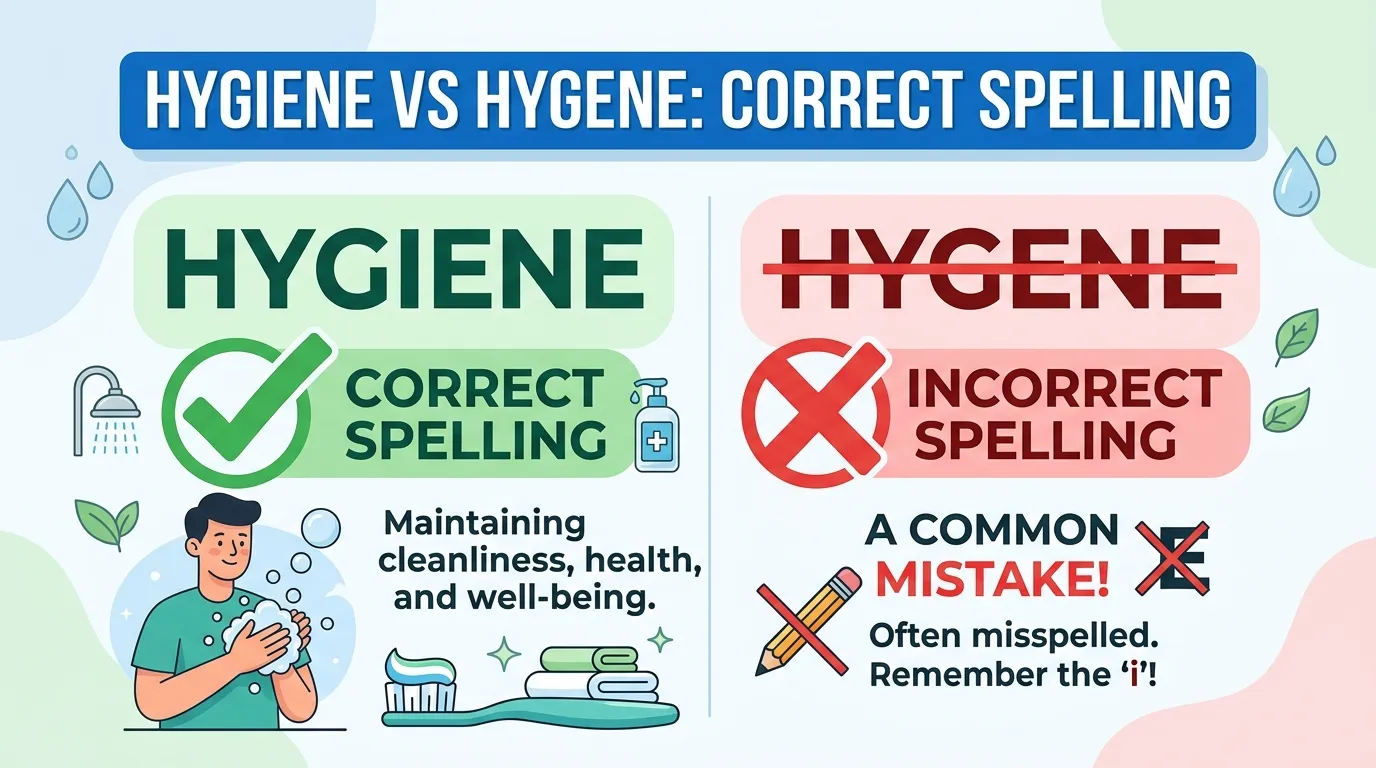
Long before the word hygiene meant handwashing and food safety, it was a person — or rather, a goddess. Hygieia was the Greek goddess of health, cleanliness, and sanitation, daughter of Asclepius, the god of medicine. Temples to Hygieia stood across the ancient Greek world, and her name carried the idea that health was something you maintained through clean living, not something you merely hoped for. When English borrowed her name, it kept her spelling — including a letter that millions of writers now drop. The correct spelling is hygiene. Hygene, without the i, is a misspelling. And the missing i is Hygieia’s own initial, still sitting in the middle of the word after more than two thousand years.
The error is easy to understand. The word is pronounced HY-jeen, and in fast speech the middle of the word collapses into a single sound that gives no clue about the letters inside it. A writer spelling by ear hears “hy-jeen” and writes hygene, because gene is a familiar chunk — it is the ending of gene itself, and of imagine, magazine, and engine. But hygiene is not built from gene. It is built from Hygieia, and the i is part of the foundation.
The Goddess in the Word
Hygieia’s name comes from the Greek hygieia, meaning health, which itself comes from hygies, meaning healthy or sound. The word traveled from Greek into Latin as hygiene, then into French as hygiène, then into English as hygiene. At every stop, the i survived. English dropped the French accent but kept the letters, giving us the modern spelling: h-y-g-i-e-n-e.
The goddess’s legacy is visible in the word’s relatives, too. Hygienic is the adjective: “hygienic conditions,” “a hygienic kitchen.” Hygienist is the professional: a dental hygienist cleans teeth and teaches oral care. Unhygienic is the negative: “unhygienic practices.” Every member of the family keeps the i. The misspelling hygene breaks the family — it severs the word from its relatives and from its goddess, and it is the first thing a careful reader notices.
There is also a useful distinction hiding in the family. Hygiene names the practices themselves — the habits and conditions that protect health. Hygienic describes something that meets those standards. A hospital room can be hygienic; the act of washing your hands is hygiene. The two words are close, but they are not interchangeable, and using the right one is part of writing about health precisely.
The Doctors Who Made Hygiene Matter
For most of history, hygiene was a matter of custom and instinct. People knew that clean places felt healthier than dirty ones, but nobody could explain why. The explanation arrived in the 1800s, and it arrived through a series of doctors who made hygiene a science — and whose stories are worth knowing, because they show why the word carries so much weight today.
Ignaz Semmelweis, a Hungarian physician working in Vienna in the 1840s, noticed that women giving birth in the hospital ward staffed by medical students died of childbed fever at far higher rates than women in the ward staffed by midwives. He realized the students were carrying something on their hands from the dissecting room to the delivery room. He ordered handwashing with chlorinated lime. Death rates collapsed. The medical establishment mocked him, and he died in obscurity — but his insight was the beginning of modern hygiene.
Florence Nightingale, working in military hospitals during the Crimean War, proved that cleanliness saved lives on a large scale. She insisted on clean wards, clean bedding, clean water, and fresh air, and she kept statistics showing that soldiers died more often from infection and filth than from wounds. Her work made hygiene a matter of hospital design, not just personal habit.
Joseph Lister took the next step, introducing antiseptic surgery — sterilizing instruments, cleaning wounds, and operating in conditions designed to keep germs out. And Edwin Chadwick, a British reformer, pushed hygiene into public policy, arguing that clean water, sewers, and housing were matters of public health, not private preference. Together, these figures turned hygiene from a goddess’s name into a science, a profession, and a public responsibility.
The germ theory of disease, developed by Louis Pasteur and Robert Koch, gave the science its foundation. Once people understood that invisible organisms caused infection, hygiene became the practical art of keeping those organisms away from bodies, food, water, and wounds. The word’s meaning widened from personal cleanliness to a whole system of practices — and its spelling stayed exactly where it had always been.
Why the I Goes Missing
Three forces conspire to produce hygene. The first is pronunciation. The middle of hygiene is pronounced as a single “jeen” sound, and nothing in that sound tells the writer that there is an i before the e. English is full of words where the ear cannot recover the spelling — definitely, separate, necessary — and hygiene is one of them.
The second is analogy. The ending -gene is familiar from real words: gene, imagine, magazine, engine, indigenous. The hand, writing quickly, reaches for the familiar pattern. Hygene looks like it belongs with gene and imagine. It does not. It belongs with Hygieia, and the i is the proof.
The third is the word’s rarity in handwriting. Most people encounter hygiene in print — on signs, in articles, in regulations — and write it far less often than they read it. Words you read but rarely write are the ones most vulnerable to spelling errors, because the hand has never built the motor habit. The fix is to write the word deliberately a few times, letter by letter: h-y-g-i-e-n-e. The fingers learn what the ear cannot teach.
Hygiene in Five Rooms
The word covers more ground than most people realize. In modern English, hygiene names practices in at least five distinct domains, and each one uses the word slightly differently:
- Personal hygiene — the daily habits of the body: washing hands, bathing, brushing teeth, grooming. “Good personal hygiene helps prevent illness.”
- Dental hygiene — care of the teeth and gums: brushing, flossing, professional cleaning. “She works in dental hygiene.”
- Food hygiene — safe handling, preparation, and storage of food: clean surfaces, correct temperatures, separation of raw and cooked foods. “Food hygiene rules require handwashing before handling ready-to-eat items.”
- Occupational hygiene — workplace safety: ventilation, protective equipment, exposure limits for dust, chemicals, and noise. “The occupational hygiene report flagged the ventilation system.”
- Public and medical hygiene — sanitation, clean water, waste disposal, sterilization of instruments, infection control in hospitals. “Hospital hygiene standards have tightened since the pandemic.”
There is also a newer usage worth knowing: sleep hygiene — the habits that promote good sleep, like keeping a regular schedule and avoiding screens before bed — and mental hygiene, an older term for practices that support mental health. Both borrow the word’s core meaning — maintenance of health through routine — and apply it to new domains. The word’s flexibility is part of its longevity.
Hygiene in the Pandemic Era
The COVID-19 pandemic gave hygiene its most public moment in a century. Handwashing, mask-wearing, surface disinfection, and ventilation became daily conversation, and the word appeared in guidance from every public health agency on Earth. The pandemic also refined the science: researchers confirmed that hand hygiene mattered most for surfaces and close contact, that ventilation mattered more than once believed for airborne spread, and that the old advice — wash your hands, cover your cough, stay home when sick — held up remarkably well. The word’s ancient meaning, health maintained through clean living, turned out to be exactly right.
The pandemic also introduced millions of people to the phrase hygiene theater — visible cleaning rituals that reassure the public without meaningfully reducing risk, like wiping down groceries while ignoring ventilation. The phrase is a reminder that hygiene is a science, not a performance. The practices matter; the appearance of the practices does not. And in writing about the pandemic, the word’s spelling mattered too: public health guidance full of misspellings would have undermined the trust it needed.
The Word Family
The relatives of hygiene are worth collecting, because they show the word’s range and because every one of them keeps the i:
- Hygienic (adjective) — meeting the standards of hygiene. “A hygienic kitchen.”
- Unhygienic (adjective) — failing those standards. “Unhygienic conditions in the camp.”
- Hygienist (noun) — a professional, most often a dental hygienist.
- Hygienically (adverb) — in a hygienic manner. “The instruments were stored hygienically.”
The opposites are worth noting too. The direct opposite of hygienic is unhygienic, not dirty — though dirty is the everyday synonym. And the word has no true opposite as a noun: there is no single word for “the absence of hygiene” other than unhygienic conditions or poor hygiene. The language treats hygiene as a baseline, and its absence as a failure of that baseline.
The Clean Finish
The memory hook is the goddess herself. Hygieia begins with H-y-g-i — and so does hygiene. The first four letters are identical. If you can spell the goddess’s name, you can spell the word, because the word is her name with ene on the end. Hygieia → hygiene. The i is not a random letter to memorize. It is the goddess’s initial, preserved in the middle of a word that has carried her name for two millennia.
So the next time you write about handwashing, food safety, or clean hospitals, give the word its full spelling. Hygiene, with the i. The goddess kept her i through Greek, Latin, French, and English. The least a writer can do is keep it through one more sentence.










