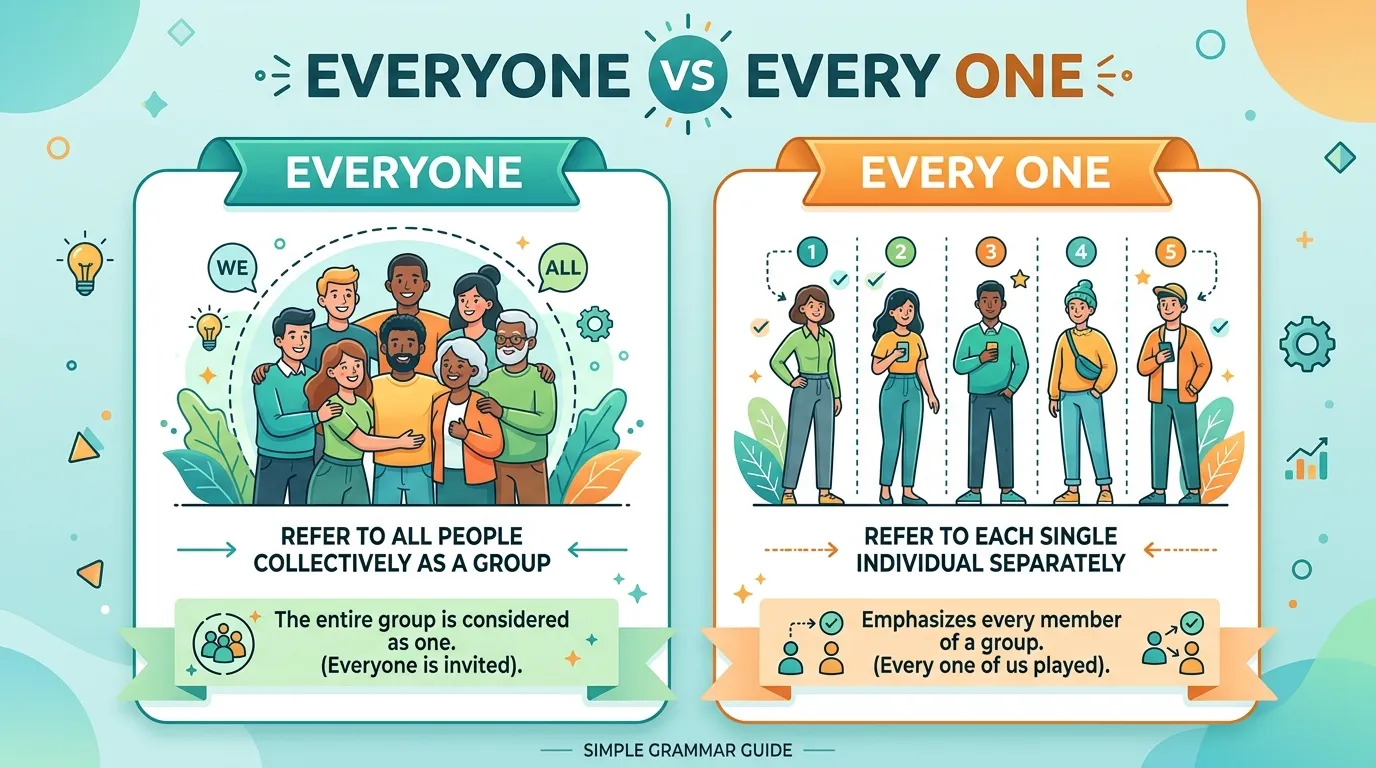
The party is on Saturday. You are writing the invitations, and you stop mid-sentence. “Everyone is welcome,” you write. Then, on the seating chart, you write, “Every one of the guests gets a name card.” Both sentences look right. Both sentences are right. And yet the two forms — everyone and every one — are not interchangeable. They are two different grammatical tools that happen to sound alike, and swapping them produces sentences that are either wrong or subtly off. The difference is small, but it is the kind of small that separates careful writing from careless writing.
The confusion is natural. The two forms are pronounced the same in most speech, they share the same root words, and they both deal with totality — with all the members of a group. But they point at the group in different ways. Everyone looks at the group as a whole. Every one looks at the members one by one. That difference in perspective is the entire story.
The Guest List
Start with the two sentences that open this article, because they contain the whole rule in miniature. “Everyone is welcome” means all the people are welcome. The sentence treats the guests as a single body, a crowd, a group. “Every one of the guests gets a name card” means each individual guest, one after another, gets a name card. The sentence treats the guests as individuals, counted one by one.
The same distinction runs through everyday writing. “Everyone enjoyed the concert” — the audience as a whole had a good time. “Every one of the songs was a hit” — each individual song, considered separately, was a hit. Notice that the second sentence is not about people at all. Every one can refer to things — songs, cookies, books, answers — while everyone refers only to people. That is the first hard rule: everyone is for people; every one is for people or things.
Everyone: The Group
Everyone is a single word, an indefinite pronoun. It means every person, all the people in a particular group or situation. “Everyone is ready.” “Everyone knows the answer.” “Everyone in the office received the email.” In each case, everyone refers to people as a group, and it takes a singular verb: everyone is, not everyone are. The singular verb surprises learners, because everyone feels plural — it refers to many people. But grammatically it is singular, and the verb must agree: “Everyone has arrived,” not “Everyone have arrived.”
Everyone also carries a social warmth that its cousins lack. “Everyone is welcome” is an invitation. “Everyone is invited” is a gesture of inclusion. The word’s job is to gather people, not to sort them. It is the word you use when the point is that nobody is left out.
There is one more detail worth knowing: everyone is always written as one word in standard English. Splitting it into every one when you mean the pronoun is a mistake — or rather, it changes the meaning, because every one is a different construction. The single word is the pronoun. The two words are the phrase. Keep them apart and half the battle is won.
Every One: The Individuals
Every one is two words: every, a determiner, plus one, a pronoun. Together they mean each individual person or thing in a group, with emphasis on the individuals rather than the group. “Every one of the students passed.” “Every one of the cookies was delicious.” “I checked every one of the answers.” In each case, the sentence is counting members, not describing a crowd.
The key to every one is the word of. In the vast majority of correct uses, every one is followed by of — every one of the students, every one of the books, every one of us. The of phrase names the group, and every one picks out its members one by one. When you see every one without an of phrase nearby, it is often a sign that everyone was meant instead.
Every one can also stand alone in a few constructions, usually for emphasis: “Every one counts.” “Every one matters.” In these sentences, the emphasis is on the individual — each person, separately, matters. The same sentence with everyone — “Everyone matters” — means the group matters, which is true but slightly different. The two-word form puts the spotlight on the individual. The one-word form puts it on the group.
The “Of” Test
Here is the fastest check in this whole article. If the word you need is followed by of — every one of the guests, every one of the books — write it as two words: every one. If it is not followed by of, and it refers to people as a group, write it as one word: everyone.
Test it on three sentences:
- “___ of the team members contributed.” — Of follows, so: “Every one of the team members contributed.”
- “___ enjoyed the party.” — No of, people as a group, so: “Everyone enjoyed the party.”
- “___ of the answers was correct.” — Of follows, things not people, so: “Every one of the answers was correct.” (Everyone would be wrong here, because the answers are not people.)
The test is not perfect — every one can occasionally appear without of, as in “Every one counts” — but it catches the overwhelming majority of cases, and it is the check professional editors use when they are writing quickly.
Everyone’s Cousins
Everyone belongs to a family of indefinite pronouns, and knowing the family helps, because the same one-word/two-word logic applies to several of them:
- Everyone / everybody — all people. “Everyone is here.” “Everybody is here.” The two are interchangeable in most contexts, though everyone is slightly more formal.
- Anyone / anybody — any person. “Anyone can join.” “Is anybody home?”
- Someone / somebody — an unspecified person. “Someone left a bag.” “Somebody should call.”
- No one / nobody — no person. “No one answered.” “Nobody answered.” Note that no one is two words, unlike everyone and anyone — one of English’s small inconsistencies.
- Everything / anything / something / nothing — the thing versions. “Everything is ready.” “Anything is possible.”
The parallel construction to watch is every body versus everybody. Just as every one (two words) differs from everyone (one word), every body (two words) differs from everybody (one word). “Every body in the morgue was identified” refers to physical bodies. “Everybody in the room was identified” refers to people. The pattern is consistent: one word for the pronoun, two words for the literal phrase.
The Singular-Verb Rule
One more rule, and it applies to the whole family. Indefinite pronouns like everyone, everybody, anyone, someone, and no one take singular verbs, even though they refer to many people. “Everyone is welcome.” “Everybody has arrived.” “Someone is at the door.” The singular verb is correct in standard English, and the plural verb — “Everyone are welcome” — is a mistake that native speakers notice instantly.
The same rule applies to every one when it is the subject: “Every one of the guests is welcome.” The verb agrees with one, which is singular, not with guests, which is plural. The of phrase is a modifier, not the subject. This is the grammatical shadow of the meaning: every one picks out individuals one at a time, and each one, taken alone, is singular.
There is a related question about pronouns: when everyone is the subject, which pronoun do you use later in the sentence? “Everyone should bring ___ notebook.” Traditional grammar prescribed his. Modern usage accepts their — “Everyone should bring their notebook” — and this singular their is now standard in all but the most formal writing. The same applies to every one: “Every one of the students should bring their notebook.” The language has settled this one, and the settlement favors their.
Everyone in Formal Writing
In formal writing — essays, reports, business documents — the distinction between everyone and every one is one of the small markers that separates polished prose from hurried prose. Examiners and editors notice it, not because the rule is difficult, but because it is easy: a writer who confuses the two forms looks as though they never learned the difference, and the error is visible in a single glance. In a job application, a cover letter, or an academic essay, the mistake costs more than it should, because the reader judges the writer’s care by the smallest details.
The safest habit in formal writing is to default to everyone when you mean people as a group, and to reserve every one for sentences with an of phrase. If the sentence has no of phrase and refers to people, everyone is almost always the right choice. If the sentence refers to things — books, answers, cookies, songs — every one is the only choice. Two questions, two spellings, no hesitation.
RSVP
The invitation goes out. The seating chart gets filled in. And the two forms fall into their places: everyone for the crowd on the invitation, every one for the name cards on the table. The group and the individuals, each with its own spelling, each with its own job.
The check fits on the back of the invitation: if of follows, split it. If the sentence is about people as a group, join it. If the sentence is about things, split it — everyone never refers to things. Three questions, two spellings, one rule. And the party, like the sentence, goes off without a hitch.










