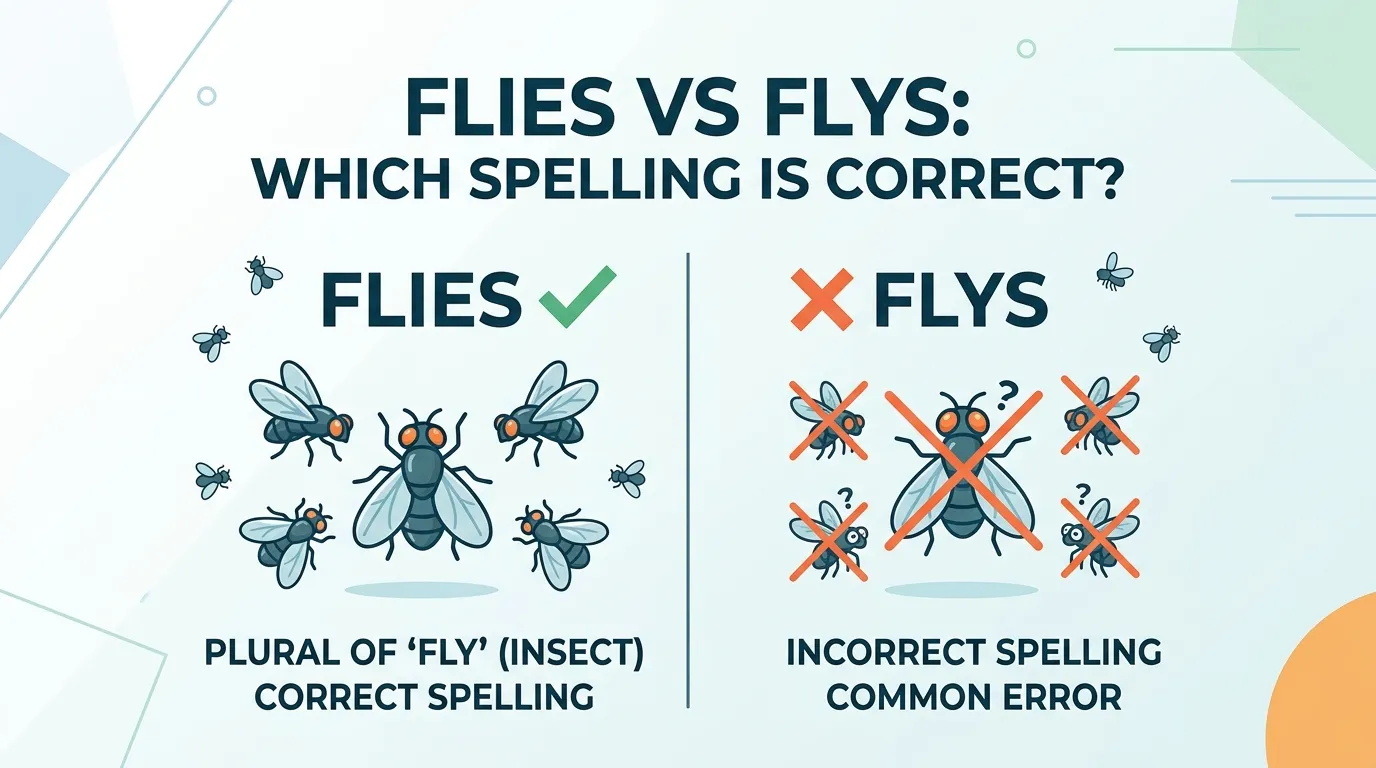
The teacher writes a sentence on the whiteboard: “The flys are everywhere.” She steps back, caps her marker, and waits. A hand goes up in the third row. “Shouldn’t that be flies?” The teacher smiles. It is the question she wanted. The correct spelling is flies. Flys is not a word in standard English — not for the insects, not for the verb, not for anything. And the reason it feels so tempting is that most English plurals really do just add -s. This is one of the cases where they don’t, and the exception follows a rule so reliable that once you learn it, you will never write flys again.
The confusion is understandable. English has thousands of words that pluralize by adding -s: cat → cats, dog → dogs, book → books. A learner who applies that pattern to fly gets flys, and the result looks reasonable. But fly belongs to a different family — the family of words that end in a consonant followed by y — and that family plays by its own rule.
The Whiteboard Problem
First, the facts. Flies has two jobs in English, and both of them use the same spelling. As a noun, flies is the plural of fly: “There are three flies in the kitchen.” “The flies were attracted to the fruit.” As a verb, flies is the third-person singular present form of fly: “She flies to Chicago every month.” “The eagle flies high above the valley.” Same letters, same rule, two different grammatical jobs.
Flys, by contrast, has no job. It is not the plural of anything. It is not a verb form. It appears in writing only as a misspelling, and spellcheckers flag it immediately. The correct forms are always flies for the plural and the third-person verb, and fly for the singular noun and the base verb. There is no corner of standard English where flys is accepted.
Consonant + Y Becomes IES
Here is the rule, in its full form: when a word ends in a consonant followed by y, change the y to i and add -es. Fly ends in l (a consonant) + y, so fly → fli + es → flies. The rule applies to nouns and verbs alike, which is why flies covers both jobs.
The family is large, and recognizing it makes the rule feel like a pattern rather than an exception:
- try → tries — “She tries her best.”
- cry → cries — “The baby cries at night.”
- study → studies — “He studies medicine.”
- city → cities — “Two cities, one river.”
- baby → babies — “Three babies in the nursery.”
- story → stories — “She told us two stories.”
- party → parties — “The parties lasted all weekend.”
Notice what all of these share: the letter before the y is a consonant. Now compare the opposite case — a vowel before the y — where the rule does not apply and the word simply adds -s:
- play → plays (not plaies)
- key → keys (not keies)
- day → days (not daies)
- boy → boys (not boies)
- monkey → monkeys (not monkies)
The test is one letter long. Look at the letter before the y. Consonant → change y to i, add es. Vowel → just add s. Fly has an l before its y, so it takes ies. That is the entire rule, and it is one of the most reliable rules in English spelling.
Fly the Verb: A Full Tense Tour
The verb fly is irregular, and its full family is worth learning together, because the irregular forms are where the second round of mistakes lives:
- Fly — base form and present tense for I, you, we, they. “I fly to Boston tomorrow.” “They fly kites on the beach.”
- Flies — third-person singular present. “She flies home on Fridays.” “The plane flies over the mountains.”
- Flew — simple past tense. “She flew to Boston yesterday.” “The bird flew away.”
- Flown — past participle, used after have, has, had, and been. “She has flown that route before.” “The flag had flown all day.”
- Flying — present participle and gerund. “She is flying tomorrow.” “Flying is faster than driving.”
The common errors are predictable: writing flyed for the past tense (the correct form is flew), writing has flew where has flown belongs, and writing flys for the third-person present. Each one comes from applying a regular pattern to an irregular verb. The irregularity is the point — fly belongs to the old family of verbs that change their vowel to mark the past, like sing/sang/sung and drive/drove/driven — and the family rewards anyone who learns it once.
Fly the Noun: Insects, Zippers, and Fishing Lures
The noun fly is busier than the insect. Its oldest meaning is the insect: a small flying insect, especially of the order Diptera, which includes houseflies, horseflies, and fruit flies. “A fly landed on the windowsill.” “Fruit flies love the banana bowl.” The plural is flies, always.
But the noun has several other lives. In fishing, a fly is an artificial lure made to look like an insect: “He tied his own flies for the trout stream.” In clothing, the fly is the opening at the front of a pair of trousers, closed by a zipper or buttons: “Your fly is open.” In baseball, a fly is a ball hit high into the air: “He caught the fly at the warning track.” In theater, the flies are the space above the stage where scenery is hung — and notice that in this sense, the word is almost always plural: “The backdrop hung in the flies.”
Then there are the idioms, which show how deeply the word sits in the language. A fly in the ointment is a small flaw that spoils something otherwise good. A fly on the wall is an unnoticed observer: “I’d love to be a fly on the wall at that meeting.” Fly by night describes something unreliable or temporary, originally a business that vanishes overnight. On the fly means done quickly, without preparation: “She fixed the slide deck on the fly.” Every one of these uses fly or flies with the standard spelling, and none of them admits flys.
The Fly in Science: Why the Insect Matters
The insect behind the word is more important to science than most people realize. The fruit fly, Drosophila melanogaster, has been a laboratory animal for over a century. Thomas Hunt Morgan’s work with fruit flies in the early 1900s established that genes sit on chromosomes, founding modern genetics. The fly’s short life cycle, cheap upkeep, and easily visible traits made it the ideal research subject, and it remains one of the most studied organisms on Earth. When geneticists write about flies, they mean these laboratory animals, and they spell the plural the same way the rest of English does.
Flies also matter to public health and to forensic science. Houseflies carry pathogens on their feet and in their gut, which is why food hygiene rules treat them as contaminants. Blowflies arrive at a body within minutes of death, and forensic entomologists use the developmental stages of their larvae to estimate the time of death. The insect’s bad reputation is earned — but its scientific value is enormous. A word that names both a kitchen pest and a Nobel Prize-winning research subject deserves to be spelled correctly.
The Apostrophe Trap
One more form causes trouble: the possessive. The singular possessive of fly is fly’s — with an apostrophe and an s: “The fly’s wings beat two hundred times a second.” The plural possessive is flies’ — with the apostrophe after the s: “The flies’ buzzing filled the room.” The difference between fly’s (one fly) and flies’ (many flies) is a single apostrophe placement, and it is exactly the kind of detail that careful writing gets right.
There is also a related trap: flys occasionally appears as a surname or a brand name, and proper nouns follow their own spelling. A person named Flys spells their name however their family spells it, and a business called Flys is spelled however its owners registered it. Proper nouns are exempt from the rule. Common nouns and verbs are not. In ordinary writing, flys is always a mistake.
The Bell Rings
The teacher erases the whiteboard and writes the rule in one line: consonant + y → ies. It is the kind of rule that fits on a sticky note, and it covers hundreds of words — flies, tries, cries, cities, babies, stories. The student in the third row nods. The class moves on. And the next time any of them writes about insects in the kitchen or a sister who travels for work, the hand writes flies without stopping to think — which is exactly what a good spelling rule is for.










