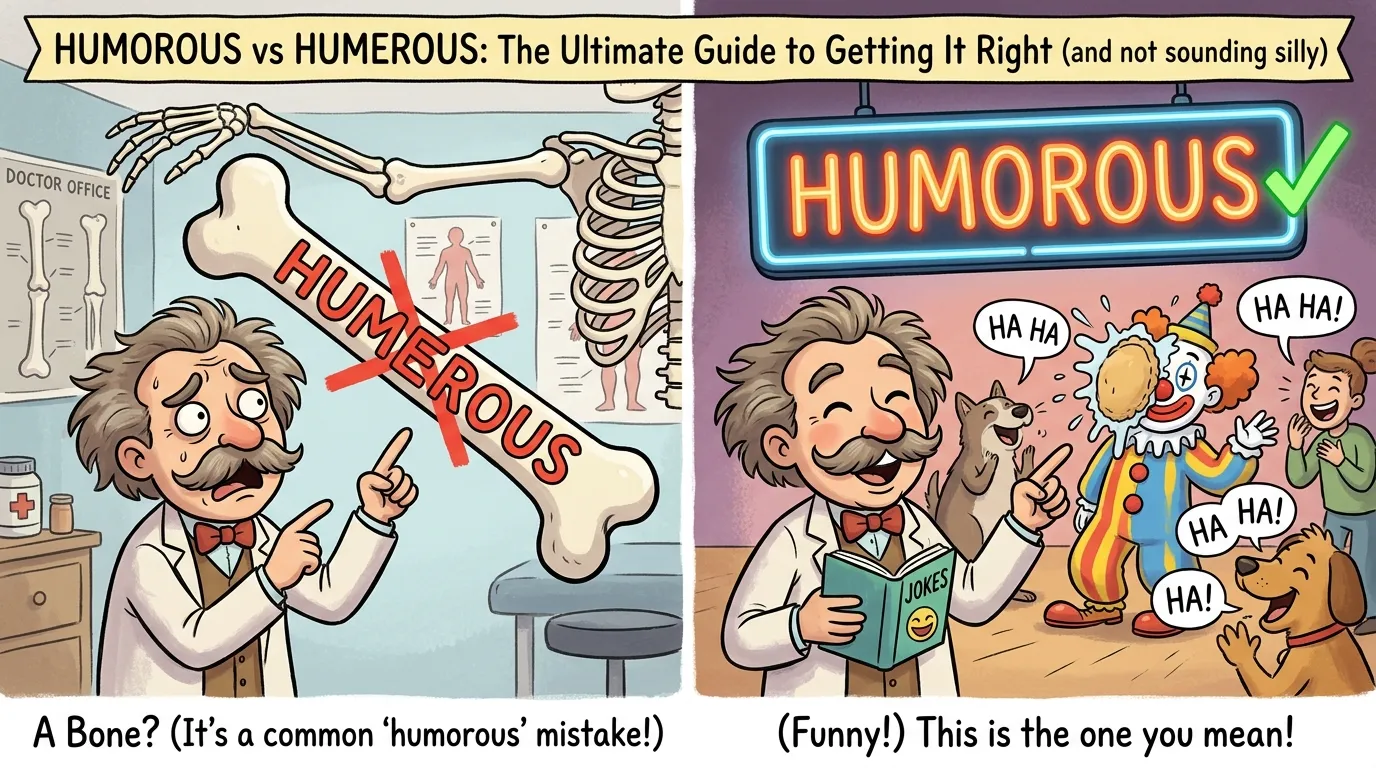
Humorous vs Humerous: Which Spelling Is Correct? | Grammar & Word Choice

If you are wondering about humorous vs humerous, the answer is simple: humorous is the correct spelling when you mean “funny,” “amusing,” or “related to humor.” Humerous is generally a misspelling in modern standard English.

The confusion is understandable. Both spellings look almost identical, and humerus is a real English word for the upper-arm bone. The similar sounds and letter patterns can easily cause a writer to type humerous when they mean humorous.

In this guide, you will learn the difference between humorous and humerous, how to pronounce humorous, why the spelling causes confusion, how the word developed, and how to use it naturally in American English. You will also see examples, comparisons, common mistakes, synonyms, related words, and practical tips for school, business, academic, journalistic, blogging, and everyday writing.


Quick Answer: Humorous vs Humerous

Humorous is the correct spelling when you mean funny, amusing, entertaining, or characterized by humor.

Humerous is not the standard spelling for this meaning. In most modern writing, it should be treated as a misspelling of humorous.

WordCorrect?Meaning
humorous✅ YesFunny, amusing, or related to humor
humerous❌ No, in standard usageUsually a misspelling of humorous
humerus✅ YesThe long bone in the upper arm
humor✅ YesAmusement or the quality of being funny
humorless✅ YesLacking a sense of humor

Correct example

The speaker gave a humorous presentation.

Incorrect example

The speaker gave a humerous presentation.

If you mean the bone

The doctor examined the patient’s humerus.

A useful distinction is:

humor → humorous

but

humerus → humeral


What Does Humorous Mean?

Humorous is an adjective that describes something funny, amusing, playful, or intended to produce laughter.

It can describe a person, story, comment, situation, book, movie, speech, article, image, conversation, or style.

Dictionary-style definition

Humorous (adjective): characterized by or expressing humor; amusing or funny.

Examples include:

  • a humorous story
  • a humorous writer
  • a humorous comment
  • a humorous movie
  • a humorous speech
  • a humorous advertisement
  • a humorous approach
  • a humorous observation

The word does not necessarily mean extremely funny.

For example:

She made a humorous comment during the meeting.

This means the comment was funny or amusing. It does not necessarily mean everyone in the room laughed loudly.


Is Humerous a Correct Word?

In modern standard English, humerous is not the spelling you should use when you mean funny or amusing.

The correct form is:

humorous

This is especially important in formal writing.

If you write:

The article has a humerous tone.

the reader will normally understand what you mean, but the spelling is considered incorrect.

Write:

The article has a humorous tone.

Instead.

Why does humerous look believable?

English spelling is full of words that sound different from the way they look. In this case, several words are visually close:

  • humor
  • humorous
  • humerus
  • humeral
  • humerous

Because humerus is a genuine word, some writers accidentally create humerous by blending the spelling patterns.

That makes humerous a particularly believable spelling mistake.


Humorous vs Humerous: The Main Difference

The biggest difference is straightforward:

Humorous is the standard adjective meaning funny or amusing.

Humerous is generally an incorrect spelling of humorous.

There is therefore no normal difference in meaning between humorous and humerous in everyday English. They are not two interchangeable adjectives with different definitions.

Compare these sentences

Correct:

The comedian told a humorous story.

Incorrect:

The comedian told a humerous story.

The first sentence uses the standard spelling.

Another example

Correct:

His humorous writing makes difficult subjects easier to understand.

Incorrect:

His humerous writing makes difficult subjects easier to understand.

Again, humerous should be replaced with humorous.


Why Do People Confuse Humorous and Humerous?

There are several reasons writers mix up these spellings.

The pronunciation is misleading

In ordinary speech, humorous can sound roughly like:

HYOO-muh-rus

or, in some American pronunciations:

YOO-muh-rus

The middle vowel is weak, so the spelling is not always obvious from pronunciation.

A person may hear the word and mentally reconstruct it as humerous.

Humerus is a real word

The anatomical term humerus refers to the long bone extending from the shoulder to the elbow.

Because humerus is familiar to students, medical professionals, and science readers, its spelling can influence how people spell humorous.

The words look almost identical

Compare:

humorous

humerous

Only one letter changes position.

That small difference is easy to miss while typing quickly.

The suffix causes confusion

The adjective is built from humor + -ous:

humor + ous = humorous

Writers sometimes assume the spelling should follow the pronunciation more closely and insert e.

It should not.


How Do You Spell Humorous Correctly?

The spelling is:

H-U-M-O-R-O-U-S

In American English, remember the sequence:

humor + ous = humorous

Do not change the o in humor to an e.

Correct forms

  • humorous
  • humorously
  • humorousness
  • humor
  • humorist
  • humorless

Incorrect form

  • humerous ❌

Example sentences

The teacher used a humorous example to explain the rule.

His humorous personality made everyone feel comfortable.

The article takes a humorous look at modern technology.

She humorously described her first day at work.


Humorous vs Humerus: Do Not Mix These Up

A particularly important distinction is between humorous and humerus.

They look and sound similar, but they have completely different meanings.

WordPart of speechMeaning
humorousAdjectiveFunny or amusing
humerusNounUpper-arm bone
humeralAdjectiveRelated to the humerus
humorNounAmusement or a sense of what is funny

Examples

That was a humorous story.

Here, humorous means funny.

The X-ray showed a fracture in the humerus.

Here, humerus means the upper-arm bone.

The injury affected the humeral region.

Here, humeral relates to the upper arm or humerus.

This distinction is especially important in medical, scientific, and academic writing.


How Do You Pronounce Humorous?

In American English, humorous is commonly pronounced approximately:

HYOO-muh-rus

A common phonetic representation is:

/ˈhjuːmərəs/

Some American speakers may use a pronunciation beginning closer to YOO, depending on accent and speech pattern.

The important point is that the word is pronounced as three syllables by many speakers:

hu-mor-ous

In natural speech, the middle vowel is usually unstressed.

Does the pronunciation change the spelling?

No.

Even if humorous sounds as though it could be spelled humerous, the standard spelling remains:

humorous


Is Humorous an Adjective?

Yes. Humorous is an adjective.

It modifies nouns or describes people and things.

Examples

a humorous book

a humorous person

a humorous remark

a humorous video

a humorous situation

a humorous tone

a humorous article

You cannot normally use humorous as the noun itself.

Instead, use humor as the noun.

Compare

His humor is excellent.

Here, humor is a noun.

He is very humorous.

Here, humorous is an adjective.

He spoke humorously about the mistake.

Here, humorously is an adverb.


Humorous, Humor, Humorously, and Humorist

These related words belong to the same word family.

WordPart of speechMeaning
humorNounThe quality or ability that produces amusement
humorousAdjectiveFunny or amusing
humorouslyAdverbIn a humorous way
humoristNounA person who creates or specializes in humor
humorlessAdjectiveLacking humor or a sense of humor

Examples

Her humor helped ease the tension.

She has a humorous personality.

He answered the question humorously.

The famous humorist wrote several comic essays.

His response sounded humorless.


Humorous vs Funny: Are They the Same?

They are close in meaning, but they are not always interchangeable.

Funny is the more common and flexible everyday word.

Humorous often sounds slightly more descriptive or polished.

Compare:

That’s a funny story.

That’s a humorous story.

Both are correct.

The first sounds more conversational. The second may sound more deliberate or descriptive.

In everyday conversation

Funny is often the natural choice:

Your brother is really funny.

In formal or descriptive writing

Humorous may work better:

The author uses a humorous tone throughout the essay.

This does not mean humorous is always formal. It is perfectly normal in everyday English, too.


Humorous vs Witty

These words overlap, but there is a useful difference.

Humorous broadly means funny or amusing.

Witty usually suggests cleverness, especially clever use of language or ideas.

Compare

She wrote a humorous article.

This tells us the article is funny or amusing.

She wrote a witty article.

This suggests the article contains clever observations or clever language.

A person can be humorous without being especially witty.

Example

His humorous stories are simple and playful.

versus:

Her witty remarks are sharp and clever.


Humorous vs Comical vs Amusing

These words are related but have slightly different shades of meaning.

WordTypical meaning
HumorousFunny or showing a sense of humor
FunnyCausing laughter or amusement
ComicalFunny, often because something looks or behaves oddly
AmusingPleasantly entertaining or mildly funny
WittyClever and funny
HilariousExtremely funny
ComicRelated to comedy or designed to make people laugh

Examples

The article has a humorous tone.

That was a funny mistake.

His oversized hat looked comical.

The conversation was amusing.

She made a witty observation.

The movie was hilarious.


Synonyms for Humorous

Depending on context, useful synonyms include:

  • funny
  • amusing
  • entertaining
  • comical
  • comic
  • witty
  • playful
  • clever
  • lighthearted
  • droll
  • jocular
  • humorous
  • hilarious
  • ridiculous
  • comedic

Not every synonym has exactly the same meaning.

For example, hilarious is much stronger than humorous, while witty emphasizes cleverness.


Antonyms of Humorous

Common opposites include:

  • serious
  • solemn
  • humorless
  • grave
  • somber
  • earnest
  • depressing
  • unamusing

Example

The first half of the speech was humorous, but the ending became serious.

His humorless response surprised everyone.

The best antonym depends on context. Serious is often the most natural opposite when contrasting tone.


Common Collocations With Humorous

A collocation is a combination of words that naturally occur together.

Common combinations with humorous include:

  • humorous story
  • humorous article
  • humorous essay
  • humorous speech
  • humorous comment
  • humorous remark
  • humorous anecdote
  • humorous character
  • humorous tone
  • humorous approach
  • humorous style
  • humorous writer
  • humorous personality
  • humorous observation
  • humorous situation
  • humorous response
  • humorous video
  • humorous advertisement
  • humorous interpretation
  • humorous account

Natural examples

She gave a humorous account of her vacation.

The newspaper published a humorous article about office life.

His humorous response broke the tension.

The documentary takes a humorous approach to a serious topic.


Common Phrases With Humorous

Some natural expressions include:

A humorous take on something

The show offers a humorous take on modern dating.

This means the subject is presented in a funny or playful way.

A humorous look at something

The book provides a humorous look at family life.

A humorous approach

The teacher uses a humorous approach to make history easier to remember.

In a humorous way

She described the experience in a humorous way.

A humorous side

He always tries to find the humorous side of difficult situations.


Humorous in Formal and Informal Writing

Humorous works in both formal and informal contexts.

Casual writing

My friend sent me a humorous video.

Business writing

The campaign uses a humorous tone to attract younger customers.

Academic writing

The author uses humorous examples to challenge conventional assumptions.

Journalism

The columnist takes a humorous look at the week’s political events.

Blogging

This humorous guide explains the mistakes every new blogger makes.

Social media

Her humorous post quickly attracted attention.

The word is flexible, which makes it useful across many types of writing.


Humorous in Academic Writing

There is nothing inherently informal about humorous.

However, academic writers should use it precisely.

Natural

The author adopts a humorous tone when discussing the subject.

Less precise

The author makes everything funny.

The first sentence tells the reader specifically what kind of tone the author uses.

In academic analysis, related terms such as comic, satirical, ironic, witty, and playful may sometimes be more precise.


Humorous in Business and Professional Writing

Humor can be useful in professional communication, but context matters.

For example:

The presentation uses a humorous opening to engage the audience.

This is neutral and professional.

But humor can become inappropriate when discussing:

  • serious workplace incidents
  • sensitive personal matters
  • legal issues
  • safety problems
  • discrimination
  • financial losses
  • emergencies

The word humorous itself is not inappropriate. The issue is whether humor is suitable for the situation.


Humorous in Journalism and Political Writing

Journalists frequently use humorous to describe a light or comic treatment of a serious subject.

Examples:

The columnist offered a humorous response to the political controversy.

The program uses humorous commentary to discuss public policy.

The article takes a humorous look at election-season promises.

However, humorous, satirical, and sarcastic should not be treated as exact synonyms.

Humorous

Generally funny or amusing.

Satirical

Uses humor, irony, exaggeration, or ridicule to criticize people, institutions, or social behavior.

Sarcastic

Often uses mocking language that means something different from the literal words.

For example:

“Great job!” he said after the computer crashed.

Depending on context, that could be sarcastic, not simply humorous.


Humorous in Sports Writing

Sports writers may use humorous to describe lighthearted moments, unusual situations, or playful commentary.

Examples:

The coach gave a humorous answer during the postgame interview.

The article offers a humorous look at the team’s travel problems.

The players shared a humorous moment after practice.

Again, humorous describes the tone or quality. It does not automatically mean the event itself was a joke.


Humorous in Technical Writing

Technical writing usually favors clarity and precision. That does not mean humor is forbidden.

For example:

The developer added a humorous error message to the application.

This is perfectly clear.

However, instructions involving safety or critical procedures should prioritize clarity over jokes.

A software error message might say:

“Well, that didn’t go as planned.”

That can be humorous.

A safety warning should usually be direct:

Warning: Disconnect the power before servicing the equipment.

The appropriate tone depends on the purpose.


American vs British English: Humorous or Humourous?

This is an important regional issue.

American English normally spells the noun:

humor

British English commonly spells it:

humour

However, the adjective is generally:

humorous

not humourous.

This is a useful spelling point because writers sometimes assume that British English must turn humor into humourous.

That is not the standard pattern.

Compare

American EnglishBritish English
humorhumour
humoroushumorous
humorlesshumourless
humoristhumourist
humorouslyhumorously

There can be variation in related forms, but humorous remains the standard adjective.

So if you are writing for a British audience, do not automatically change humorous to humourous.


American English Recommendation

If your audience is primarily American, use:

humorous

and:

humor

Examples:

The movie has a humorous tone.

I enjoy his sense of humor.

Avoid:

humerous ❌

and do not use:

humourous ❌

if you are trying to follow standard American spelling.


A Simple Memory Trick for Humorous

Here is an easy way to remember the spelling:

HUMOR + OUS = HUMOROUS

Think of the noun first:

humor

Then add:

-ous

You get:

humorous

Another memory trick

Remember:

Humor has an O. Humorous keeps the O.

Do not replace the o with e.

For the anatomy word

Remember:

Humerus = bone

Humorous = funny

If someone has a broken arm, think humerus.

If someone tells a joke, think humorous.


Common Mistakes With Humorous

Mistake 1: Writing humerous

❌ The article is very humerous.

✅ The article is very humorous.


Mistake 2: Confusing humorous with humerus

❌ The doctor examined his humorous.

✅ The doctor examined his humerus.


Mistake 3: Using humorous as a noun

❌ His humorous is excellent.

✅ His humor is excellent.


Mistake 4: Using humor as an adjective

❌ She has a humor personality.

✅ She has a humorous personality.


Mistake 5: Confusing humorous and hilarious

The story was humorous.

This means funny or amusing.

The story was hilarious.

This means extremely funny.

They are not always interchangeable.


Awkward vs Natural Examples

Awkward or incorrectNatural correction
He wrote a humerous article.He wrote a humorous article.
She has a humor personality.She has a humorous personality.
The speaker answered humorous.The speaker answered humorously.
The doctor checked his humorous.The doctor checked his humerus.
It was a humorous joke that made everyone laugh.It was a funny joke that made everyone laugh.
His humorously speech was entertaining.His humorous speech was entertaining.

The last examples show why choosing the correct grammatical form matters as much as choosing the correct spelling.


Humorous vs Humorless

These words express opposite ideas.

Humorous means funny or characterized by humor.

Humorless means lacking humor or a sense of humor.

Examples

She wrote a humorous review.

He gave a humorless response.

The movie is humorous rather than serious.

The character appears completely humorless.


Humorous vs Serious

These words often describe contrasting tones.

The article has a humorous tone.

versus:

The article has a serious tone.

A piece of writing can also be both.

For example:

The documentary takes a humorous approach to a serious subject.

This means the subject is serious, but the presentation contains humor.

That distinction is useful in journalism, literature, advertising, politics, and entertainment writing.


Historical Meaning and Etymology of Humorous

The history of humorous is more interesting than its modern meaning suggests.

The word comes from humor, which ultimately traces back through Latin humor, meaning moisture or fluid.

In ancient medical thought, especially the theory of bodily humors, the body was believed to contain important fluids whose balance affected health and temperament.

Over time, humor developed additional meanings related to a person’s mood, temperament, or disposition.

The adjective humorous eventually became associated with being governed by one’s temperament or whims. Older English could therefore use humorous in senses that are now obsolete, including ideas such as capricious, whimsical, or changeable.

Its modern sense became strongly associated with humor, amusement, and comedy.

Today, when someone describes a story as humorous, the normal meaning is simply that it is funny or amusing.


Can Humorous Have a Figurative Meaning?

Yes.

The word can describe more than an obvious joke.

For example:

The situation was unintentionally humorous.

Nobody necessarily planned to make a joke. The circumstances themselves were amusing.

Another example:

There was something humorous about the way he carefully organized his messy desk.

The humor may come from a contrast or unusual situation rather than a deliberate punchline.

This is why humorous can be broader than joke-filled.


Does Humorous Mean Sarcastic?

No.

Humorous and sarcastic can overlap, but they are not synonyms.

A humorous statement may simply be playful.

A sarcastic statement often mocks someone or communicates an idea through irony.

Humorous

My cat believes she owns the entire house.

This is playful.

Sarcastic

Wonderful. Another meeting that could have been an email.

This may be sarcastic because the speaker’s literal words express praise while the intended meaning is criticism.

A sentence can be both humorous and sarcastic, but neither word automatically implies the other.


Does Humorous Mean Funny?

Yes, in most modern contexts.

The simplest definition is:

Humorous = funny or amusing.

However, humorous can be slightly softer than hilarious.

A humorous comment might make you smile.

A hilarious comment is expected to make you laugh a lot.

That makes humorous a useful general-purpose adjective.


When Should You Use Humorous?

Use humorous when you want to describe something as:

  • funny
  • amusing
  • playful
  • comic
  • lighthearted
  • characterized by humor
  • designed to create amusement

It works particularly well with nouns such as:

story, essay, article, speech, comment, remark, tone, personality, approach, observation, book, movie, character, response, account, advertisement, and video.


When Should You Avoid Humorous?

Sometimes another word is more precise.

Use witty when clever language is important.

Use satirical when the humor is designed to criticize.

Use sarcastic when mocking or ironic language is involved.

Use hilarious when something is extremely funny.

Use amusing when something is mildly entertaining.

Use comical when something is funny because of appearance, behavior, or circumstances.

Precise word choice makes your writing stronger.


Which Is Correct for School and College Writing?

Use humorous.

For example:

The author uses a humorous tone to make the criticism more accessible.

This is grammatically correct and appropriate for academic analysis.

Avoid:

The author uses a humerous tone.

That spelling can make otherwise polished work look careless.


Which Is Correct for Business Emails?

Use humorous when the context calls for it.

For example:

His humorous presentation helped keep the audience engaged.

But avoid forcing humor into serious business communication simply because the word itself is appropriate.

Correct spelling and appropriate tone are separate issues.


Which Is Correct for Blogs and Websites?

Use humorous.

For example:

We created a humorous guide for people who are new to cooking.

For SEO writing, you might naturally use related terms such as:

  • humorous writing
  • humorous article
  • funny article
  • humorous tone
  • funny stories
  • humorous examples
  • humor in writing
  • humorous content

These phrases can help cover the topic naturally without repeatedly forcing the exact same keyword.


Humorous vs Humerous: Final Comparison

FeatureHumorousHumerous
Standard spelling?YesNo, generally
Means funny?YesIntended to mean humorous, but misspelled
Used in American English?YesNo, as a standard spelling
Used in British English?YesNo, as a standard spelling
Adjective?YesNot standard
Related nounhumor/humour
Related anatomy wordOften confused with humerus
Appropriate for formal writing?YesNo
Appropriate for academic writing?YesNo
Best choiceHumorousAvoid

Frequently Asked Questions About Humorous vs Humerous

Is it humorous or humerous?

The correct spelling is humorous when you mean funny or amusing. Humerous is generally a misspelling and should be avoided in standard English.

What is the difference between humorous and humerous?

There is no standard meaning distinction. Humorous is the correct adjective meaning funny or amusing. Humerous is generally an incorrect spelling.

Is humerous a word?

In modern standard English, humerous is not the normal accepted spelling for the meaning “funny.” Writers should use humorous instead.

How do you spell humorous correctly?

Spell it:

H-U-M-O-R-O-U-S

A useful formula is:

humor + ous = humorous

Is humorous American or British?

Humorous is used in both American and British English. The noun differs more clearly: American English generally uses humor, while British English commonly uses humour.

Is humorous an adjective?

Yes. Humorous is an adjective. It describes someone or something that is funny, amusing, playful, or characterized by humor.

Is humorous the same as funny?

They are close synonyms. Funny is more common in everyday conversation, while humorous can sound more descriptive or polished. Humorous does not necessarily mean extremely funny.

What is the difference between humorous and humerus?

Humorous means funny or amusing. Humerus is the long bone in the upper arm. They are completely different words.

What is the opposite of humorous?

Depending on context, possible opposites include serious, solemn, somber, humorless, and earnest. The most natural choice depends on the sentence.

How can I remember the spelling of humorous?

Remember:

Humor + ous = humorous.

Keep the o from humor. If you are thinking about the upper-arm bone, use humerus, not humerous.


Conclusion: Humorous vs Humerous

When choosing between humorous vs humerous, the correct choice is clear: use humorous.

Humorous is the standard adjective meaning funny, amusing, playful, or characterized by humor. It works naturally in American English and is also standard in British English.

Humerous is generally a spelling mistake, often caused by the similarity between humorous and the anatomical word humerus.

The easiest way to remember the difference is:

humor → humorous
humerus → upper-arm bone

For professional, academic, journalistic, business, blogging, and everyday writing, choose humorous whenever you mean “funny.”

If you want an even simpler rule, remember this:

Funny = humorous. Bone = humerus.

That one distinction will prevent the most common spelling error and help keep your writing clear, accurate, and polished.

Leave a Comment