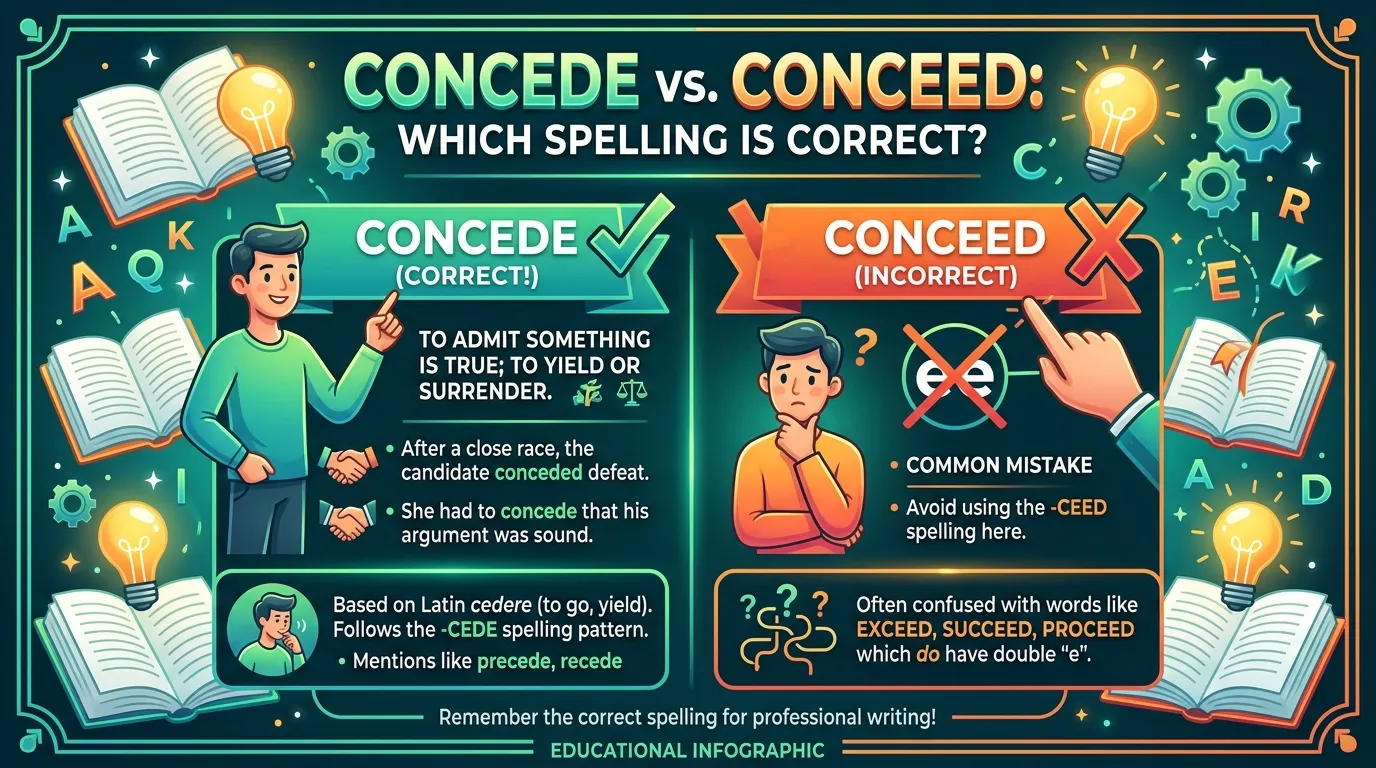
If you are unsure whether the correct spelling is concede or conceed, the answer is simple: concede is the correct English word, while conceed is a misspelling. There is no standard English verb spelled conceed.
The confusion is understandable. Many English verbs contain -ceed, such as proceed, succeed, exceed, and recede. Because concede sounds similar to these words, it is easy to accidentally add an extra e and write conceed. However, the correct spelling is always concede.
In this guide, you will learn what concede means, how to pronounce it, how to use it in a sentence, why conceed is incorrect, and how the word works in everyday, academic, business, political, journalistic, and sports writing. You will also find common mistakes, synonyms, antonyms, collocations, examples, memory tricks, and answers to common questions about concede vs conceed.
Quick Answer: Concede or Conceed?
Concede is correct. Conceed is incorrect.
| Spelling | Correct? | Meaning |
|---|---|---|
| concede | ✅ Yes | To admit something is true, accept something reluctantly, or give up something |
| conceed | ❌ No | Misspelling of concede |
Correct examples
- I concede that you were right.
- The team had to concede defeat.
- She conceded that the plan needed changes.
- The candidate conceded the election after the results became clear.
Incorrect examples
- I conceed that you were right. ❌
- The team conceeded defeat. ❌
- He conceedes that the argument is valid. ❌
The correct forms are concede, concedes, conceded, conceding, and concession.
What Does Concede Mean?
Concede is a verb with several related meanings. At its core, it means to admit, accept, grant, or give something up, often when you would prefer not to.
For example:
I concede that your argument is stronger.
Here, concede means admit or acknowledge that something is true.
It can also mean accepting defeat:
The losing candidate conceded the election.
In this context, conceded means the candidate accepted that they had lost.
The word can also describe giving something to another person:
The company conceded several points during the negotiations.
Here, the company agreed to give up or allow certain things.
So, depending on context, concede can mean:
- admit something is true
- acknowledge a point
- accept defeat
- surrender
- give something up
- grant something
- allow something after resistance
These meanings are closely connected because they all involve accepting something that you may initially have resisted.
What Does Conceed Mean?
Conceed is not a standard English word.
If you see conceed in a sentence, it is almost certainly a spelling mistake for concede.
For example:
I conceed that you were right.
The correct version is:
I concede that you were right.
Likewise:
The team conceeded three goals.
Should be:
The team conceded three goals.
This is why searching for concede vs conceed can be confusing. The two spellings look plausible, but only one belongs in standard English.
Why Do People Confuse Concede and Conceed?
The main reason is the spelling pattern of other English words.
Consider these verbs:
- proceed
- succeed
- exceed
- recede
- intercede
- precede
Several of these words contain the letters -ceed. That makes it easy to assume that concede should also contain two e’s before the final d.
But concede has a different spelling pattern:
c-o-n-c-e-d-e
Not:
c-o-n-c-e-e-d
The pronunciation can also contribute to the confusion because the ending sounds similar to other words ending in -cede and -ceed.
The best approach is not to rely entirely on sound. Learn the spelling as a complete word:
concede = admit or accept
Concede vs Conceed: The Key Difference
There is actually no difference in meaning between the two because conceed does not have a standard meaning.
The distinction is simply:
- Concede = correct English spelling
- Conceed = incorrect spelling
Comparison
| Feature | Concede | Conceed |
|---|---|---|
| Standard English word | Yes | No |
| Part of speech | Verb | None |
| Correct spelling | Yes | No |
| Can be used formally? | Yes | No |
| Appears in dictionaries? | Yes | No as a standard verb |
| Meaning | Admit, accept, grant, or surrender | — |
| Example | She conceded the point. | She conceeded the point. ❌ |
If you are writing an essay, email, report, article, application, business document, or professional message, always use concede.
How Do You Pronounce Concede?
Concede is pronounced:
kuhn-SEED
The stress falls on the second syllable.
A simple pronunciation guide is:
concede → /kənˈsiːd/
The final syllable sounds like “seed.”
Example
I concede your point.
The word concede sounds roughly like:
kuhn-SEED
The incorrect spelling conceed does not have a separate standard pronunciation because it is not a standard English word.
Is Concede a Verb?
Yes. Concede is a verb.
Its main grammatical forms are:
| Form | Example |
|---|---|
| Base form | concede |
| Third-person singular | concedes |
| Past tense | conceded |
| Past participle | conceded |
| Present participle | conceding |
Examples
Present:
I concede that the evidence is convincing.
Third person:
She concedes that she made a mistake.
Past:
He conceded that his first answer was wrong.
Past participle:
The point has been conceded.
Present participle:
They are conceding too much during the negotiation.
How to Use Concede in a Sentence
The most common structure is:
concede + that-clause
She conceded that the decision was difficult.
Another common structure is:
concede + noun
The company conceded defeat.
You can also use:
concede + something + to someone
The manager conceded the advantage to his competitor.
And:
concede + something
The team conceded two goals.
The correct structure depends on the meaning.
The Main Meanings of Concede
1. Concede Means “Admit”
This is one of the most common meanings.
I concede that you have a valid point.
The speaker is admitting that the other person is correct, even if they did not originally agree.
More examples:
- She conceded that the evidence was strong.
- He conceded that his prediction was wrong.
- The writer conceded that the argument had some weaknesses.
- After reviewing the data, the researcher conceded that the result was unexpected.
This usage is common in debates, essays, discussions, and professional communication.
2. Concede Means “Accept Defeat”
In politics and competition, concede often means accept that you have lost.
The candidate conceded the election.
This does not necessarily mean the person personally likes the result. It means they have accepted the outcome.
Examples:
- The candidate conceded after the final results were announced.
- The team conceded defeat after a difficult match.
- The challenger eventually conceded that victory was no longer possible.
This is particularly common in political journalism.
3. Concede Means “Give Something Up”
Concede can also mean to give something to someone after resistance or negotiation.
The company conceded several demands during the negotiations.
The company agreed to allow or surrender certain things.
Examples:
- The employer conceded some of the workers’ demands.
- The government conceded additional powers to the local authority.
- After several hours of negotiation, both sides conceded important points.
4. Concede Means “Allow or Grant”
In some contexts, concede means to grant something as true or valid.
The judge conceded that the evidence was relevant.
Here, concede means acknowledge or grant the validity of something.
This meaning is especially useful in formal writing.
Concede in Sports
Concede has a very common sports meaning: allow the opposing team or player to score.
For example:
The team conceded two goals in the second half.
This means the opposing team scored two goals against them.
You may see this usage in soccer, football, hockey, and other sports.
Sports examples
- The goalkeeper conceded three goals.
- The defense conceded a late goal.
- The team conceded too many points in the final quarter.
- They conceded the lead in the final minutes.
- The club has conceded only five goals this season.
Notice the difference between these two meanings:
The team conceded defeat.
This means the team accepted that it had lost.
The team conceded two goals.
This means the team allowed the opponent to score two goals.
Concede in Politics
Political writing frequently uses concede when discussing elections.
For example:
The candidate conceded the election after the results became clear.
Here, the candidate acknowledges defeat.
Other examples:
- The incumbent conceded the race.
- The candidate refused to concede immediately.
- After a recount, the candidate conceded defeat.
- The party leader conceded that the opposition had performed better than expected.
The phrase concede defeat is especially common.
Concede in Academic Writing
In academic writing, concede is useful when recognizing a valid point while maintaining a broader argument.
For example:
Although the method has limitations, the researchers concede that it remains useful in certain situations.
This creates a balanced tone.
Other examples:
- The author concedes that further research is necessary.
- The study concedes several limitations.
- Critics concede that the theory has explanatory value.
- The argument concedes that economic factors played a role.
In an essay, concede can help introduce a counterargument.
Example
Critics may concede that the policy improved efficiency while arguing that it created other problems.
This shows that the writer understands more than one side of an issue.
Concede in Business and Professional Writing
In business communication, concede often appears in discussions about negotiations, contracts, pricing, and disagreements.
Examples:
- The supplier conceded on the delivery schedule.
- The company conceded several points during negotiations.
- The manager conceded that the original estimate was too low.
- Both parties conceded certain demands to reach an agreement.
However, concede can sometimes sound more formal than necessary.
Instead of:
We concede that the deadline was unrealistic.
A more conversational alternative might be:
We agree that the deadline was unrealistic.
The best choice depends on tone.
Concede in Everyday English
You can use concede in ordinary conversation, but it has a somewhat formal or deliberate tone.
For example:
I concede. You were right.
This sounds stronger and more formal than:
Okay, you were right.
Another example:
I’ll concede that the movie was better than I expected.
This sounds natural but slightly more polished than:
I’ll admit the movie was better than I expected.
For casual conversations, admit is often more common.
For formal discussions, concede can be a better choice.
Concede vs Admit
These words overlap, but they are not always identical.
Admit generally means acknowledging something is true, often something unfavorable or previously denied.
Concede often suggests that the speaker is giving ground after disagreement or resistance.
Compare:
She admitted that she made a mistake.
This simply states that she acknowledged her mistake.
She conceded that her opponent had a stronger argument.
This suggests she had been arguing a different position but eventually acknowledged the strength of the opposing argument.
Simple distinction
Admit: acknowledge something.
Concede: acknowledge or grant something, often reluctantly or after disagreement.
Concede vs Accept
Accept is broader than concede.
I accept your apology.
This means I receive or approve the apology.
I concede that your argument is stronger.
This means I acknowledge your point, often after disagreement.
You can sometimes replace concede with accept, but the nuance may change.
Concede vs Surrender
These words can both involve giving up, but surrender is usually stronger.
The army surrendered.
This means it stopped fighting and gave up.
The company conceded several demands.
This means it gave ground in negotiations.
Therefore:
- concede = give ground or acknowledge
- surrender = completely give up or submit
Synonyms for Concede
Depending on context, useful synonyms include:
When meaning “admit”
- admit
- acknowledge
- recognize
- accept
- grant
- allow
- confess
When meaning “give up”
- yield
- surrender
- relinquish
- sacrifice
- give in
- give way
When meaning “accept defeat”
- yield
- give up
- accept defeat
- acknowledge defeat
Be careful: these words are not interchangeable in every sentence.
Antonyms of Concede
Possible opposites include:
- deny
- reject
- dispute
- challenge
- resist
- oppose
- contest
- refuse
- maintain
- insist
For example:
She conceded that he was correct.
Opposite:
She denied that he was correct.
Or:
The candidate conceded defeat.
Opposite:
The candidate refused to concede defeat.
Common Collocations With Concede
A collocation is a combination of words that naturally occur together.
Common combinations with concede include:
- concede defeat
- concede a point
- concede an argument
- concede a goal
- concede a loss
- concede a mistake
- concede that
- concede ground
- concede a demand
- concede an advantage
- concede victory
- concede a race
Example sentences
The team conceded a goal in the final minute.
She conceded the point during the debate.
He conceded that the evidence was convincing.
The candidate finally conceded defeat.
Learning these combinations can make your writing sound more natural.
Common Phrases With Concede
Concede defeat
Meaning: accept that you have lost.
The candidate decided to concede defeat.
Concede a point
Meaning: admit that another person’s argument contains a valid point.
I concede the point, but I still disagree with the overall conclusion.
Concede that
Meaning: acknowledge that something is true.
She conceded that the plan needed improvement.
Concede ground
Meaning: give up a position, advantage, or part of an argument.
The company refused to concede ground during the negotiations.
Concede a goal
Meaning: allow an opponent to score.
The goalkeeper conceded a goal just before halftime.
Concede vs Conceed in Formal Writing
For formal writing, the answer is especially straightforward:
Use concede. Never use conceed.
This applies to:
- academic essays
- research papers
- business reports
- legal writing
- journalism
- professional emails
- resumes
- applications
- websites
- blog posts
- technical documents
- government writing
A misspelling such as conceed can make otherwise strong writing look careless.
Concede vs Conceed in American English
American English uses concede.
There is no standard American spelling conceed.
Examples:
The candidate conceded the race.
The player conceded a goal.
I concede that your explanation makes sense.
The same spelling is standard in British English and other major varieties of English.
Regional Variations: Is “Conceed” British English?
No.
Conceed is not a standard British spelling either.
Unlike some words that have different American and British spellings, such as color/colour or organize/organise, concede does not normally change spelling between American and British English.
Correct:
- American English: concede
- British English: concede
- International English: concede
Incorrect:
- conceed
Word History and Etymology of Concede
The word concede comes through English from Latin roots associated with the idea of yielding, granting, or giving way.
Its historical development is related to the Latin verb concedere, meaning to withdraw, yield, grant, or give way.
The modern meanings of concede still reflect this basic idea.
When you concede an argument, you give ground.
When you concede defeat, you give up the claim to victory.
When you concede a point, you grant that the point is valid.
This connection makes the different meanings easier to understand.
Is Concede Formal or Informal?
Concede is generally neutral to formal.
It is perfectly acceptable in everyday conversation, but it appears particularly often in:
- journalism
- politics
- academic writing
- debates
- business
- sports reporting
- formal discussions
For casual writing, words such as admit, agree, or give in may sound more natural.
Tone comparison
| Word | Typical tone |
|---|---|
| concede | Neutral/formal |
| admit | Neutral |
| acknowledge | Formal |
| agree | Neutral |
| give in | Informal |
| surrender | Strong |
| yield | Formal |
Awkward vs Natural Examples
Example 1
Awkward:
I conceed that you are correct.
Natural:
I concede that you are correct.
Example 2
Awkward:
The team conceeded two goals.
Natural:
The team conceded two goals.
Example 3
Awkward:
She conceed the point.
Natural:
She conceded the point.
Example 4
Less natural for casual conversation:
I concede that your sandwich is better.
More conversational:
I’ll admit that your sandwich is better.
The first sentence is grammatically correct, but the second may sound more relaxed.
Common Mistakes With Concede
Mistake 1: Adding an extra e
❌ conceed
✅ concede
Mistake 2: Using “conceed” as the past tense
❌ He conceeded defeat.
✅ He conceded defeat.
The past tense changes concede to conceded.
Mistake 3: Spelling the third-person form incorrectly
❌ She concedes the point.
This sentence is actually correct.
A common mistake is:
❌ She conceedes the point.
✅ She concedes the point.
Mistake 4: Confusing concede with precede
These are different words.
- concede = admit, grant, or give up
- precede = come before
Example:
The introduction precedes the main discussion.
Concede, Precede, Proceed, and Exceed
These words are easy to confuse because of their similar endings.
| Word | Meaning |
|---|---|
| concede | admit, grant, or give up |
| precede | come before |
| proceed | continue or move forward |
| exceed | go beyond a limit |
| recede | move back or become less |
Examples
I concede that you are right.
A short introduction precedes the article.
We will proceed with the plan.
The cost may exceed the budget.
The floodwaters began to recede.
A useful way to remember them is to focus on their meanings rather than assuming their spellings follow one identical pattern.
Memory Trick: How to Remember Concede
Try this simple trick:
Concede = “C” + “ede”
Think:
concede = concede a point
Both start with con- and contain -cede.
You can also remember:
Concede has one “e” before the d.
Spell it slowly:
con – cede
C-O-N-C-E-D-E
Not:
C-O-N-C-E-E-D
Another memory sentence:
I concede the point.
Whenever you think of the phrase concede a point, the spelling becomes easier to remember.
Natural Alternatives to Concede
Choose an alternative based on your audience and tone.
Casual
- admit
- agree
- give in
- accept
Okay, I’ll admit you were right.
Neutral
- acknowledge
- accept
- recognize
- admit
She acknowledged that the criticism was fair.
Formal
- concede
- acknowledge
- grant
- recognize
The author concedes that the evidence is limited.
Stronger meaning of giving up
- surrender
- yield
- relinquish
The company refused to relinquish control.
Real-World Examples of Concede
Everyday conversation
I’ll concede that was a pretty good idea.
Workplace
The manager conceded that the deadline was too ambitious.
Academic
The author concedes that the sample size was limited.
Politics
The candidate conceded the election.
Sports
The defense conceded three goals.
Journalism
The team conceded defeat after a dramatic final period.
Business negotiation
The supplier conceded several terms to secure the contract.
Debate
I concede your point, but I disagree with your conclusion.
These examples demonstrate why context matters when interpreting the word.
Concede in Blogging and Online Writing
For blogs and online articles, concede is useful when discussing disagreements or presenting balanced arguments.
For example:
Even critics concede that the product has improved over time.
This structure is especially useful because it acknowledges an opposing perspective before presenting another point.
However, don’t use concede simply because it sounds sophisticated. If admit or acknowledge is clearer, use the simpler word.
Good SEO writing should prioritize clarity over unnecessarily formal vocabulary.
Concede in Technical Writing
In technical writing, concede can appear when discussing limitations or accepted findings.
Example:
The report concedes that the current system has limited scalability.
However, technical documentation often benefits from direct wording:
The report acknowledges that the current system has limited scalability.
Both are grammatically correct. Acknowledge may be clearer when the meaning is simply recognizing a fact rather than giving ground in an argument.
Concede vs Acknowledge
These words are closely related.
Acknowledge means to recognize or accept something as true or existing.
Concede often implies giving ground, especially in an argument or disagreement.
Compare:
The report acknowledges the problem.
This simply recognizes the problem.
The company concedes that the problem is serious.
This can suggest that the company is accepting a point that it may previously have disputed or minimized.
Concede vs Yield
Yield can mean give way, surrender, or allow something.
The driver yielded to the approaching traffic.
But:
The company conceded several points during negotiations.
Yield is often used for physical movement, authority, or surrendering a position. Concede is especially useful for arguments, points, demands, and defeat.
Can Concede Be Used as a Noun?
No. Concede is primarily a verb.
The related noun is concession.
For example:
The company made a concession during the negotiation.
Here, concession means something that has been granted or given up.
Related forms
- concede — verb
- conceded — past tense/past participle
- conceding — present participle
- concession — noun
- concessive — adjective
Related Words
Concession
A concession is something granted or given up.
The agreement included several concessions.
Concessive
Concessive is a grammatical or linguistic term relating to concession.
For example:
Although it was raining, they continued the game.
The word although introduces a concessive relationship.
Conceded
This is the past tense and past participle of concede.
She conceded the point.
Grammar Tip: Conceded vs Conceding
Use conceded for completed actions:
He conceded that he was wrong.
Use conceding when the action is ongoing or functions as a participle:
By conceding the point, she ended the argument.
Or:
He is conceding too much in the negotiation.
A Practical Guide to Choosing the Right Word
Ask yourself what you mean.
Do you mean “admit something is true”?
Use concede or admit.
I concede that you are right.
Do you mean “accept defeat”?
Use concede.
The candidate conceded defeat.
Do you mean “allow an opponent to score”?
Use concede.
The goalkeeper conceded a goal.
Do you mean “give something up during negotiations”?
Use concede.
The company conceded several demands.
Do you mean “recognize something exists”?
Acknowledge may be more natural.
The report acknowledges the problem.
Frequently Asked Questions About Concede vs Conceed
Is “concede” or “conceed” correct?
Concede is correct. Conceed is a misspelling and is not a standard English word.
How do you spell concede?
The correct spelling is C-O-N-C-E-D-E: concede.
It contains only one e between the c and d in the ending.
What is the past tense of concede?
The past tense is conceded.
Example:
She conceded that she was wrong.
Not conceeded.
What does concede mean in simple English?
Concede means to admit something is true, accept defeat, or give something up.
For example:
I concede that you were right.
Is conceed a word?
No. Conceed is not a standard English word. It is usually a spelling error for concede.
Is concede formal English?
Yes. Concede is standard English and has a neutral-to-formal tone. It is common in academic, political, business, journalistic, and sports writing.
What is the difference between concede and admit?
Both can mean acknowledging something as true. Admit is broader and more common in everyday speech, while concede often suggests giving ground in an argument or accepting an unfavorable point.
What does concede mean in sports?
In sports, concede often means allowing an opponent to score.
The team conceded two goals.
It can also mean accepting defeat:
The team conceded defeat.
What is the noun form of concede?
The main noun form is concession.
Example:
The company made a major concession during negotiations.
Is “conceded” spelled with two e’s?
No. The correct spelling is conceded.
Correct:
conceded
Incorrect:
conceeded
The verb concede becomes conceded by adding -d, not by adding another e.
Conclusion: Concede vs Conceed
The difference between concede vs conceed is straightforward: concede is the correct spelling, and conceed is a misspelling.
Concede is a standard English verb meaning to admit something, acknowledge a point, accept defeat, grant something, or give something up. It is widely used in everyday conversation as well as academic, business, political, journalistic, and sports writing.
Remember these core examples:
- I concede that you are right.
- The candidate conceded defeat.
- The team conceded two goals.
- The company conceded several demands.
The spelling is:
C-O-N-C-E-D-E
Not:
C-O-N-C-E-E-D
If you are writing in American English, British English, academic English, professional English, or general international English, concede is the form to use.
A simple memory trick is to connect the word with the phrase “concede a point.” Once you remember that concede means giving ground or admitting something, its spelling becomes much easier to recognize.
When in doubt, choose concede. There is no standard English situation in which you should replace it with conceed.